

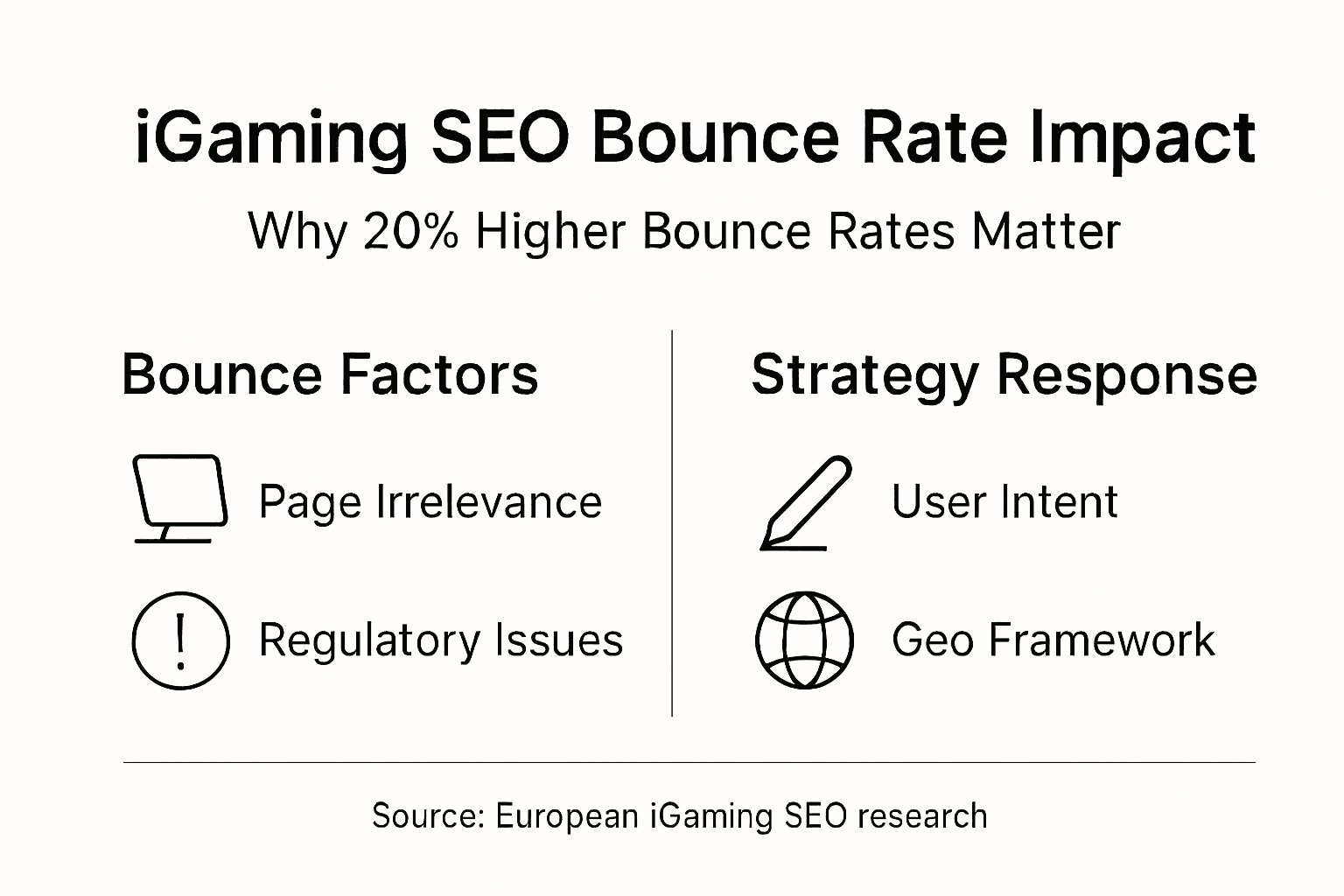
High-risk gambling keywords suffer 20% higher bounce rates when marketers apply standard SEO tactics. European iGaming SEO demands specialized strategies that balance strict regulatory compliance with competitive ranking performance. This guide reveals how to optimize safely for conversions, navigate complex legal frameworks, and measure true ROI using iGaming-specific KPIs that reflect player lifetime value.
Table of Contents
- Understanding The Regulatory Landscape Across Europe
- Optimizing High-Risk Igaming Keywords Safely
- Implementing Geo-Specific Seo Frameworks For Regulated Markets
- Building Authority Through Compliance-Sensitive Link Acquisition
- Aligning Content With Responsible Gaming And User Intent
- Tracking Seo Performance With Igaming-Specific Kpis
- Enhance Your Igaming Seo Strategy With Expert Support
- Frequently Asked Questions
Key takeaways
| Point | Details |
|---|---|
| European iGaming SEO needs compliance with diverse regulations | Each jurisdiction enforces unique content restrictions and advertising rules |
| High-risk keywords require intent-aligned optimization | Matching searcher intent reduces bounce rates and improves conversion quality |
| Geo-specific SEO improves visibility in regulated markets | Localized content and metadata address language needs and legal requirements |
| Building trust with responsible gaming messaging boosts rankings | Sites with clear safety disclosures see up to 15% better ranking performance |
| KPIs like player LTV better reflect true SEO success | Lifetime value metrics reveal long-term ROI beyond surface traffic numbers |
Understanding the regulatory landscape across Europe
Europe’s iGaming sector operates under at least 15 major regulatory frameworks, each imposing distinct requirements on content, advertising, and keyword usage. Strict legal frameworks differ widely across EU countries impacting iGaming SEO, creating a complex environment where strategies effective in one market may trigger penalties in another. Germany restricts bonus advertising, while the UK demands responsible gambling disclaimers on all promotional content.
Content restrictions directly limit how you can optimize pages and target keywords per jurisdiction. Sweden’s Spelinspektionen bans certain keyword combinations in paid search, impacting organic strategies too. Non-compliance risks include sudden ranking drops, manual actions from search engines, and legal consequences from national regulators.
Regulation landscapes evolve constantly as governments refine gambling laws. Spain updated its advertising code in 2024, adding new restrictions that caught many operators off guard. Building a compliance matrix that maps keyword usage, content types, and metadata requirements per market helps you avoid costly mistakes and maintain visibility.
Key compliance considerations include:
- Age verification and geo-blocking requirements for content access
- Mandatory responsible gaming messages and help resources
- Restrictions on bonus claims and promotional language
- Licensing information display and regulatory body logos
- Time-based advertising limitations during sports events
Navigating SEO compliance considerations requires coordination between legal teams, compliance officers, and SEO specialists. Regular audits ensure your content meets current standards while maintaining competitive keyword coverage.
Optimizing high-risk iGaming keywords safely
Targeting high-risk gambling keywords without specialized strategies leads to 20% higher bounce rates because generic SEO fails to match player intent or regulatory expectations. Casino, sportsbook, and betting keywords carry elevated risk due to strict oversight and user sensitivity around gambling content. Safe optimization starts with grading keywords by compliance risk before building campaigns.
Risk grading framework:
- Classify keywords as low, medium, or high risk based on regulatory restrictions
- Audit competitor approaches to identify safe optimization patterns
- Match content format and depth to searcher intent at each funnel stage
- Implement natural language that avoids over-optimization triggers
- Monitor bounce rates and engagement metrics for early warning signs
Align content tightly with user intent to reduce bounce rates and signal relevance. Someone searching “best casino bonuses” seeks comparison content, not signup pressure. Deliver comprehensive tables comparing offers, terms, and wagering requirements. When users find exactly what they searched for, they stay longer and convert better.

Avoid keyword stuffing and forced exact-match repetition. Search engines penalize unnatural language, especially in regulated sectors where trust matters. Use thematic relevance instead, incorporating related terms and synonyms that demonstrate topical authority without triggering manual reviews.
Pro Tip: Create landing pages for high-risk keywords that immediately address the specific question or need, then provide clear navigation to related topics rather than aggressive conversion funnels that spike bounce rates.
Monitor bounce rates weekly and segment by keyword risk level. A sudden spike on high-risk terms may indicate algorithm updates or compliance issues. Refine content iteratively based on engagement data, testing different messaging approaches while maintaining regulatory compliance.
Implementing geo-specific SEO frameworks for regulated markets
Geo-specific content can drive significant traffic uplift by addressing local compliance and language needs, making geographic targeting essential for European iGaming success. Each market demands tailored metadata, content structure, and regulatory messaging. Spanish players expect content in Spanish with references to DGOJ licensing, while UK audiences require UKGC disclaimers and responsible gambling tools.
Tailor metadata for each country’s regulations and language preferences. Title tags and meta descriptions must incorporate local terminology, regulatory references, and cultural nuances. German metadata should reference Glücksspielstaatsvertrag compliance, while Swedish content highlights Spelinspektionen licensing.
Geo-targeting technical framework:
| Market | Domain Strategy | Hreflang | Key Requirements |
|---|---|---|---|
| UK | Subdomain uk.site.com | en-GB | UKGC license display, responsible gambling links |
| Germany | Subfolder site.com/de | de-DE | GGL compliance, deposit limits disclosure |
| Spain | Subfolder site.com/es | es-ES | DGOJ logo, advertising restrictions |
| Sweden | Subdomain se.site.com | sv-SE | Spelinspektionen license, bonus term clarity |
Utilize hreflang tags correctly to signal language and regional targeting without creating duplicate content issues. Implement local domains or subfolders based on brand strategy and technical resources. Subdomains offer clearer separation for distinct regulatory frameworks, while subfolders maintain consolidated domain authority.
Respect cultural variations and user expectations per market. Italian players engage differently with casino content than Norwegian audiences. Localization goes beyond translation to address betting preferences, payment methods, and regulatory comfort levels. Coordinate closely with compliance teams to stay current on geo-restrictions and content requirements.
Measure localized SEO performance separately for each market. Track rankings, traffic quality, and conversion rates by country to identify optimization opportunities. A strategy working in Portugal may underperform in Finland due to different player behaviors and regulatory constraints.
Building authority through compliance-sensitive link acquisition
Niche, compliant backlinking increases domain authority without risking penalties, making link quality more critical than quantity in iGaming SEO. Search engines scrutinize gambling site backlink profiles intensely, penalizing manipulative schemes and low-quality sources. Focus acquisition efforts on regulated iGaming domains, industry publications, and authoritative sports or finance sites.
Avoid black-hat tactics and unrelated link schemes entirely. Purchased links from content farms or unrelated niches trigger manual reviews and algorithmic devaluation. Private blog networks carry extreme risk in regulated sectors where trust signals directly impact rankings.
Effective compliant backlink strategies include:
- Partnerships with licensed operators for mutual linking
- Sponsorships of sports teams or events with editorial coverage
- Guest contributions to industry publications and regulatory news sites
- Data-driven research that earns natural citations from gambling analysts
- Affiliate relationships with transparent, compliant commission structures
Leverage partnerships and sponsorships with compliant brands to earn authoritative links naturally. Sponsoring a football club generates links from sports media covering the partnership. Contributing expert analysis to gambling industry reports earns citations from regulatory bodies and news outlets.
Pro Tip: Create original research studies on gambling trends, player behavior, or regulatory impacts. Data-driven content earns backlinks from journalists, analysts, and industry sites seeking credible sources to cite.
Monitor backlink profiles weekly using tools that identify toxic links early. Disavow harmful links promptly to prevent association with spam networks or penalty domains. Regular audits catch negative SEO attacks where competitors build spammy links to damage your profile.
Build trust signals that impact search rankings positively. Links from government gambling regulators, responsible gaming organizations, and established industry associations carry substantial authority. Pursue these relationships through compliance excellence and community contributions.
Aligning content with responsible gaming and user intent
Sites with clear responsible gaming messaging see up to 15% better ranking performance because search engines reward trust signals in regulated sectors. Embedding visible safety disclosures demonstrates commitment to player protection, improving both algorithmic trust and user engagement. Responsible gaming content also meets regulatory requirements across European markets.
Embed responsible gaming disclosures visibly on every page touching gambling content. Footer links alone no longer satisfy regulatory or algorithmic expectations. Include age verification notices, deposit limit tools, and self-exclusion resources within content where appropriate. UK sites must display GAMSTOP access prominently, while Swedish operators highlight Spelpaus integration.
“Responsible gaming integration signals trustworthiness to both search algorithms and regulatory bodies, creating competitive advantage in crowded SERPs where credibility differentiates winners from penalized losers.”
Craft content aligned precisely with searchers’ intent and regulatory expectations. Someone searching “how to set gambling limits” seeks educational guidance, not promotional offers. Deliver clear instructions for using deposit controls, cooling-off periods, and self-assessment tools. Match content format to intent: tutorials for how-to queries, comparisons for evaluation searches, and direct answers for informational questions.
Key alignment strategies include:
- Use language encouraging safe play and transparency about odds
- Display certification badges from regulatory bodies and testing agencies
- Provide clear information about licensing jurisdiction and complaint processes
- Link to independent gambling support organizations in every market
- Avoid aggressive promotional language that conflicts with responsible messaging
Improve user engagement metrics through clear, credible messaging that builds confidence. Players stay longer on sites demonstrating genuine concern for safety. Lower bounce rates and higher dwell times signal content quality to search algorithms, improving rankings organically.
Display certification badges from eCOGRA, iTech Labs, or Gaming Laboratories International to demonstrate fairness verification. These trust markers reassure users and strengthen responsible gaming SEO strategies by signaling third-party validation.
Tracking SEO performance with iGaming-specific KPIs
Conversion quality and player LTV metrics provide deeper insights into SEO ROI for iGaming affiliates than traditional traffic volume measurements. Standard SEO dashboards tracking rankings and visits miss the critical factor: player value over time. A keyword driving 1,000 low-value signups underperforms one generating 100 high-LTV players.
Prioritized iGaming SEO KPIs:
- Track player lifetime value (LTV) from organic channels to measure long-term value beyond initial conversions
- Use conversion quality tracking focusing on first deposit amounts, wagering activity, and retention rates
- Monitor penalty flags and compliance-related ranking drops through daily position tracking for high-risk keywords
- Incorporate ROI-linked KPIs calculating revenue per visitor and cost per acquisition from organic search
- Measure engagement metrics like pages per session and return visitor rates to assess content stickiness
Player lifetime value separates profitable SEO investments from vanity metrics. Calculate average player value over 90 days, 6 months, and 12 months by traffic source. Organic search typically delivers higher LTV than paid channels because intent-matched content attracts better-qualified players.
Conversion quality metrics focus on valuable leads, not just volume. Track deposit conversion rate, average first deposit size, and percentage of players reaching wagering thresholds. Keywords attracting bonus hunters inflate signup numbers without generating revenue. Quality-focused optimization targets terms driving depositing players.
Monitor compliance flags daily to catch ranking drops before they cascade. Set up alerts for sudden position losses on regulated keywords. Algorithm updates often target gambling sites first when rolling out quality or trust-focused changes. Early detection enables rapid response before traffic drops significantly.
Adjust SEO tactics based on iGaming SEO KPIs data for sustained growth. If certain keywords drive high traffic but low LTV, refine content to filter intent better. When compliance-focused pages show strong engagement but lower rankings, investigate technical issues or strengthen topical authority through supporting content.
Enhance your iGaming SEO strategy with expert support
Implementing the expert iGaming SEO strategies covered requires specialized knowledge of regulations, algorithms, and player behavior patterns unique to gambling markets. Professional services accelerate results while reducing compliance risks through frameworks proven across multiple European jurisdictions. Expert guidance helps you navigate keyword optimization, geo-targeting complexity, and authority building without triggering penalties.
Our team specializes in SEO compliance solutions tailored to iGaming operators and affiliates competing in high-value SERPs. We provide compliance audits, keyword risk assessment, and localized content strategies that maintain visibility while meeting regulatory standards. From backlink profile analysis to responsible gaming integration, we handle technical complexity so you can focus on business growth.
Leverage professional SEO performance tracking configured for iGaming KPIs that matter. We implement custom dashboards measuring player LTV, conversion quality, and penalty risk alongside traditional metrics. Our coaching equips your team with frameworks for sustainable, compliant SEO that scales across regulated markets while maximizing ROI from organic channels.
Frequently asked questions
What are the main iGaming SEO challenges in Europe?
Europe’s diverse regulations create complex compliance requirements that vary dramatically between jurisdictions. High-risk keyword optimization demands specialized approaches balancing conversion goals with strict legal requirements. Maintaining visibility across multiple markets while meeting distinct regulatory frameworks for content, advertising, and player protection represents the central challenge.
How can marketers safely optimize high-risk iGaming keywords?
Use risk grading to identify compliant keywords before building campaigns, classifying terms by regulatory sensitivity and penalty risk. Align content strictly with user intent, delivering exactly what searchers seek rather than aggressive promotion. Continuously monitor bounce rates and engagement metrics, refining approaches based on performance data while avoiding keyword stuffing that triggers manual reviews.
Why is geo-targeting essential in iGaming SEO?
Regulatory variation requires localized SEO content and metadata addressing each market’s unique legal requirements and language preferences. Geo-targeting improves SERP visibility per market by matching local search behavior and regulatory expectations. Proper implementation supports compliance with language requirements, licensing disclosures, and responsible gaming mandates specific to each jurisdiction.
What KPIs best measure iGaming SEO success?
Player lifetime value from organic search traffic reveals true long-term ROI beyond initial conversion metrics. Conversion quality measures focusing on deposit amounts, wagering activity, and retention rates identify valuable player acquisition. Compliance flags and penalty monitoring provide early warning of algorithm updates or regulatory issues affecting rankings before significant traffic loss occurs.