

Every SEO specialist working in the regulated iGaming space knows one misstep can jeopardize rankings and revenue across multiple jurisdictions. As global regulatory frameworks tighten, the pressure to combine effective search optimization with robust legal compliance grows for both operators and affiliates. This guide clarifies how SEO compliance in iGaming goes far beyond algorithm tweaks, blending strategic policy, responsible gambling standards, and jurisdiction-specific content tactics to protect your authority and future-proof your business.
Table of Contents
- Defining SEO Compliance In iGaming
- Types Of SEO Compliance Requirements
- How Regulatory Laws Shape SEO
- Core Features Of A Compliant SEO Strategy
- Common Risks And Penalties In iGaming SEO
- Best Practices To Maintain Compliance
Key Takeaways
| Point | Details |
|---|---|
| SEO Compliance as a Hybrid Discipline | SEO compliance in iGaming integrates search engine optimization with regulatory adherence across various jurisdictions. This intersection influences content strategies significantly, balancing legal requirements with marketing goals. |
| Importance of Cross-Department Collaboration | Successful iGaming SEO requires collaboration between marketing, legal, and compliance teams to ensure all messaging adheres to regulations and promotes responsible gambling. |
| Active Monitoring of Regulatory Changes | Staying informed about regulatory updates is crucial for maintaining SEO compliance; regular content audits help identify necessary adjustments to meet evolving legal standards. |
| Compliance as a Competitive Advantage | Treating compliance not as a burden but as a strategic advantage can enhance brand trust, leading to improved search rankings and user loyalty in a regulated market. |
Defining SEO Compliance in iGaming
SEO compliance in iGaming isn’t simply about ranking higher than your competitors. It’s a hybrid discipline that sits at the intersection of search engine optimization and strict regulatory oversight. Unlike traditional SEO, where you optimize content for Google’s algorithms while following general webmaster guidelines, iGaming SEO compliance requires you to simultaneously satisfy multiple stakeholders: search engines, regulators, and players in dozens of different jurisdictions. This means your content strategy must balance visibility with legal precision, transparency with marketing effectiveness, and brand voice with mandatory responsible gambling messaging. The stakes are real. A single non-compliant page could trigger penalties from regulators, crush your domain authority, or worse, result in fines that dwarf any revenue you gained from ranking that keyword.
At its core, SEO compliance in iGaming means adhering to complex legal and regulatory requirements across different jurisdictions while optimizing for search engine visibility. It goes beyond creating optimized content and responsible gambling disclosures. According to industry standards, compliance requires integrating policy, strategy, and culture throughout your operations, plus ensuring employee training reinforces responsible gaming principles. Your content must respect specific laws around advertising and promotions, maintain accuracy and transparency at all times, and communicate responsible gambling messaging clearly. When you approach regulatory SEO through an iGaming-specific lens, you’re building a foundation where legal requirements aren’t obstacles to rankings but rather accelerators of trust and authority.
What separates compliant iGaming sites from non-compliant ones is operational accountability. You can’t separate your marketing team from your legal and compliance teams. Your SEO specialists need to understand which keywords trigger stronger regulatory scrutiny. Your content writers must know which promotional phrases are prohibited in certain jurisdictions. Your link builders need to recognize which partnerships could compromise your brand safety. This integration prevents the common mistake where marketing drives traffic to pages that violate local regulations, forcing sudden content removal or domain downgrades. Compliant iGaming operators embed responsible gambling standards into every page, every offer, and every customer touchpoint, treating compliance as a competitive advantage rather than a constraint.
Here’s a comparison of compliance roles in iGaming SEO operations:
| Team Role | Primary Responsibility | Compliance Impact | Typical Collaboration |
|---|---|---|---|
| SEO Specialist | Optimize content for ranking | Avoids regulatory keyword issues | Works with legal |
| Legal/Compliance | Monitor legal/regulatory changes | Ensures all content is lawful | Reviews SEO plans |
| Content Writer | Create promotional content | Uses permitted phrases only | Informed by compliance |
| Link Builder | Acquire partnerships/backlinks | Prevents unsafe brand associations | Informed by legal |
Pro tip: Map your target jurisdictions first, document their specific SEO restrictions and responsible gambling messaging requirements, then build your content roadmap backward from those constraints rather than trying to retrofit compliance into existing content.
Types of SEO Compliance Requirements
Compliance in iGaming SEO breaks down into several distinct but interconnected categories, each carrying real consequences if you get them wrong. The first major category is regulatory marketing controls, which vary dramatically across jurisdictions. In the United Kingdom, you’re operating under strict Advertising Standards Authority rules. In Malta, you’re answering to the Malta Gaming Authority. In the Netherlands, you’re navigating the KSA framework. Each territory has its own restrictions on what you can claim about bonuses, deposit requirements, win rates, and player protections. What’s permitted in one market might be prohibited in another, which means your SEO content strategy can’t be a one-size-fits-all approach. You need jurisdiction-specific landing pages that respect local advertising restrictions while still competing for high-value keywords. This is where cross-market SEO strategy becomes essential for maintaining compliance across your portfolio of regulated markets.
The second category involves Google’s sensitive content guidelines, particularly their “Your Money or Your Life” (YMYL) classification that applies to financial services and gambling content. Google treats iGaming sites as YMYL, which means your content faces stricter quality standards, requires stronger authoritativeness, and demands higher topical expertise signals. Your authors must have demonstrable credentials. Your site must show clear ownership and organizational transparency. Your backlink profile must reflect connections to authoritative sources in the gaming and responsible gambling space. This isn’t just about avoiding manual penalties; it directly affects your ranking potential. Non-compliant YMYL content simply won’t rank well, regardless of technical optimization.
The third critical requirement is responsible gambling integration across all your SEO assets. This goes beyond a single disclaimer page. You need responsible gambling messaging embedded throughout your content architecture, player protection information accessible from key pages, and harm prevention resources clearly visible. Standards accreditation requires you to demonstrate this integration through policy, operational strategy, and employee training that extends to your marketing and SEO teams. Your content writers need training on responsible messaging. Your SEO specialists need to understand player vulnerability signals. Your link builders need to recognize partnerships that enhance your responsible gambling credibility.
Pro tip: Create a compliance matrix that maps each target jurisdiction’s specific advertising restrictions, prohibited keywords, and required disclosures, then use it as a reference document every time your SEO team creates new content or pursues link opportunities.
How Regulatory Laws Shape SEO
Regulatory laws don’t just constrain your iGaming SEO strategy. They fundamentally reshape what you can optimize for, which keywords you can target, and how you structure your entire content architecture. When a country imposes stricter limits on bonus promotions, your entire keyword strategy for that market shifts. You can no longer optimize aggressively for “maximum bonus” or “biggest welcome offer” keywords because advertising those claims becomes illegal. Instead, you’re competing in a different search space focused on responsible gaming messaging, player protection features, and transparency. This regulatory friction forces iGaming operators to pivot away from volume-based keyword strategies toward quality-based competitive positioning. Your ability to rank depends less on claiming flashier bonuses and more on demonstrating trustworthiness, compliance infrastructure, and player-first messaging.

Consider how stake limits and deposit caps reshape content strategy. When Germany implemented deposit limits, operators couldn’t market around unlimited stakes anymore. Content targeting high-roller keywords became legally risky. Instead, compliant operators shifted their SEO efforts toward content around responsible bankroll management, self-exclusion tools, and safer gaming features. This regulatory boundary actually created a differentiation opportunity. Operators who adapted their SEO to highlight compliance features gained trust signals that ranked better in a market where regulators and players both valued responsible gaming. The law created a new competitive dynamic where compliance messaging became a ranking advantage rather than a burden.
Another critical way regulations shape SEO involves user acquisition boundaries and targeting restrictions. Many jurisdictions now prohibit targeting minors through any digital channel. This affects your SEO fundamentally. You can’t optimize content around age-gating loopholes or target keywords with high minor traffic intent. Your backlink strategy must avoid gaming-adjacent communities where younger audiences congregate. Your internal linking patterns must reinforce adult-only messaging throughout your site. European privacy regulations like GDPR compound this challenge by restricting how you collect behavioral data, target users, and track conversions. You lose the granular audience data that powers effective SEO personalization. Your competitive advantage shifts from behavioral targeting to transparent, compliant content that ranks on merit rather than algorithmic manipulation.
The practical reality is that regulatory environments are tightening globally. Countries are moving from unregulated wild-west scenarios toward stricter frameworks. This means your SEO framework must be built for regulation from day one, not retrofitted after penalties. Operators who anticipate regulatory changes and build compliant content strategies actually gain long-term ranking advantages over competitors who cut corners.
Below is a summary of key regulatory factors affecting iGaming SEO strategies:
| Regulatory Factor | Effect on SEO Strategy | Example Jurisdiction | Operator Action |
|---|---|---|---|
| Bonus Promotion Limits | Restricts keyword targeting | United Kingdom | Focus on responsible gaming |
| Deposit/Stake Caps | Alters content themes | Germany | Highlight safer gaming |
| Age Targeting Restrictions | Removes minor-related keywords | Netherlands | Emphasize adult-only content |
| Data Privacy (GDPR) | Limits behavioral personalization | European Union | Use transparent messaging |
Pro tip: Monitor regulatory announcements in your target markets quarterly and update your SEO keyword strategy immediately when new restrictions appear, treating regulatory changes as catalyst events for competitive content repositioning rather than obstacles to work around.
Core Features of a Compliant SEO Strategy
A compliant iGaming SEO strategy isn’t built by bolting compliance onto your existing marketing framework. It requires integrating legal conformity, content quality, and search engine guidelines from the ground up. The foundation starts with jurisdiction-specific keyword research that accounts for regulatory boundaries from day one. You’re not just finding high-volume keywords. You’re identifying keywords that are legally permissible in each market where you operate. A keyword like “instant withdrawal” might be safe in one jurisdiction but problematic in another where instant transactions face regulatory scrutiny. Your keyword research process needs legal vetting built in, which means your SEO team must work directly with compliance specialists to validate target keywords before content creation begins. This prevents the costly mistake of investing in content that ranks well but violates local laws.
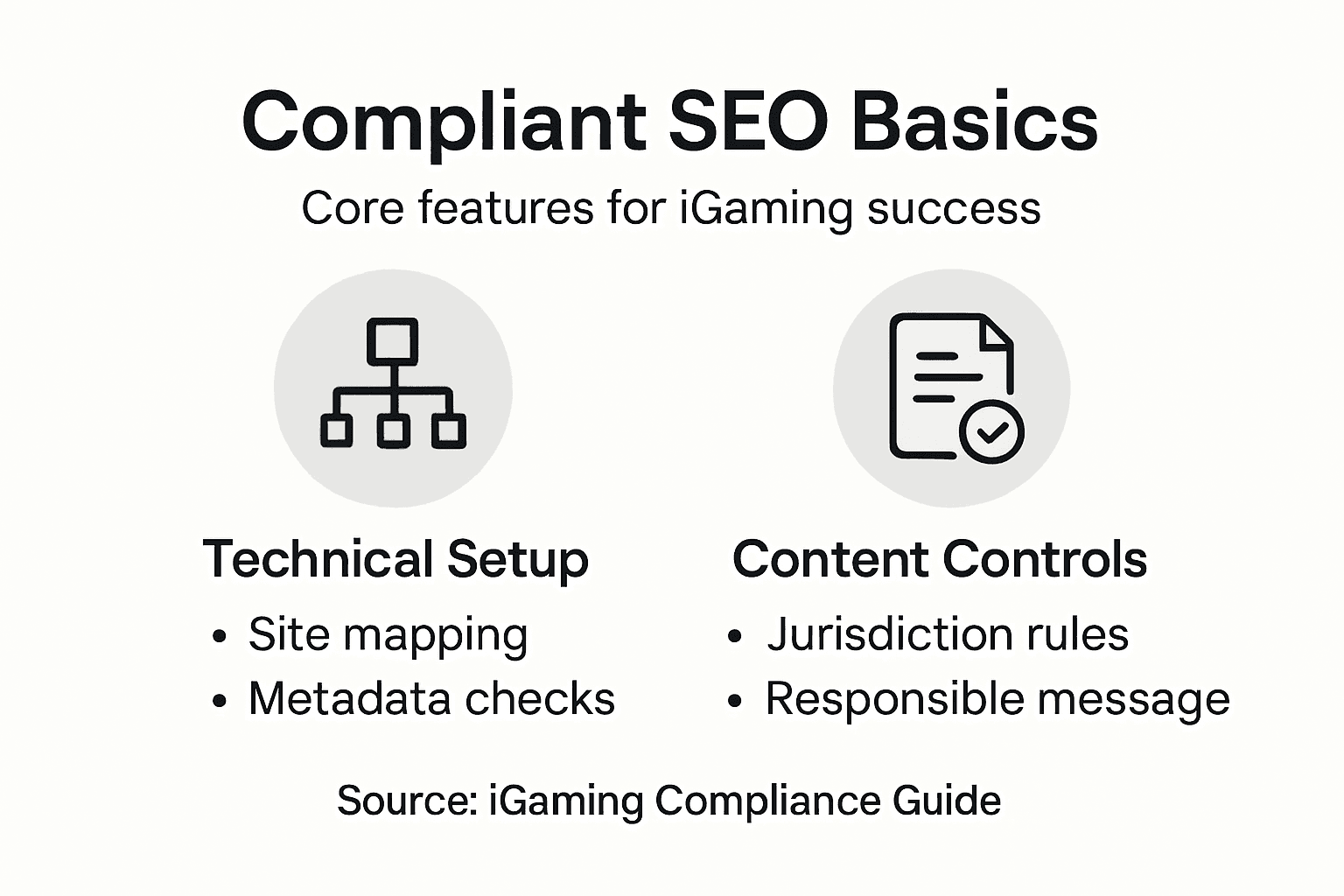
Once your keywords are vetted, your content architecture must reflect both SEO best practices and regulatory requirements. This means transparent affiliate disclosures placed prominently rather than buried in footer links. It means responsible gambling messaging integrated naturally throughout your content, not as an afterthought disclaimer. It means metadata, headers, and internal linking patterns that accurately represent your content’s true nature and value proposition. Your site structure should be logical and crawlable, helping both search engines and regulators understand your content hierarchy. URL hierarchy with clear keyword inclusion helps search engines understand relevance while also making your content organization transparent to auditors. Fast load times aren’t just a ranking factor. They’re part of demonstrating you’re operating a professional, trustworthy platform that respects user time and accessibility.
The technical backbone of compliance involves robust site architecture paired with metadata discipline. Every page needs accurate meta descriptions that don’t overpromise or make prohibited claims. Every heading should clearly communicate the page’s actual content. Internal linking should follow logical paths that don’t manipulate users toward prohibited offers. Your crawl optimization should ensure search engines can easily discover your responsible gambling resources, player protection pages, and compliance documentation. This technical transparency actually builds authority with both Google and regulators. When your site structure makes it obvious you’re operating responsibly, you gain trust signals that improve rankings. Conversely, black-hat SEO tactics like keyword stuffing, hidden text, or deceptive linking patterns will trigger both search engine penalties and regulatory investigations.
What separates compliant operators from non-compliant ones is treating compliance as a competitive advantage rather than a cost center. Implementing technical SEO foundations like proper site structure and metadata works hand-in-hand with regulatory requirements, creating a strategy where better SEO performance and better compliance reinforce each other.
Pro tip: Conduct a compliance audit of your entire site before launching any new SEO initiative, mapping every page’s claims against local regulations and flagging content that requires revision or removal before pursuing link building or ranking improvements.
Common Risks and Penalties in iGaming SEO
Non-compliance in iGaming SEO carries consequences that extend far beyond search ranking drops. The financial penalties are severe. Regulatory fines for misleading marketing claims or unlicensed gambling promotion can reach hundreds of thousands of dollars, with some jurisdictions imposing penalties calculated as a percentage of player deposits. The Malta Gaming Authority, UK Gambling Commission, and European regulators have demonstrated they will levy significant fines against operators and affiliates who mislead players or operate without proper licensing. But the financial hit is only part of the damage. License revocation means you lose your entire operational foundation. If you operate a licensed betting site or casino, non-compliance in your SEO content can trigger license suspension or permanent revocation, essentially destroying your business overnight. For affiliates, the stakes are equally high. Partner operators will terminate affiliate relationships immediately upon discovering non-compliant marketing, cutting off revenue streams that may represent your primary income source.
Beyond regulatory penalties, non-compliance creates reputational damage that compounds over time. When your SEO content makes prohibited claims about bonuses, winnings, or player protections, and regulators catch it, that enforcement action becomes public record. News outlets covering gambling regulation will report on penalties and violations. Player review sites flag non-compliant operators. Trust erodes rapidly. Players migrate to competitors they perceive as safer. Your domain authority suffers when regulators specifically call out your site for violations. Google’s own systems flag non-compliant iGaming sites for review, potentially triggering manual penalties that drop your rankings below competitors. What makes this particularly damaging is that recovery is slow. Even after you fix the non-compliant content, regulatory and algorithmic trust must be rebuilt through months of clean compliance history.
A critical but underestimated risk involves affiliate responsibility for operator violations. Affiliates often assume operators handle all compliance, but regulatory agencies hold affiliates accountable for the claims in their promotional content. If you’re promoting an operator’s bonus offer using prohibited language or exaggerated claims, regulators may fine you directly, regardless of whether the operator approved the messaging. This means your SEO content, your landing pages, and your affiliate disclosures are all direct liability surfaces. Many affiliates discover this the hard way when they receive cease-and-desist notices or fines for promotions they thought were vetted by the operator. Implementing proper on-page SEO practices with compliance vetting built in protects both your rankings and your legal standing.
The fragmented regulatory landscape creates an additional risk category. Regulations change constantly, and what was compliant last quarter may be prohibited this quarter. Many affiliates and operators fail to monitor regulatory updates in their target jurisdictions, gradually becoming non-compliant as laws shift. Penalties aren’t always issued immediately after violations begin. Regulators conduct periodic audits and sweeps. You may operate non-compliant for months before discovery, by which time you’ve accumulated significant regulatory exposure and accumulated penalty exposure. The smart defense is continuous monitoring of regulatory announcements in every target market and quarterly reviews of your content against current legal frameworks.
Pro tip: Set up regulatory monitoring alerts for each jurisdiction you operate in, review your SEO content quarterly against any legal updates, and maintain a compliance change log documenting when you updated content to meet new requirements, which demonstrates good faith compliance effort if regulators ever question your practices.
Best Practices to Maintain Compliance
Maintaining SEO compliance requires moving beyond reactive audits and building compliance into your operational DNA. Start with technical foundations that support both SEO and regulatory transparency. A clear site hierarchy makes it obvious to both search engines and regulators what content exists and how pages relate to each other. Keyword-targeted URLs that accurately reflect page content help search engines understand relevance while preventing the temptation to hide non-compliant pages or misdirect users through deceptive URL structures. Breadcrumbs improve user navigation and create transparent content pathways that demonstrate you’re not trying to obscure any section of your site. Optimize crawlability and indexability so that Google can discover all your content, including responsible gambling resources and player protection information. When you make it easy for search engines to crawl your entire site, you eliminate the opportunity to accidentally hide non-compliant content or accidentally exclude compliance-related pages from indexing. This transparency builds trust with both algorithms and regulators.
Beyond technical implementation, content audits must happen regularly and systematically. Quarterly audits of your entire SEO asset base should check every page against current regulations in your target jurisdictions. Are bonus claims still legally permissible? Has the language around wagering requirements changed? Do your player protection disclosures still meet current standards? Have new prohibited terms entered the regulatory landscape? Content audits aren’t one-time exercises. Regulations shift, and your content must shift with them. Assign ownership of these audits to someone with both SEO knowledge and compliance awareness. That person should maintain audit documentation, track updates made, and flag pages requiring revision before they’re published or promoted through link building.
The third critical practice involves embedding compliance into company culture and employee training. Your content writers need to understand responsible gambling messaging and prohibited claims. Your SEO specialists need to recognize which keywords trigger stronger regulatory scrutiny. Your link builders need to understand that partnerships with non-compliant sites or illegal operators damage your own compliance standing. This requires ongoing training, not one-time onboarding. Accreditation programs like RG Check provide structured frameworks for demonstrating organizational commitment to responsible gaming standards. Participation in these programs signals to regulators, players, and search engines that you take harm prevention seriously. That commitment translates into competitive advantage because compliant operators gain credibility that ranks better in markets where regulatory oversight is increasing.
Finally, stay ahead of regulatory changes through active monitoring. Subscribe to regulatory announcements from your target jurisdictions. Join industry associations that provide regulatory updates. Establish relationships with compliance consultants who track changes specific to your markets. Many operators discover new regulations too late because they don’t monitor regulatory bodies proactively. By the time enforcement actions occur, you’ve already operated non-compliant for months. Proactive monitoring lets you update content before regulators start audits, demonstrating good faith compliance effort that protects you during enforcement reviews.
Pro tip: Assign one team member as compliance captain responsible for quarterly regulatory monitoring and content audits across all target jurisdictions, and create a shared document where SEO and compliance teams collaborate on approved messaging templates and prohibited keywords specific to each market.
Master SEO Compliance and Outsmart Regulations in iGaming
Navigating the complex world of iGaming SEO compliance requires more than standard marketing tactics. This article highlights critical challenges like managing jurisdiction-specific keyword restrictions, integrating responsible gambling messaging, and aligning your SEO efforts with strict regulatory laws. These pain points demand a strategy where legal oversight, SEO expertise, and content quality work hand in hand to avoid costly penalties and build lasting trust.
At 1on1seo.com, our specialized iGaming SEO coaching program is designed precisely for these challenges. We help you optimize for high-risk keywords safely, implement geo-specific strategies tailored to markets like the United Kingdom, Germany, and the Netherlands, and build authoritative backlinks that maintain brand safety. By mastering compliance fundamentals alongside performance SEO, you transform regulatory requirements into competitive advantages.
Ready to elevate your iGaming SEO with a compliant and winning approach? Discover how our expert-led coaching empowers affiliates, operators, and agencies to thrive in this regulated landscape. Visit 1on1seo.com today and start building a resilient SEO strategy that ranks high and stays compliant. Let us help you turn regulatory risks into sustainable growth.
Frequently Asked Questions
What is SEO compliance in iGaming?
SEO compliance in iGaming refers to the need for operators to meet complex legal and regulatory requirements while optimizing for search engine visibility. It involves ensuring that content is not only optimized for SEO but also adheres to jurisdiction-specific laws and regulations concerning advertising, promotions, and responsible gambling messaging.
Why is SEO compliance important for iGaming operators?
SEO compliance is crucial for iGaming operators because non-compliance can lead to severe penalties, including fines, revocation of licenses, and significant reputational damage. Compliant SEO practices build trust with players and regulators, enhancing brand authority and long-term sustainability in the market.
How can iGaming companies ensure their SEO content is compliant?
iGaming companies can ensure SEO compliance by conducting thorough keyword research that considers legal boundaries, integrating responsible gambling messaging across their content, and collaborating closely between marketing, legal, and compliance teams to vet any promotional claims before publication.
What are the risks of non-compliance in iGaming SEO?
The risks of non-compliance in iGaming SEO include hefty financial penalties, loss of operating licenses, and reputational harm that can lead to decreased player trust and traffic. Non-compliance may also trigger regulatory investigations, which can further damage a company’s standing in the marketplace.
Recommended
- 7 Steps to a Winning iGaming On-Page SEO Checklist
- Technical SEO for iGaming: Scaling and Crawl Success
- Cross-Market SEO Strategy: Gaining iGaming Edge Globally
- Essential Guide to WordPress SEO Launch Checklist
- Content Compliance Requirements for SEO Success
- What is Search Optimisation? A Detailed Understanding - Jarrod Harman