

Most iGaming marketers still optimize desktop sites first, assuming mobile will follow. That’s backwards. Google switched to mobile-first indexing as standard by 2024, meaning your mobile site now determines rankings across all devices. For regulated iGaming operators competing in high-stakes SERPs, mastering mobile-first SEO isn’t optional. It’s the foundation of visibility, compliance, and conversion. This guide walks you through the strategies, tools, and compliance nuances that separate winning iGaming SEO from wasted effort.
Table of Contents
- Understanding Mobile-First SEO And Google’s Indexing Approach
- Key Nuances And Best Practices For Mobile-First SEO In IGaming
- Practical Strategies And Tools To Optimize Mobile-First SEO For IGaming
- Mobile-First SEO’s Impact On IGaming Compliance And Search Rankings
- Optimize Your IGaming SEO With Expert Mobile-First Strategies
- Frequently Asked Questions
Key takeaways
| Point | Details |
|---|---|
| Mobile-first indexing is now standard | Google uses your mobile site version to rank all searches, desktop included, since 2024. |
| Content parity prevents ranking drops | Stripped-down mobile sites lose rankings because Google can’t index missing content. |
| Compliance outweighs speed in iGaming | Regulatory requirements on mobile impact SEO more than pure performance metrics. |
| Real 4G data beats lab testing | Server logs and PageSpeed Insights with 4G emulation reveal actual mobile user experience. |
| Crawl budget optimization matters | Pruning low-value pages and eliminating shadow content improves indexing efficiency on large sites. |
Understanding mobile-first SEO and Google’s indexing approach
Mobile-first SEO is Google’s standard indexing approach where the mobile version of a website is crawled, indexed, and used for rankings across all devices, fully rolled out by 2024. This shift fundamentally changed how search engines evaluate site quality. Google’s crawlers now prioritize your mobile site’s structure, content, and performance when determining where you rank, even for users searching on desktop computers.
The timeline matters for iGaming marketers managing legacy sites. Google began testing mobile-first indexing in 2016, expanded it gradually through 2020, and completed the transition by 2024. Any site still optimized primarily for desktop now faces ranking penalties, regardless of how strong the desktop experience is. The mobile version is the primary version in Google’s eyes.
Mobile-first indexing differs from mobile-only indexing. Google still serves desktop results to desktop users, but it evaluates your mobile site to decide those rankings. If your mobile site lacks content, has broken navigation, or hides elements behind accordions that desktop shows openly, Google indexes less information about your pages. That directly impacts visibility across all devices.
For iGaming sites handling complex regulatory content, age verification flows, and jurisdiction-specific disclaimers, this creates unique challenges:
- Mobile templates often hide compliance text to improve user experience
- Bonus terms and responsible gaming warnings may be abbreviated on small screens
- Geo-targeting scripts can behave differently on mobile versus desktop
- Payment method details and withdrawal policies might be condensed
These differences aren’t cosmetic. They affect what Google indexes and how your pages rank for high-value keywords like “best online casino” or “sports betting bonus.” Understanding mobile-first indexing as the foundation lets you build SEO consulting strategies that work with Google’s algorithms, not against them.
“Mobile-first doesn’t mean mobile-only. Desktop sites still exist and serve desktop users. But Google evaluates the mobile version to determine quality signals for all rankings.”
Key nuances and best practices for mobile-first SEO in iGaming
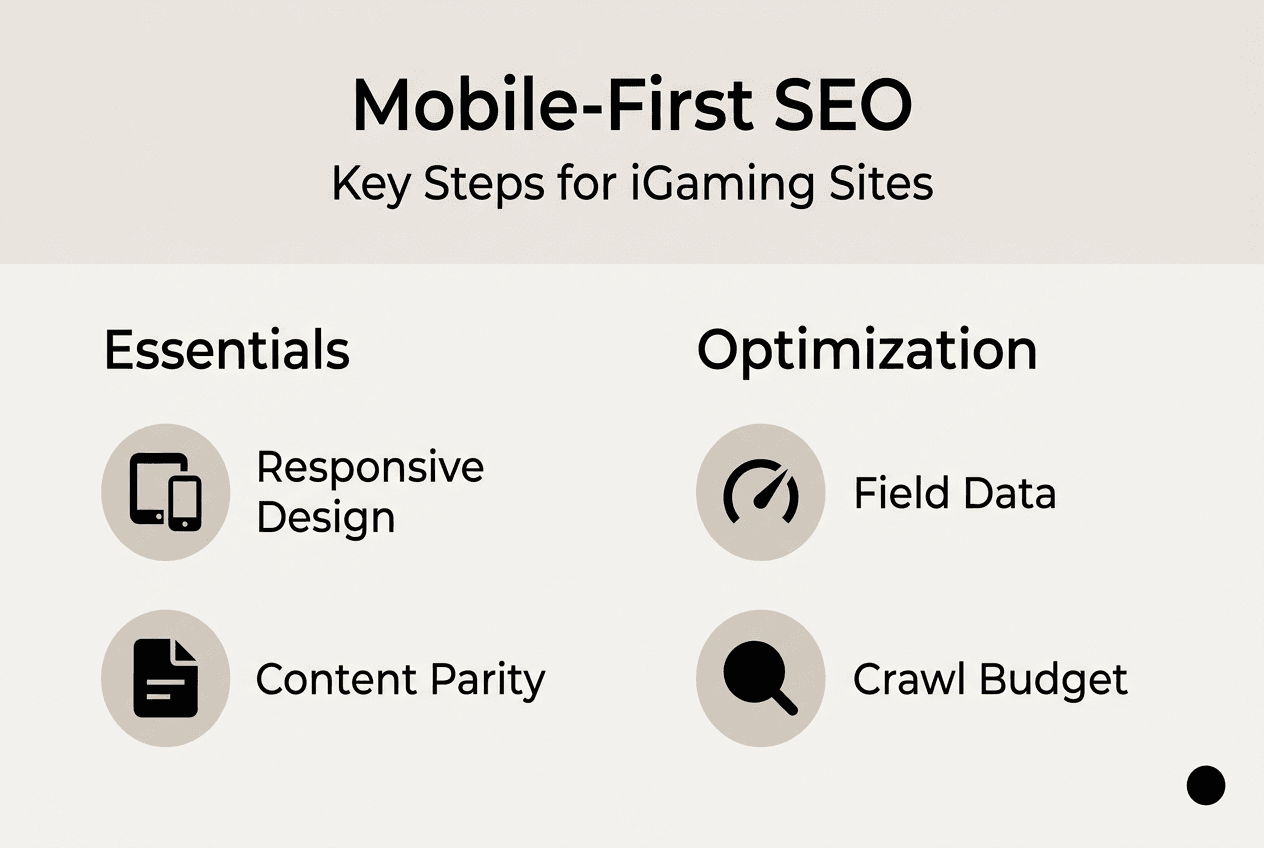
Responsive design beats separate mobile sites every time. Google explicitly prefers responsive frameworks where one URL serves adaptive content to all devices. Separate m.example.com subdomains create duplicate content risks, split link equity, and require twice the maintenance. For iGaming operators juggling multiple markets and languages, responsive design simplifies compliance updates and reduces technical debt.

Content parity is non-negotiable. Your mobile site must contain the same substantive content as your desktop version. Not lite versions, not summarized pages, not content hidden behind tabs that users must click to reveal. Google indexes what’s visible in the mobile DOM on initial load. If your desktop site has 2,000 words of expert betting analysis but mobile shows 500 words with a “read more” button, Google indexes 500 words. Your rankings reflect that reduced content depth.
This creates tension in iGaming where mobile screens are small and regulatory text is long. The solution isn’t hiding content. It’s better information architecture. Use expandable sections that load content in the DOM even when visually collapsed. Implement proper heading hierarchy so Google understands content structure without relying on visual layout. Test your mobile pages with Google Search Console’s Mobile Usability report to catch indexing gaps.
Core Web Vitals field data matters more than lab scores. Google uses real user metrics from Chrome User Experience Report, not synthetic Lighthouse tests. Your PageSpeed Insights lab score might show green, but if actual mobile users on 4G networks experience slow loading, that’s what affects rankings. For iGaming sites with heavy JavaScript for live odds, this distinction is critical.
Pro Tip: Run PageSpeed Insights with 4G throttling enabled and compare field data across different geographic markets. A site that loads fast in the UK might struggle in emerging markets where your next growth opportunity exists.
Compliance requirements in iGaming override pure speed optimization. If your mobile site needs to load age verification, jurisdiction checks, and responsible gaming warnings before showing content, that’s correct even if it impacts Largest Contentful Paint scores. Google’s algorithms recognize regulated industries have different priorities. The key is implementing these requirements efficiently, not eliminating them to game Core Web Vitals.
Here’s what matters most for strategic use of images in SEO and company branding and SEO in mobile-first contexts:
- Lazy load images below the fold, but ensure hero images and logos load immediately
- Use WebP format with fallbacks for older mobile browsers
- Implement proper alt text that works for both SEO and screen readers
- Size images appropriately for mobile viewports, not desktop resolutions
- Ensure brand elements maintain visibility and hierarchy on small screens
Mobile SEO nuances extend beyond technical optimization. User experience signals like bounce rate, time on site, and interaction patterns differ dramatically between mobile and desktop. iGaming users on mobile often have higher intent but less patience. Your mobile site architecture must facilitate quick conversions while maintaining the content depth Google needs for rankings.
Practical strategies and tools to optimize mobile-first SEO for iGaming
Auditing mobile user experience requires looking beyond surface metrics. Server logs and PageSpeed Insights with real 4G data reveal how Googlebot and actual users experience your site. Server logs show which pages Googlebot Mobile crawls most frequently, how much time it spends on your site, and where it encounters errors. This data exposes crawl budget waste that synthetic testing misses.
Start your mobile-first SEO optimization with this process:
- Export server logs for the past 30 days and filter for Googlebot Mobile user agent
- Identify pages with high crawl frequency but low organic traffic
- Check these pages in Google Search Console for mobile usability errors
- Run PageSpeed Insights with 4G throttling on your top 20 landing pages
- Compare mobile versus desktop crawl rates to spot indexing discrepancies
- Audit structured data implementation across mobile and desktop versions
- Test mobile navigation paths to ensure all important pages are accessible
Shadow content kills mobile-first SEO performance. Shadow content refers to pages or elements visible to desktop users but hidden from mobile crawling. Common culprits in iGaming include bonus comparison tables that only render on desktop, payment method details tucked into mobile-hidden divs, and responsible gaming resources linked only in desktop footers. Google can’t rank content it can’t see on mobile.
Detecting shadow content requires systematic comparison. Crawl your site with Screaming Frog or similar tools using both desktop and mobile user agents. Export the results and compare page counts, word counts per page, and internal link structures. Discrepancies reveal content that exists on desktop but disappears on mobile. For large iGaming sites with thousands of pages, this audit is tedious but essential.
Pro Tip: Use Google Search Console’s URL Inspection tool to see exactly how Googlebot renders your mobile pages. The rendered HTML view shows what content Google actually indexes, not what your CMS thinks it’s serving.
Crawl budget optimization becomes critical as your iGaming site scales. Google allocates finite crawling resources based on site authority, server performance, and perceived content quality. Large affiliate sites with thousands of low-value pages waste crawl budget on content that never ranks. Pruning these pages frees Googlebot to focus on your money pages.
Identify pruning candidates with this data:
| Metric | Threshold | Action |
|---|---|---|
| Pages with zero organic traffic in 12 months | Any page | Evaluate for deletion or noindex |
| Pages crawled frequently but never ranking | Crawled weekly, no top 50 rankings | Consolidate or remove |
| Duplicate or near-duplicate content | Similarity above 80% | Canonical or merge |
| Orphaned pages with no internal links | Zero referring domains | Delete or reintegrate |
Tools for monitoring mobile SEO health include Google Search Console, PageSpeed Insights, Chrome DevTools mobile emulation, and server log analyzers. SEO consulting often reveals that iGaming operators focus on the wrong metrics. Lighthouse scores look impressive in reports but don’t correlate with rankings if field data tells a different story.
For SEO compliance for iGaming, mobile auditing must verify that regulatory requirements remain visible and functional across devices. Age gates, jurisdiction blockers, and responsible gaming links can’t be afterthoughts in mobile design. They’re ranking factors in regulated markets where Google evaluates trustworthiness and legal compliance as quality signals.
Real mobile 4G conditions vary by market. A site optimized for US 4G LTE might struggle in markets with slower connections. Use PageSpeed Insights to test your site with different network throttling profiles. If you’re expanding into new jurisdictions, test from servers in those regions to catch localization issues that affect mobile performance.
Mobile-first SEO’s impact on iGaming compliance and search rankings
Mobile-first SEO is critical for iGaming where compliance priorities often outweigh pure speed, affecting SEO rankings and user trust. The business case for investing in mobile-first optimization extends beyond rankings. It impacts regulatory standing, user acquisition costs, and competitive positioning in saturated markets.
Compare outcomes with and without mobile-first optimization:
| Factor | Without Mobile-First SEO | With Mobile-First SEO |
|---|---|---|
| Organic visibility | Declining rankings as Google prioritizes mobile | Stable or improving rankings across devices |
| Compliance risk | Regulatory content hidden or incomplete on mobile | Full compliance visible to users and regulators |
| User engagement | High mobile bounce rates, low conversion | Lower bounce rates, improved mobile conversions |
| Crawl efficiency | Wasted budget on low-value pages | Optimized crawling of high-value content |
| Competitive position | Losing ground to mobile-optimized competitors | Advantage in mobile-dominant markets |
Compliance plays a unique role in iGaming SEO rankings. Google’s algorithms evaluate trust signals more heavily in Your Money or Your Life industries. A mobile site that hides responsible gaming warnings or makes age verification difficult signals poor quality. These trust deficits compound with technical SEO weaknesses to suppress rankings.
Mobile-first SEO enhances user engagement through faster load times, clearer navigation, and content that fits user context. iGaming users on mobile often research quickly between other activities. They need immediate access to odds, bonus terms, and account features. Sites that deliver this experience see measurable improvements:
- Lower bounce rates as users find information faster
- Higher pages per session as navigation becomes intuitive
- Improved conversion rates when friction points are removed
- Better retention as mobile experience matches desktop quality
Competitive advantage in regulated markets comes from mobile readiness that competitors lack. Many established iGaming operators still run legacy desktop-first sites with bolted-on mobile versions. New entrants with mobile-native designs capture market share by ranking better and converting more mobile traffic. For iGaming SEO ranking strategies, mobile-first isn’t future-proofing anymore. It’s table stakes.
Actionable benefits of mastering mobile-first SEO include:
- Ranking for high-intent mobile queries that drive immediate conversions
- Passing compliance audits that verify mobile accessibility of required disclosures
- Reducing customer acquisition costs by improving organic mobile visibility
- Building sustainable competitive moats through superior mobile user experience
- Scaling into new markets where mobile is the primary internet access method
The regulatory SEO guide for iGaming emphasizes that mobile compliance isn’t separate from mobile SEO. They’re integrated. A site that meets regulatory requirements on mobile automatically satisfies many of Google’s quality signals. Conversely, sites that hide compliance content to improve mobile aesthetics fail on both fronts.
Mobile user behavior data reveals intent patterns that desktop misses. Users searching “best sportsbook” on mobile are often ready to sign up immediately. Desktop users might be researching for later. Your mobile site must capitalize on this higher intent with streamlined conversion paths that don’t sacrifice the content depth Google needs for rankings. Balancing these priorities separates amateur mobile optimization from expert mobile SEO impact in iGaming.
Optimize your iGaming SEO with expert mobile-first strategies
Mastering mobile-first SEO for iGaming requires specialized knowledge of both search algorithms and regulatory requirements. Our iGaming SEO ranking strategies guide provides frameworks developed specifically for betting, casino, and sportsbook operators competing in regulated markets. We help you implement the technical optimizations, content strategies, and compliance integrations that drive rankings without triggering regulatory flags.
Our coaching program covers mobile-first auditing, crawl budget optimization, and shadow content elimination tailored to iGaming’s unique challenges. You’ll learn to balance Core Web Vitals with compliance requirements, optimize for high-intent mobile queries, and build sustainable competitive advantages through superior mobile user experience. Access detailed guides on iGaming SEO explained strategies and regulatory SEO explained to implement these strategies immediately. Ready to dominate mobile SERPs in your markets? Let’s build your mobile-first SEO strategy together.
Frequently asked questions
What is mobile-first SEO for iGaming?
Mobile-first SEO for iGaming means optimizing your betting, casino, or sportsbook site so Google’s mobile crawler can fully index all content, including regulatory disclosures and bonus terms. The mobile version of your site determines rankings across all devices. For iGaming operators, this requires balancing user experience with compliance visibility, ensuring age verification, responsible gaming warnings, and jurisdiction-specific content remain accessible to both users and search engines on mobile devices.
How does Google’s mobile-first indexing affect desktop search results?
Mobile-first indexing means the mobile version is crawled and used for rankings on all devices, including desktop. If your mobile site has less content than desktop, your desktop rankings suffer because Google indexes the mobile version. Desktop users still see desktop-formatted results, but the ranking determination comes from evaluating your mobile site’s quality, content depth, and user experience signals.
Why is content parity between mobile and desktop versions essential for iGaming sites?
Content parity ensures Google indexes complete information, avoiding ranking drops and compliance risks in iGaming. If your mobile site hides bonus terms, payment details, or responsible gaming resources that desktop shows, Google can’t rank you for queries related to that content. Regulators also expect consistent disclosure across devices. Stripped-down mobile sites create both SEO penalties and regulatory exposure.
What tools help monitor and improve mobile-first SEO performance?
Use server logs and PageSpeed Insights with real 4G data to audit mobile SEO accurately. Server logs reveal how Googlebot Mobile crawls your site and where it encounters issues. PageSpeed Insights with 4G throttling shows actual user experience, not lab conditions. Google Search Console’s Mobile Usability report catches rendering problems, while URL Inspection shows exactly how Google indexes your mobile pages. These tools together provide complete visibility into mobile-first SEO health.