

Think international SEO for gambling is just translating your homepage into German or Spanish? That’s a costly mistake that could land you in legal trouble or buried on page ten. The reality is far more complex. International SEO for gambling means navigating a maze of regional laws, high-risk keywords, geo-targeting requirements, and trust signals that directly impact your rankings. This guide walks you through the exact strategies that separate operators who dominate SERPs from those who struggle to get noticed.
Table of Contents
- Understanding International SEO In Gambling
- Key Regulatory And Compliance Constraints In Gambling SEO
- Geo-Specific Optimization Techniques For Gambling Sites
- Keyword Strategy For Regulated And High-Risk Gambling Markets
- Authority Building And Responsible Gaming Signals In SEO
- Responsible Use Of AI In Gambling SEO Content
- Measuring SEO Performance For International Gambling Campaigns
- Common Misconceptions And Pitfalls In International Gambling SEO
- Elevate Your International Gambling SEO With 1on1 SEO
Key Takeaways
| Point | Details |
|---|---|
| Compliance First | International gambling SEO requires adherence to diverse regional laws and restrictions. |
| Geo-Targeting Essential | Proper hreflang implementation and localized content boost regional rankings significantly. |
| High-Risk Keywords | Tailored strategies for restricted keywords maximize conversions while maintaining compliance. |
| Trust Signals Matter | Responsible gaming features improve search rankings by 15-20% in regulated markets. |
| Measure Player Value | Tracking lifetime value from organic traffic increases acquisition ROI by 35%. |
Understanding International SEO in Gambling
International SEO for gambling is not your typical multilingual website optimization. It’s a specialized discipline that combines technical SEO mastery with deep knowledge of gambling regulations, player psychology, and compliance requirements across dozens of jurisdictions. While standard international SEO might involve translating content and adding hreflang tags, gambling sites face additional layers of complexity that can make or break your visibility.
The fundamental difference lies in three critical areas. First, legal frameworks vary wildly between countries and even states within countries. What works in Malta won’t fly in New Jersey. Second, player intent differs dramatically across cultures. A “casino bonus” search in the UK carries different expectations than the same query in Brazil. Third, trust and compliance signals weigh heavily in gambling SERPs because search engines understand the high-risk nature of your industry.
Less than 20% of gambling sites fully implement compliance-driven international SEO beyond translation. This creates a massive opportunity for operators willing to do the work properly. The operators who understand these nuances dominate their target markets while competitors waste budgets on strategies that violate local laws or miss the mark on user intent.
Here’s what makes gambling international SEO unique:
- Keyword restrictions based on licensing and jurisdiction
- Content limitations around bonus promotions and claims
- Mandatory responsible gaming messaging in specific regions
- Stricter quality standards from search engines due to YMYL classification
Pro Tip: Before launching any international gambling SEO campaign, create a compliance matrix documenting keyword restrictions, content rules, and licensing requirements for each target market. This single document will save you from costly penalties and wasted content production. Explore more advanced iGaming SEO strategies and stay updated with iGaming SEO industry trends.
Key Regulatory and Compliance Constraints in Gambling SEO
Regulatory frameworks shape every aspect of your international gambling SEO strategy. The European Union enforces GDPR requirements that affect tracking and personalization. The UK Gambling Commission mandates specific content standards for operators targeting British players. Individual US states maintain their own rules, with New Jersey differing significantly from Pennsylvania or Michigan. Asia presents even more complexity, with some countries banning online gambling entirely while others maintain highly regulated markets.
Compliance challenges such as keyword restrictions and content licensing significantly impact your SEO approach. For instance, many jurisdictions prohibit targeting minors through content or imagery. Others restrict claims about winning probabilities or bonus amounts. Some markets require all gambling content to display licensing information prominently, which affects your page templates and content structure.

The stakes are high. Non-compliance doesn’t just risk penalties from regulators. It also triggers search engine filters that can suppress your rankings or remove your pages from results entirely. Google has become increasingly sophisticated at identifying gambling content that violates regional laws, even if your site operates from a different jurisdiction.
Managing compliance across multiple markets requires these strategies:
- Segment your site structure by jurisdiction using ccTLDs, subdomains, or subdirectories
- Implement geo-blocking for restricted markets at the server level
- Create market-specific content templates with built-in compliance features
- Maintain updated documentation of regulatory changes across all target markets
- Review all content through both SEO and legal lenses before publication
Licensed markets demand stricter adherence but reward compliance with better rankings. Search engines recognize licensed operators and give them preferential treatment over unlicensed competitors. This means importance of compliance in gambling SEO extends beyond avoiding penalties to actively improving your competitive position.
Pro Tip: Set up automated alerts for regulatory changes in your target markets using Google Alerts and industry newsletters. Regulations change frequently, and staying ahead of updates prevents compliance violations that damage rankings.
Geo-Specific Optimization Techniques for Gambling Sites
Geo-targeting isn’t optional in gambling SEO. It’s the foundation that determines whether your content reaches the right players in the right markets. The technical implementation starts with hreflang tags that signal to search engines which language and regional version of your content should appear in specific search results. A Swedish player searching for “casino bonus” should see your Swedish content, not your English or Finnish version.
You face three main options for structuring your international gambling site: country code top-level domains (ccTLDs like .uk or .de), subdomains (uk.yourbrand.com), or subdirectories (yourbrand.com/uk/). Each approach carries different SEO implications and operational requirements.
| Structure | Pros | Cons | Best For |
|---|---|---|---|
| ccTLD | Strongest local trust signals, clear geographic targeting | Higher costs, more complex management | Mature markets with high revenue potential |
| Subdomain | Moderate local signals, easier management than ccTLDs | Weaker authority sharing, viewed as separate sites | Testing new markets before full investment |
| Subdirectory | Authority flows from main domain, centralized management | Weaker local trust signals | Markets where licensing allows single domain operation |
Beyond structure, cultural customization separates effective cross-market SEO techniques from superficial translation. This means adapting imagery to local preferences, adjusting color schemes based on cultural associations, and restructuring navigation to match regional user behavior patterns. A German player expects detailed terms and conditions upfront, while a Brazilian player prioritizes instant bonus information.
Geo-targeting tactics improve traffic and search rankings by making content regionally relevant. This includes:
- Currency and payment method localization for each market
- Local sporting events and teams in sportsbook content
- Regional gambling terminology and slang
- Market-specific bonus structures that comply with local regulations
Localization for betting SEO extends to your link building strategy. Links from local gambling forums, regional sports news sites, and country-specific directories carry more weight for geo-targeted rankings than generic international links.
Pro Tip: Use Google Search Console’s International Targeting report to monitor how search engines interpret your geo-targeting signals. Misconfigurations here cause your content to appear in the wrong markets, wasting crawl budget and confusing search engines about your true target audience.
Keyword Strategy for Regulated and High-Risk Gambling Markets
Keyword strategy in gambling SEO requires balancing opportunity with risk. High-value gambling keywords often face restrictions based on jurisdiction, licensing status, and content guidelines. Your keyword research must account for these limitations while identifying opportunities that competitors overlook.
Start by mapping keywords to player intent stages:
- Research intent: “how does online poker work” or “safest online casinos”
- Comparison intent: “best welcome bonuses 2026” or “poker sites compared”
- Transaction intent: “play blackjack now” or “register casino account”
- Brand intent: specific operator or game names
Each stage requires different content approaches and faces different compliance considerations. Research intent keywords typically have fewer restrictions but lower immediate conversion value. Transaction intent keywords convert better but face stricter regulations in many markets.
Flexible keyword strategies accommodate varying restrictions and maximize conversions in regulated markets. This means building backup keyword sets for each primary target. If a jurisdiction restricts “casino bonus” targeting, you might pivot to “welcome offer” or “sign up promotion.” The semantic meaning remains similar, but the regulatory classification differs.
Develop your keyword framework around these principles:
- Segment keywords by regulatory risk level (unrestricted, conditionally allowed, prohibited)
- Create market-specific keyword maps that account for local restrictions
- Monitor keyword performance and compliance status continuously
- Build content hubs that can pivot between related keywords as regulations shift
- Track keyword cannibalization across your international properties
Player acquisition goals should drive your keyword prioritization. A keyword with 1,000 monthly searches but 8% conversion to first deposit beats a 10,000 monthly search keyword with 0.5% conversion. In gambling keyword management, lifetime player value matters more than raw traffic volume.
Authority Building and Responsible Gaming Signals in SEO
Link building in gambling carries unique risks that make quality and compliance non-negotiable. A single link from a blacklisted gambling directory or unlicensed operator can trigger search engine penalties that devastate your rankings. This means your safe off-page SEO strategy must prioritize link source verification above volume metrics.
Focus your link acquisition on these source types:
- Licensed gambling operators in complementary verticals (poker site linking to sports betting guide)
- Regulated affiliate sites with proper licensing disclosures
- Mainstream sports and entertainment publications covering gambling topics
- Academic institutions and research organizations studying gambling
- Government gambling regulatory bodies and responsible gaming organizations
Avoid links from unlicensed operators, link farms disguised as gambling directories, sites promoting gambling in prohibited markets, and any source that violates search engine quality guidelines. These links actively harm your rankings rather than helping them.
Responsible gaming integration provides a competitive SEO advantage beyond ethical considerations. Sites with responsible gaming signals improve search rankings by 15-20% in regulated markets. Search engines recognize responsible gaming content as a trust signal that improves your overall site quality assessment.
Implement these responsible gaming features prominently:
- Self-exclusion tools accessible from every page
- Deposit and loss limit setting functionality
- Links to problem gambling support organizations
- Educational content about gambling risks and statistics
- Age verification and identity confirmation processes
| Authority Signal | Implementation | SEO Impact |
|---|---|---|
| Licensed Backlinks | Acquire links only from verified licensed operators | High trust signal, reduced penalty risk |
| Responsible Gaming Content | Dedicated pages with self-exclusion tools | 15-20% ranking improvement in regulated markets |
| Licensing Display | Prominent license numbers and regulatory logos | Increased click-through rates from SERPs |
| Third-Party Verification | eCOGRA, GLI, or similar certifications | Enhanced E-E-A-T signals |
Compliance and authority building work together rather than competing. The operators who build authority through compliant, high-quality sources create sustainable ranking advantages that competitors can’t replicate through shortcuts.
Pro Tip: Create a responsible gaming resource hub that other gambling sites will naturally want to link to. High-quality statistics, research summaries, and support resources attract editorial links from news sites and educational institutions, building authority while demonstrating your commitment to player safety.
Responsible Use of AI in Gambling SEO Content
AI content generation offers efficiency gains that are tempting in the competitive gambling space. You can produce dozens of game reviews, market analysis pieces, and betting guides in the time it once took to create a handful. However, unchecked AI content creates compliance nightmares and ranking penalties that outweigh any efficiency benefits.
Unchecked AI content can trigger compliance violations because AI models don’t understand nuanced gambling regulations. An AI might generate content that makes prohibited claims about winning probabilities, uses restricted terminology in specific markets, or fails to include mandatory responsible gaming disclosures. These violations expose you to regulatory penalties and search engine filters.
The solution is structured oversight rather than avoiding AI entirely. Implement these safeguards:
- Create detailed prompts that include compliance requirements for each market
- Review all AI-generated content through both editorial and legal teams before publication
- Use AI for research and outline generation rather than final content
- Maintain human oversight for factual claims, statistics, and regulatory statements
- Train your team to recognize common AI compliance risks specific to gambling content
Balanced AI workflows combine automation efficiency with human expertise. Use AI to analyze competitor content, identify keyword opportunities, and generate initial content drafts. Then have experienced gambling content specialists refine the output, verify compliance, and add the strategic insights that only human expertise provides.
Responsible AI use in AI content risks and best practices means understanding where AI excels and where it fails. AI handles research aggregation and content structuring well. It struggles with nuanced compliance interpretation and strategic positioning decisions that differentiate your content from competitors.
Pro Tip: Create market-specific AI content guidelines that document prohibited claims, required disclosures, and approved terminology for each jurisdiction. This reference document helps both AI tools and human writers maintain compliance across your international content production.
Measuring SEO Performance for International Gambling Campaigns
Traditional SEO metrics tell an incomplete story in gambling. Rankings and traffic matter, but player lifetime value (LTV) determines whether your SEO investment generates real business returns. A campaign that delivers 10,000 visitors with 1% conversion to low-value players underperforms against 1,000 visitors with 5% conversion to high-value players.
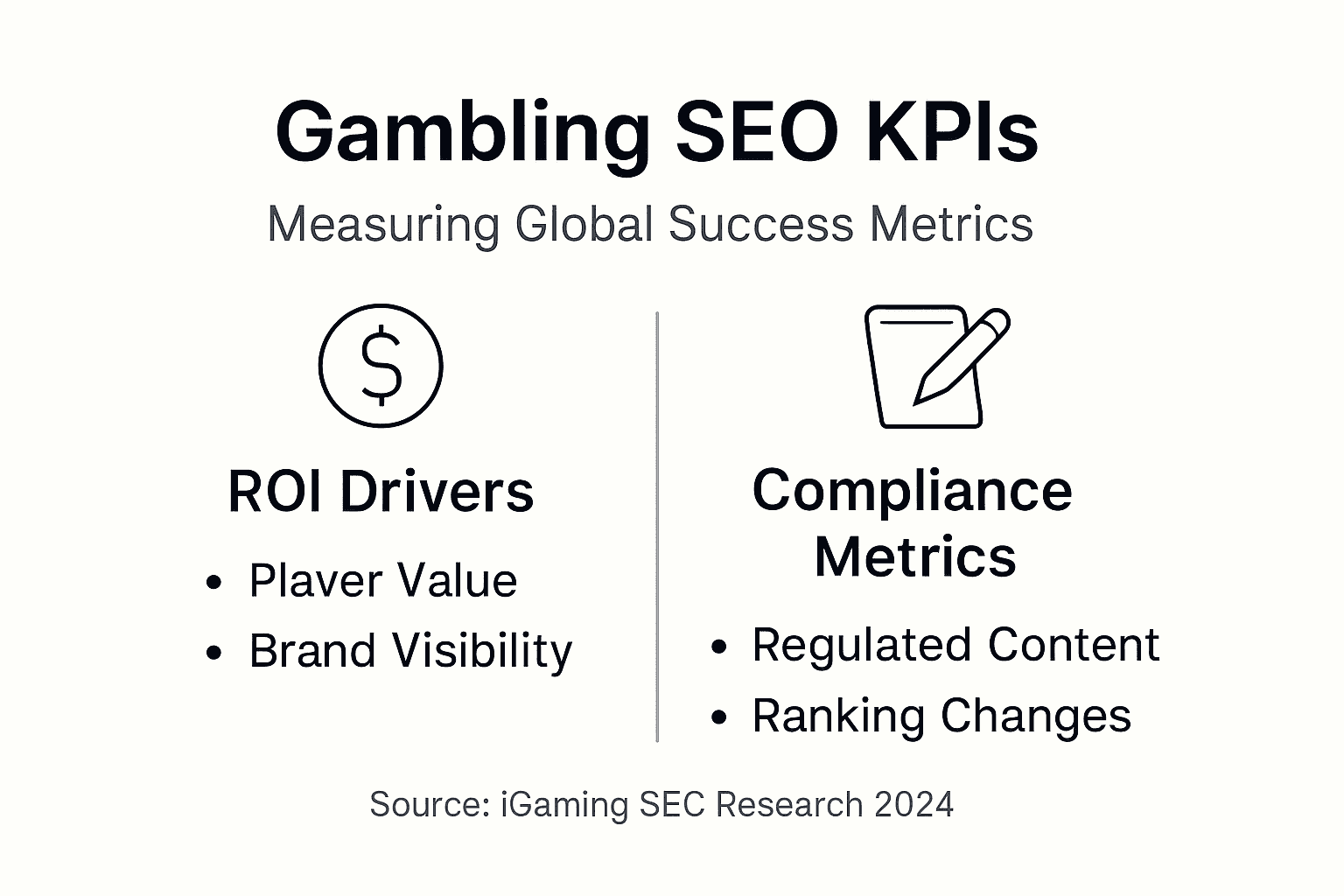
Tracking player lifetime value from organic traffic can increase acquisition ROI by 35%. This requires connecting your SEO analytics to player database systems that track deposit behavior, game preferences, and retention patterns. You need to know which keywords and content pieces attract players who stick around and generate revenue rather than claiming a bonus and disappearing.
Geo-specific performance measurement reveals which international markets justify continued investment. Your iGaming SEO success metrics should include:
- Organic traffic volume by country and language variant
- Conversion rate from organic visitor to registered player by market
- First deposit value and time to first deposit by traffic source
- Player retention at 30, 60, and 90 days by acquisition channel
- Lifetime value projection at 180 days for organic-acquired players
| KPI | Calculation | Target Benchmark | Why It Matters |
|---|---|---|---|
| Player LTV from Organic | Total player value / organic acquisition cost | 3:1 minimum ratio | Determines true SEO campaign profitability |
| Geo-Specific Conversion | Registrations per market / traffic per market | Varies by jurisdiction | Identifies highest-value target markets |
| Compliance Impact Score | Ranking changes after compliance updates | Positive trend | Validates that compliance improves rankings |
| Content ROI by Type | Player value generated / content production cost | Varies by content type | Guides content strategy priorities |
Compliance tracking must integrate with your performance measurement. Monitor ranking changes after implementing responsible gaming features or updating content for new regulations. This data proves the business case for compliance investment and helps you prioritize which regulatory updates deserve immediate attention.
Segment your analytics by player acquisition funnel stage. Traffic from research intent keywords should show different conversion patterns than transaction intent traffic. Understanding these patterns helps you optimize content strategy and resource allocation across your international properties.
Explore more about iGaming SEO performance KPIs to refine your measurement framework and maximize campaign returns.
Common Misconceptions and Pitfalls in International Gambling SEO
The biggest misconception is that translation equals international SEO. Operators waste massive budgets translating content without adapting to local regulations, player preferences, or search behavior. The result is content that ranks poorly and converts worse because it fails to connect with target audiences.
Unsupervised AI content creates a different but equally costly problem. AI-generated gambling content often includes compliance violations, factual errors about odds or game rules, and generic advice that fails to differentiate your brand. These issues damage trust signals and trigger search engine quality filters.
Geo-targeting neglect represents another common failure. Sites that don’t properly implement hreflang tags and geo-specific content structures confuse search engines about their target markets. This causes the wrong content to appear in the wrong regions, wasting crawl budget and missing opportunities in your true target markets.
Responsible gaming signal omission might seem like a minor oversight, but it costs you rankings and player trust. The common SEO pitfalls in gambling that operators make include:
- Launching international sites without researching local gambling regulations
- Using identical content across markets with only language translation
- Building links from any gambling site without verifying licensing status
- Ignoring mobile experience optimization despite mobile-first indexing
- Failing to track player value metrics beyond basic traffic and ranking reports
- Copying competitor strategies without understanding their compliance approach
- Neglecting technical SEO fundamentals like site speed and structured data
These mistakes share a common thread: prioritizing speed and shortcuts over strategic implementation. International gambling SEO requires patience and thoroughness because the penalties for getting it wrong extend beyond rankings to regulatory consequences and brand damage.
Elevate Your International Gambling SEO with 1on1 SEO
Navigating international gambling SEO successfully requires specialized expertise that most agencies and in-house teams lack. The intersection of technical SEO, regulatory compliance, and player psychology creates challenges that generic SEO strategies can’t address. Our advanced iGaming SEO strategies combine deep industry knowledge with proven frameworks that deliver measurable results in regulated markets. We’ve helped operators increase player acquisition by 35% while maintaining full compliance across multiple jurisdictions. Our coaching program teaches you the exact winning iGaming SEO strategies that separate dominant brands from struggling competitors, including safe off-page SEO techniques tailored specifically for gambling markets.
Frequently Asked Questions
What are the biggest SEO compliance challenges in regulated gambling markets?
Keyword restrictions and content limitations create the most immediate challenges. Many jurisdictions prohibit targeting specific gambling terms or making claims about winning probabilities. You must also navigate varying responsible gaming disclosure requirements and licensing display rules that differ by market. Check our gambling SEO compliance FAQs for detailed guidance.
How can AI be safely used to generate SEO content for gambling sites?
AI works best for research, outline creation, and initial draft generation rather than final content. Always route AI-generated content through editorial and legal review before publication. Create market-specific prompts that include compliance requirements, and train your team to recognize common AI errors like prohibited claims or factual inaccuracies about odds and game rules.
Which metrics best measure the effectiveness of international gambling SEO?
Player lifetime value from organic traffic provides the most accurate success measure because it connects SEO directly to revenue. Supplement this with geo-specific conversion rates, first deposit values, and player retention metrics at 30, 60, and 90-day intervals. Traffic and rankings matter less than the quality and value of players you acquire.
How do geo-targeting strategies differ for emerging versus mature markets?
Mature markets justify ccTLD investments and comprehensive localization because the player base and revenue potential support higher costs. Emerging markets work better with subdirectory structures that allow you to test demand before committing to full localization. Emerging markets also require more educational content because players may be less familiar with online gambling.
What common SEO mistakes should iGaming marketers avoid internationally?
Avoid treating translation as a complete international SEO strategy, using AI content without compliance review, and building links from unlicensed gambling sites. Also, don’t ignore mobile optimization, responsible gaming signals, or player value tracking. The biggest mistake is copying competitor strategies without understanding whether they comply with regulations in your target markets.