

TL;DR:
- Most casino audits are not about paperwork, but verifying that controls actually function as regulators require.
- Regulators demand precise evidence standards and testing methods, reflecting operational controls, not vague guidance.
- Building an effective checklist involves mapping controls to standards, conducting walkthroughs, testing, staff interviews, and maintaining organized evidence.
Most compliance officers walk into a casino audit expecting a document review and walk out with a regulatory finding they never saw coming. The casino audit checklist is not a paperwork formality. It is a structured testing program that regulators like the Nevada Gaming Control Board and the UK Gambling Commission (UKGC) use to verify that controls actually work, not just that they exist on paper. If your checklist does not mirror the evidence standards and testing methods these regulators demand, you are not auditing. You are filing.
Table of Contents
- Understanding casino audit requirements and regulatory standards
- Core components of a casino audit checklist for compliance and operations
- Comparing regulatory audit approaches: Nevada vs. UK Gambling Commission
- Practical steps to build and implement your casino audit checklist
- Why traditional casino audits fall short and how to rethink your checklist for 2026
- Strengthen your iGaming compliance with expert SEO strategies
- Frequently asked questions
Key Takeaways
| Point | Details |
|---|---|
| Regulatory frameworks | Casino audit checklists must align with Nevada MICS and UK Gambling Commission security audit standards to ensure compliance. |
| Evidence-based audits | Effective audits combine document review, staff interviews, control walkthroughs, and independent testing to verify operational controls. |
| Audit independence | Log reviews and audit testing require independence from system administrators to ensure unbiased results. |
| Regular updates | Audit checklists should be regularly updated to reflect latest regulations, enforcement trends, and internal control changes. |
| Integrated SEO compliance | Integrating SEO and marketing compliance with casino audits strengthens overall governance and online visibility. |
Understanding casino audit requirements and regulatory standards
The first mistake iGaming compliance teams make is treating their casino regulatory checklist as a generic internal review tool. Regulators do not publish vague guidance. They publish precise, product-area control standards that define exactly what evidence they expect and how that evidence must be gathered.
Nevada’s Gaming Control Board provides regulator-style internal audit checklists with separate walkthrough and testing documents organized by gaming product area. Slots, Table Games, IT, and other domains each have their own workpapers. This is not one master list. It is a modular audit system designed to reflect how each product area operates.
The Nevada Minimum Internal Control Standards (MICS) are published as versioned documents with distinct sections covering every major operational domain. Think of them as the baseline. Your internal audit checklist must prove your controls meet or exceed each relevant MICS criterion.
The UKGC takes a different but equally demanding approach. UK remote gambling security audits must be conducted annually by an independent auditor and must conform to ISO/IEC 27001 security standards. The audit must cover all relevant technical security requirements, and the report structure is specified, not optional.
Key regulatory requirements your checklist must address:
- Jurisdiction-specific control standards (Nevada MICS, UKGC Remote Technical Standards)
- Evidence requirements for each control area, not just descriptions of what controls exist
- Auditor independence and qualification criteria
- Reporting formats, deadlines, and escalation procedures for major findings
Understanding iGaming compliance basics before you build a checklist is not optional. The regulatory framework shapes every item on the list.
Core components of a casino audit checklist for compliance and operations
A casino audit checklist that passes regulatory scrutiny is built on two distinct layers: walkthrough documentation and operational testing. These are not interchangeable. A walkthrough confirms that a control is designed correctly. Testing confirms it actually operates.

Nevada’s IT-related MICS guidance provides a clear illustration. Log review independence, retention periods, and review frequency are all explicitly defined. Your checklist must include specific test steps that verify each of these elements with actual evidence, not just a checkbox confirming “log reviews occur.”
The UKGC’s audit approach requires a combination of enquiry, evidence gathering, and on-site or remote inspection. Documentation alone does not constitute an audit. This mirrors what the best casino compliance programs already practice, but many teams still default to document pulls when regulators expect observed control performance.
Essential casino audit checklist components:
- Control design review (walkthrough): Document how each control is designed, who owns it, and what evidence it generates
- Operational testing: Pull samples, test frequencies, verify log review dates, and confirm approval signatures
- Staff interviews: Confirm control awareness and procedural knowledge at the operational level
- Evidence file: Maintain organized, time-stamped documentation for every tested item
- Reporting structure: Executive summary, findings by control area, risk rating, and remediation timeline
Step-by-step sequence for audit execution:
- Map your checklist items to the relevant regulatory standard (MICS section, RTS requirement, etc.)
- Identify the evidence type required for each item (log, system report, signed approval, etc.)
- Conduct walkthroughs with control owners before pulling samples
- Test samples against defined criteria and document exceptions immediately
- Interview staff to validate that documented procedures match actual practice
- Rate each finding by severity and assign remediation ownership
- Draft the audit report in the format required by your regulator
Pro Tip: Focus your testing hours on control areas with the highest regulatory failure rates in your jurisdiction. For Nevada operators, IT access controls and table game cash controls are frequent pain points. For UKGC licensees, RTS security requirements and responsible gambling controls draw the most scrutiny.
Using structured evidence gathering methods adapted to casino environments ensures your findings hold up under regulator review. Similarly, building responsible marketing controls into your checklist closes a gap many operators miss entirely. Marketing compliance is an audit area, not a separate function.
A well-designed marketing automation checklist can also serve as a structural reference when organizing recurring audit tasks, especially for operators managing large affiliate or promotional workflows.
Comparing regulatory audit approaches: Nevada vs. UK Gambling Commission
Understanding how Nevada and the UKGC structure their audit expectations helps you customize your casino regulatory checklist when you operate across multiple jurisdictions. These are not minor stylistic differences. They reflect fundamentally different audit philosophies.
Nevada’s audit framework is product-area specific. Each gaming domain has its own walkthrough and testing documentation, with MICS criteria as the control benchmark. The internal audit function is expected to operate year-round, with ongoing testing cycles rather than a single annual event.
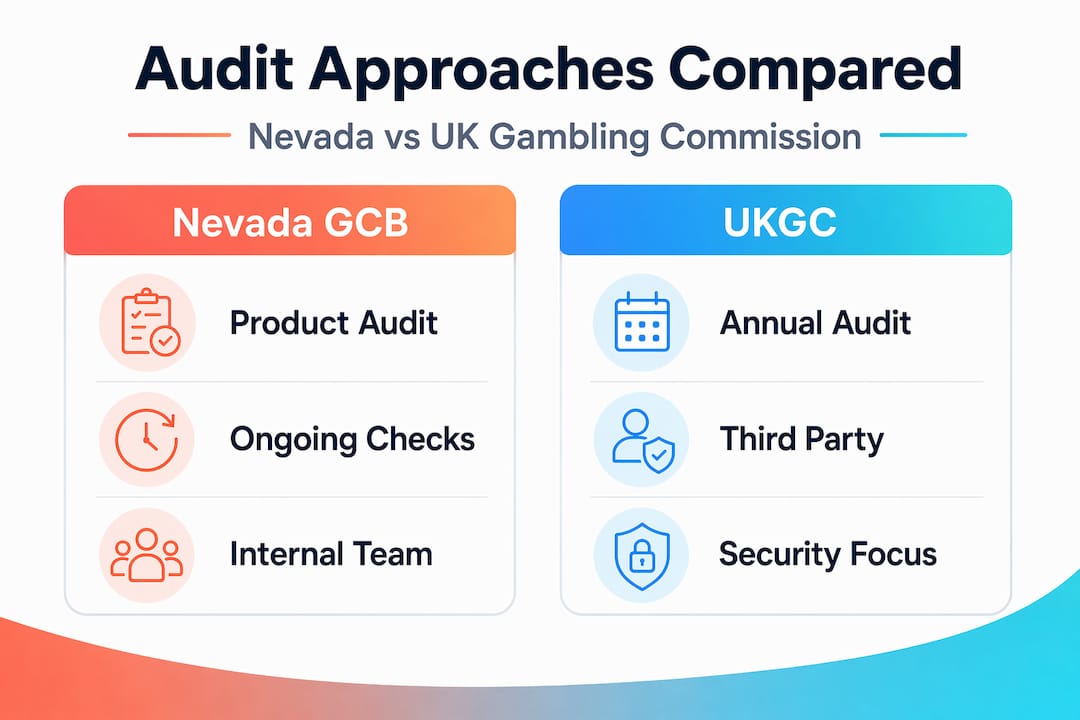
The UKGC mandates an annual third-party security audit covering all Remote Technical Standards security elements. The auditor must be independent, qualified, and capable of conducting on-site or remote inspections. The report must include an executive summary, audit approach, scope, findings, and a signed declaration.
| Dimension | Nevada GCB | UK Gambling Commission |
|---|---|---|
| Audit frequency | Ongoing internal audit program | Annual external audit (security-specific) |
| Audit scope | All MICS operational domains | All RTS security requirements |
| Auditor type | Internal audit function (with independence requirements) | Independent third-party auditor |
| Inspection method | Walkthroughs, testing, sampling | Enquiry, evidence, on-site or remote inspection |
| Report format | Workpaper-based, product-area organized | Structured report with executive summary and signed declaration |
| Timing | Continuous with periodic reporting cycles | First audit within 6 months of license; annually thereafter |
| Key independence rule | Log reviews by non-administrators | Auditor must not be the licensee’s own staff |
The operational implication is clear. If you hold licenses in both Nevada and the UK, you need a dual-structured checklist. One that feeds your internal audit cycle with MICS-aligned workpapers, and one that prepares all RTS security evidence for annual third-party review.
Reviewing your compliance audit workflows to separate these tracks early saves significant rework when audit season arrives.
Practical steps to build and implement your casino audit checklist
Building a checklist that works in practice starts with one discipline most teams skip: translating regulatory language into testable evidence steps. “Management shall review logs” is a MICS requirement. “Obtain and review the last three months of access logs; confirm reviewer is not a system administrator; verify review dates against retention schedule” is a checklist item.
Step-by-step checklist development process:
- Pull the full text of the applicable regulatory standard for each operational domain
- Identify every control requirement (look for “shall,” “must,” and “required”)
- Write a corresponding evidence test for each requirement (what you will obtain, verify, or observe)
- Assign a responsible audit team member for each item
- Define the sample size and selection method for testing items
- Set a review deadline for each checklist section that aligns with your regulatory reporting calendar
- Build an exception log template that captures finding, severity, root cause, and owner
UKGC audit reports must be submitted within strict deadlines, and major non-conformities require prompt notification to the Commission. Your checklist must include a reporting milestone column so nothing falls through when findings emerge.
AML/CFT compliance is increasingly a checklist priority for casino operators. FinCEN’s 2026 AML/CFT proposal requires board or senior management approval of the written AML/CFT program and mandates that the designated compliance officer be based in the United States. Both of these are verifiable checklist items. Confirm board resolution date, confirm officer location, confirm program version currency.
Include roles and responsibilities explicitly in your checklist. Not “compliance team” as a generic owner, but the named position responsible for approval, execution, and sign-off at each stage.
Pro Tip: Build a quarterly review trigger into your checklist template. Regulations change, operations evolve, and a checklist that was accurate in January may miss new requirements by October. Set a calendar reminder to cross-reference your items against the current published MICS or RTS version.
Linking your checklist governance to your SEO compliance strategies also matters for operators where affiliate and content marketing intersect with licensing conditions.
Why traditional casino audits fall short and how to rethink your checklist for 2026
Here is the uncomfortable truth about most casino audit programs: they are designed to produce evidence that the audit happened, not evidence that the controls work. That distinction matters enormously when a regulator reviews your findings.
The UKGC states directly that a good audit cannot be conducted remotely based only on documentation. Yet documentation-only audits remain standard practice at many operators. Teams pull logs, confirm they exist, check a box, and call it tested. That is not testing. That is filing with extra steps.
Nevada’s IT MICS guidance highlights log review independence as a fundamental audit control principle, not an administrative nicety. If the system administrator reviews their own access logs, the review is worthless. The checklist item must include a verification step that confirms who performed the review, not just that a review was documented.
The pattern behind most audit failures is structural. Checklists are designed for completion, not for detection. When the goal is to finish the list, teams unconsciously avoid tests that might surface findings. Reframe your checklist as a control detection tool. The purpose is not to confirm everything is fine. It is to find what is not.
Marketing compliance belongs in the audit checklist and most teams leave it out entirely. Bonus terms, responsible gambling messaging, affiliate disclosure, and geo-targeting controls are all licensing conditions. Treating them as marketing team concerns rather than audit items is how operators accumulate regulatory exposure quietly.
Independence is not just an auditor qualification requirement. It is a checklist design principle. Every review step in your checklist should answer: who is doing this, and do they have a conflict of interest in the finding?
Building your digital PR and compliance approach around the same evidence standards you apply to internal audits creates consistency across your governance program. Regulators notice when public-facing claims and internal controls tell different stories.
Strengthen your iGaming compliance with expert SEO strategies
Audit readiness and search visibility are more connected than most operators realize. Regulatory trust signals, authoritative content, and compliant marketing practices all feed into both. If your compliance program is solid but your digital presence does not reflect it, you are leaving acquisition value on the table.
Our iGaming SEO ranking strategies are built specifically for operators and affiliates who work within strict regulatory frameworks. We understand why iGaming needs SEO that goes beyond keywords, into trust architecture, responsible gaming signals, and geo-specific compliance. If you are building or refining your casino affiliate SEO and compliance program, our coaching gives you frameworks that hold up under both algorithm updates and regulatory review.
Frequently asked questions
What are the key elements of a casino audit checklist?
A casino audit checklist includes control criteria drawn from regulatory standards, evidence gathering procedures, walkthrough documentation, operational testing protocols, and structured reporting requirements. Nevada’s Gaming Control Board organizes these elements by gaming product area, with separate walkthrough and testing documents for each domain.
How often must a UK remote gambling operator complete a security audit?
UK remote gambling operators must complete an annual security audit conducted by an independent auditor, with the first audit due within six months of license approval and annually thereafter.
Why is independence in log reviews important for casino IT audits?
Independence prevents system administrators from reviewing their own access activity, which would allow improper actions to go undetected. Nevada’s IT MICS guidance requires that log reviews be performed by IT personnel other than the system administrators responsible for those systems.
Can a good casino audit be conducted remotely based only on documentation?
No. The UK Gambling Commission explicitly states that a good audit cannot rely solely on remote documentation review. Effective audits require a combination of enquiry, evidence gathering, and on-site or remote inspection.
What new AML/CFT requirements are proposed by FinCEN for casino audits in 2026?
FinCEN’s 2026 AML/CFT proposal requires board or senior management approval of the written AML/CFT program and mandates that the designated compliance officer be located in the United States, both of which must be verifiable checklist items.