

TL;DR:
- SEO compliance in iGaming requires ongoing monitoring of content, technical setups, and backlinks to meet regulations.
- Regular audits utilizing specialized tools and tailored checklists help identify and resolve compliance issues promptly.
- Building a proactive, forward-looking monitoring system ensures legal adherence and maintains competitive search visibility.
One compliance misstep in iGaming SEO can cost you rankings, revenue, and your operating license before you realize what happened. Unlike generic verticals, iGaming operates under layers of regulatory scrutiny where your meta descriptions, keyword choices, and backlink profile are all fair game for enforcement action. The stakes are high, and the rules shift constantly across jurisdictions. This guide walks you through exactly how to build and run a repeatable SEO compliance monitoring process, from building your toolkit to documenting results for regulators and stakeholders alike.
Table of Contents
- Understanding SEO compliance in the iGaming industry
- Building your compliance monitoring checklist and toolkit
- Step-by-step: How to monitor SEO compliance in practice
- How to troubleshoot and resolve compliance issues
- How to measure and report ongoing compliance
- What most iGaming SEO audits miss about compliance
- Get expert help with your iGaming SEO compliance
- FAQ
Key Takeaways
| Point | Details |
|---|---|
| Compliance is high-stakes | Overlooking SEO compliance can result in penalties, revenue loss, or de-indexing for iGaming brands. |
| Checklists and tools are essential | Structured checklists and the right monitoring tools are critical for thorough and repeatable SEO compliance checks. |
| Continuous audits prevent issues | Scheduled audits and rapid troubleshooting help you catch and fix compliance gaps before they impact rankings. |
| Clear documentation builds trust | Detailed reporting and record-keeping demonstrate your SEO compliance to supervisors and regulators. |
| Proactive compliance is a competitive edge | Businesses that view compliance as a strategic priority gain long-term search visibility and market trust. |
Understanding SEO compliance in the iGaming industry
SEO compliance in iGaming means ensuring every element of your site’s search optimization meets both search engine guidelines and the legal requirements of each market you operate in. That includes on-page content, meta data, technical configurations, and the links pointing to your site. It is a lot more nuanced than standard SEO work because the rules are not just about ranking well. They determine whether you can operate at all.
Regulatory bodies like the UK’s why SEO compliance matters framework, Malta’s MGA, and the New Jersey Division of Gaming serve as the primary compliance authorities in major regulated markets. Each one has specific mandates around advertising standards, restricted keyword usage, responsible gambling messaging, and how you can target users through organic search. Breaking any of these rules in your content or technical SEO setup can trigger fines, site bans, or loss of licensing.
SEO compliance mistakes in iGaming usually fall into three categories:
- On-page compliance gaps: Missing responsible gambling disclaimers, using phrases that imply guaranteed winnings, or failing to add age restriction signals
- Off-page compliance issues: Building links from restricted domains, earning placements on non-licensed affiliate sites, or associating with prohibited promotional networks
- Technical compliance failures: Using geo-blocking incorrectly, failing to implement hreflang for multi-jurisdiction sites, or allowing restricted content to be indexed in markets where it is banned
“SEO compliance for iGaming is crucial to avoid legal and regulatory repercussions for iGaming brands.”
The best way to think about compliance is as a set of non-negotiable constraints that shape every SEO decision you make. It is not something you bolt on at the end of a campaign. It has to be embedded into your keyword research, content planning, link acquisition, and technical setup from the start.
Building your compliance monitoring checklist and toolkit
With a clear picture of what compliance covers, the next step is organizing how you actually check for it. A content audit workflow built on a structured checklist helps marketers systematically verify SEO compliance, minimizing risky oversights that manual review alone will miss.
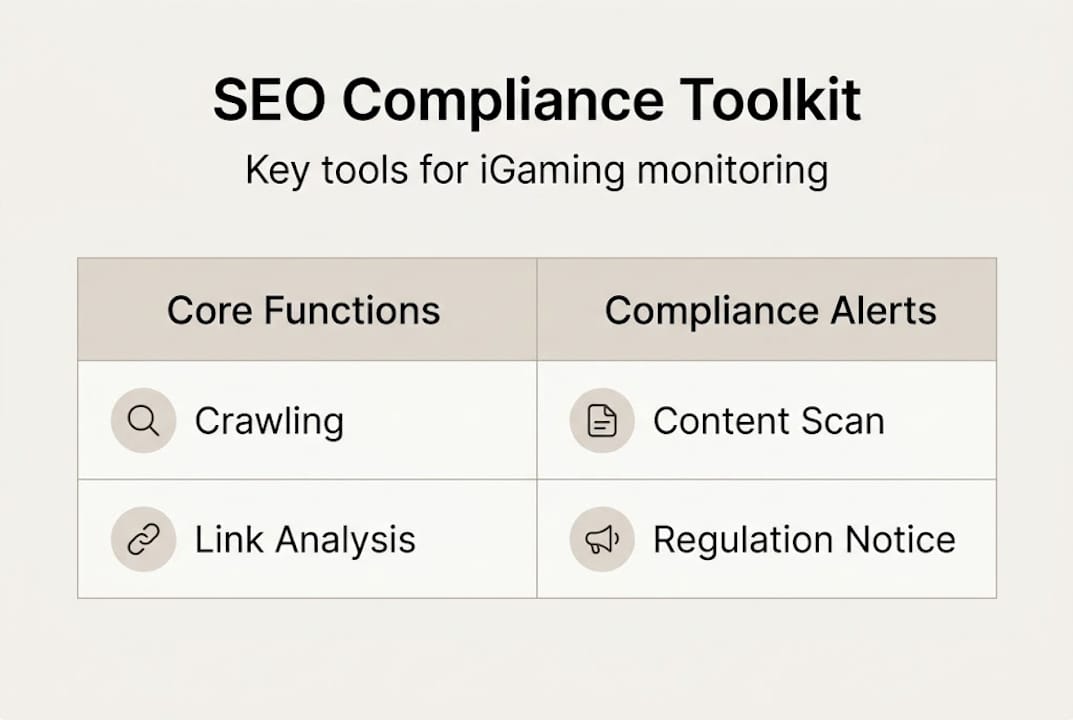
Your toolkit should cover four core functions: crawling, content scanning, link analysis, and regulatory alerting. Here is a comparison of leading tools used by iGaming SEO teams:
| Tool | Core monitoring features | Has regulatory alerts | Starting price (approx.) | Best for |
|---|---|---|---|---|
| SEMrush | Full site crawl, content audit, backlink tracking | Limited | $129/month | General SEO plus link oversight |
| ScreamingFrog | Deep technical crawl, custom extraction | No | $259/year | Technical compliance audits |
| BrightEdge | Enterprise content and performance tracking | Yes (enterprise tier) | Custom pricing | Large operators, multi-region |
| ContentKing | Real-time on-page monitoring | Yes | $49/month and up | Fast detection of content drift |
| SE Rankings | SEO monitoring plus compliance flags | Limited | $65/month | Mid-market affiliates and operators |
When customizing your checklist, account for jurisdiction-specific rules. A checklist for a UK-licensed casino site will look very different from one for a New Jersey sportsbook. For example, UK requirements from ASA and GamCare mandate specific language around responsible gambling on any ranking content, while New Jersey has its own disclaimers and geo-restriction requirements. Reference the SEO compliance best practices established for enterprise environments and adapt them to your market.
The key checklist items for most iGaming markets include:
- Meta titles and descriptions free of restricted phrases
- Age verification and responsible gambling links present on all key pages
- No indexable content in markets where you lack a license
- All affiliate links tagged and from compliant referring domains
- Schema markup and structured data aligned with local advertising standards
Your SEO consulting checklist can serve as a foundation and be adapted per market and content type.
Pro tip: Block out 90 minutes every Monday morning to run your checklist against the previous week’s published content and any new pages added. This prevents compliance debt from building up silently.
Step-by-step: How to monitor SEO compliance in practice
Now that your tools and checklists are ready, here is how to run monitoring consistently without letting it overwhelm your team. Regular audits are the backbone of an effective iGaming SEO compliance strategy.
- Run a full site crawl with ScreamingFrog or your preferred crawler. Flag pages with missing meta data, broken links, or restricted phrases appearing in indexed content.
- Review all published content from the past period for restricted keyword usage, missing disclaimers, or outdated regulatory language.
- Check all backlinks using SEMrush or a dedicated link tool. Look for new links from unlicensed affiliates or blacklisted domains.
- Test geo-blocking rules across your key restricted markets. Use VPN testing to confirm that users in unlicensed territories cannot access restricted pages.
- Review structured data and schema for pages targeting featured snippets. Any promotional language in schema that violates advertising standards needs immediate correction.
- Document every issue found in a shared audit log accessible to legal, content, and tech teams.
- Apply fixes within defined SLA windows and log resolutions. For critical compliance violations, treat these as emergency fixes with a 24-hour turnaround requirement.
Below is a sample audit log format your team can use:
| Page URL | Issue detected | Risk severity | Action taken | Date resolved | Owner |
|---|---|---|---|---|---|
| /casino-bonuses/ | Missing age restriction disclaimer | High | Added footer disclaimer tag | Jan 8, 2026 | Content team |
| /sports-betting/nba/ | Meta title includes “guaranteed wins” phrase | Critical | Updated to compliant copy | Jan 9, 2026 | SEO lead |
| /affiliates/uk-partners/ | Link from unlicensed UK affiliate | High | Link disavow submitted | Jan 10, 2026 | Link team |
For responsible marketing compliance, embed these checks into your publishing workflow so issues never make it to the live site in the first place. Managing SEO compliance risk proactively is far less costly than remediation after a regulatory notice.
Pro tip: Set up Google Search Console alerts combined with your crawler’s scheduled reports to flag new indexation of previously blocked pages in real time.
How to troubleshoot and resolve compliance issues
Finding a compliance gap is only half the problem. The harder part is diagnosing root causes quickly and fixing them before a regulator or search engine acts. Quick issue resolution reduces your risk of penalties and lost traffic in highly regulated sectors.

Root causes usually fall into four buckets: new regulatory rules you were not tracking, content drift from writers or agencies unfamiliar with compliance requirements, technical changes that broke geo-blocking or robots.txt configurations, and algorithm updates that shifted what kinds of language trigger quality flags.
The top five compliance errors in iGaming SEO you need to watch for:
- Missing responsible gambling messaging on pages targeting high-intent keywords
- Using restricted promotional language like “best odds guaranteed” in title tags or H1s
- Publishing in unlicensed geo-markets due to incorrect hreflang or CDN misconfiguration
- Links from non-compliant affiliates that were not vetted before being built
- Schema markup with prohibited claims that appear in search engine rich results
“Non-compliance gaps left unaddressed will compound over time. What starts as a missing disclaimer can grow into a pattern that draws regulatory investigation.”
For affiliate compliance strategies, partner vetting is as much a compliance task as it is an acquisition one. Your rankings and your license can both be put at risk by who links to you. The speed with which you adapt to Google algorithm updates also determines how often compliance-adjacent ranking signals catch you off guard.
How to measure and report ongoing compliance
Resolving issues is not enough. You need to track and report compliance performance continuously so that leadership, legal, and external regulators can see your diligence over time. Regular compliance reporting proves adherence to both internal and external review boards.
Key metrics to track for ongoing SEO compliance:
- Number of compliance flags found per audit cycle
- Average time to resolution for each severity level
- Rate of repeat violations (same issue appearing twice or more)
- Coverage rate: percentage of site audited in each review cycle
- Number of restricted keywords found in indexed content
- Link disavow requests submitted versus total flagged links
For measuring SEO compliance effectively, build a simple dashboard in Google Data Studio or a business intelligence tool that pulls from your crawler, link tool, and audit log. This gives stakeholders a real-time view without needing to request manual reports.
Tailor your reporting format to your audience. Legal teams want risk exposure data. Marketing leadership wants traffic impact summaries. External regulators want documented evidence of systematic monitoring and timely resolution.
Pro tip: Schedule automated weekly emails with your compliance dashboard snapshots for department heads, and a more detailed monthly report with trend lines for leadership reviews.
What most iGaming SEO audits miss about compliance
Here is the uncomfortable truth most agencies will not tell you. Standard compliance audits check what already exists. They catch yesterday’s problems. What they consistently miss is the forward-looking dimension: emerging regulatory signals, regulatory draft consultations, and the soft compliance signals that search engines are increasingly using to score trust in gambling content.
We see this play out repeatedly. A brand passes its monthly audit with a clean report, then takes a ranking hit because a new ASA ruling changed how gambling bonuses can be described in organic snippets. Their audit process was not designed to catch that. For deeper compliance insight, you need legal, SEO, and content teams reviewing draft regulatory guidance together, not waiting for violations to appear in your crawl data.
Compliance is not a cost center. When competitors stumble after regulatory shifts, the brands that built systematic, forward-looking monitoring processes pick up their organic traffic and affiliate relationships. That is a measurable competitive advantage. Build compliance into every SEO decision, not just your audit cycle.
Get expert help with your iGaming SEO compliance
Building a compliance monitoring system that actually works in a regulated iGaming market takes more than a checklist. It requires frameworks that adapt as regulations evolve, tools configured for your specific jurisdictions, and SEO strategies that treat compliance as a ranking signal, not just a legal requirement. Our team has developed iGaming SEO strategies specifically for operators, affiliates, and agencies operating in the most competitive and regulated SERPs in the world. Whether you need a full compliance audit or want to avoid the most common traps with our mistake prevention guide, we can help. Start with a consulting session to map your compliance exposure and build a monitoring plan built for your markets.
FAQ
What is SEO compliance monitoring in iGaming?
SEO compliance monitoring in iGaming means continually checking that your site follows regulations, guidelines, and industry standards to avoid penalties or loss of search visibility. It covers on-page content, technical configurations, and your backlink profile.
Which tools are best for SEO compliance in iGaming?
The best tools combine site crawlers, content scanners, and regulatory alert systems tailored to the iGaming sector. A checklist combined with technology is the optimal approach for consistent monitoring.
How often should I audit for SEO compliance?
Audit your iGaming site at least monthly, and immediately after major algorithm or regulatory changes. Regular audits are essential for staying ahead of compliance risk in shifting markets.
What are the most common SEO compliance errors?
The most common errors are misleading ad copy, using restricted keywords, ignoring local laws, and missing responsible gambling messaging. These mistakes can trigger penalties and significant traffic loss if left unaddressed.
How do I prove SEO compliance to stakeholders?
Keep detailed reports, audit logs, and documented compliance actions ready to share with management or regulators. Documentation and reporting are vital parts of a robust and defensible compliance process.