

TL;DR:
- Effective casino SEO begins at the wireframe stage, with foundational decisions supporting rankings and compliance. Core Web Vitals, content architecture, hreflang reciprocity, and schema markup are critical elements that influence visibility and user experience from launch. Proper technical implementation of design and legal requirements ensures organic growth, trustworthiness, and regulatory adherence in highly competitive markets.
Casino SEO is not a keyword game. Most iGaming developers and designers treat search optimization as something bolted on after launch, a layer of metadata and title tags applied to an already-built site. That approach consistently fails. Genuine seo-friendly casino design starts in the wireframe stage, where structural decisions about content architecture, page templates, and compliance UI either support or sabotage your rankings before a single piece of content goes live. This guide gives you the technical and strategic foundation to build casino sites that rank, convert, and satisfy regulators from day one.
Table of Contents
- Key Takeaways
- Core Web Vitals and casino design performance
- Content architecture for casino SEO
- International SEO and hreflang for casino sites
- Schema markup and structured data for casino authority
- Balancing compliance, UX, and crawlability
- My honest take on casino design and SEO
- Build your casino site to rank from the ground up
- FAQ
Key Takeaways
| Point | Details |
|---|---|
| Core Web Vitals define UX ranking | LCP, INP, and CLS thresholds directly affect casino site rankings and must be built into design decisions, not patched later. |
| Content architecture drives SEO | Separating informational and transactional pages into distinct templates improves indexation and supports compliance disclosure requirements. |
| Hreflang must be reciprocal | Every language variant needs matching bidirectional tags with exact canonical URL matches to avoid indexing failures across regulated markets. |
| Schema markup builds credibility | Implementing Article schema with author and date properties signals freshness and authorship to Google, supporting E-E-A-T in iGaming. |
| Compliance UI must stay crawlable | Age gates and geo-restrictions built as client-side overlays hide content from crawlers. Use server-side template elements instead. |
Core Web Vitals and casino design performance
The role of SEO in casino site performance is inseparable from how your pages load, respond, and hold together visually. Core Web Vitals thresholds are LCP at or below 2.5 seconds, INP at or below 200 milliseconds, and CLS at or below 0.1, measured at the 75th percentile using Google’s CrUX dataset at the URL level. Miss these numbers and you are not just creating friction for users. You are telling Google’s ranking system that your casino site delivers a poor experience.
Casino UIs are among the hardest environments to hit these thresholds. You are dealing with autoplay game trailers, live dealer feeds, dynamic lobby tiles that refresh in real time, and promotional banners that animate on load. Each of those elements fights against your Core Web Vitals scores.
Here is where most casino developers lose points on LCP specifically. The largest contentful element on a casino homepage is almost always a hero banner or a featured game preview image. If that asset is lazy-loaded, the browser deprioritizes it and your LCP score tanks. Preload hero images in the initial HTML using a "` tag and never lazy-load anything above the fold.
INP is the metric that catches casino sites off guard most often. Unlike the retired FID metric, INP measures full-session input latency across every user interaction, not just the first. Slots lobby filtering, live search, and game launch sequences all contribute. Long main-thread tasks and expensive DOM operations are the primary culprits. Break up JavaScript execution with requestIdleCallback, defer non-critical scripts, and keep DOM node counts reasonable on lobby pages.
Key design decisions that protect Core Web Vitals scores:
- Reserve explicit width and height attributes on all game tile images to prevent layout shifts and keep CLS at zero
- Use CSS
containon dynamic lobby sections that update asynchronously to prevent reflow cascading into stable content - Serve game preview thumbnails in WebP or AVIF format with image optimization practices applied consistently across all resolutions
- Implement a responsive casino design with mobile-first CSS loading so that mobile users, who represent the majority of iGaming traffic, get the fastest possible critical path
Pro Tip: Run your casino lobby page through PageSpeed Insights targeting a mid-range Android device on a simulated 4G connection. That benchmark is closer to your median user than a desktop Chrome test and will expose INP and LCP failures invisible on fast hardware.
Poor stability and slow response directly increase bounce rates, and UX and SEO are interdependent in iGaming contexts where dynamic interactive content is the norm.
Content architecture for casino SEO
On-page SEO for casinos starts with a clear separation of user intent across your page templates. A player searching “how does RTP work” and a player searching “best slots bonus 200%” are expressing completely different needs. Combining both on the same page template produces a page that serves neither intent well and confuses crawlers about what the page is actually for.
The architecture decision that matters most is how you define and build your template types. Here is a practical hierarchy that works for most casino sites:
- Informational templates (guides, how-to pages, game rule explainers) should have no deposit CTAs above the fold. Google reads aggressive commercial signals on informational pages as a trust mismatch.
- Transactional templates (game lobby, registration, deposit pages) should surface regulatory disclosures and licensing information prominently. These are the pages regulators and algorithms scrutinize most.
- Hybrid templates (bonus review pages, casino comparisons) need structured headings that clearly separate the informational from the promotional content within the page.
- Compliance-specific template blocks should be built as reusable components that inject age verification notices, jurisdiction disclaimers, and responsible gambling links automatically based on user geo-location.
iGaming sites must embed compliance elements within crawlable templates rather than injecting them via JavaScript overlays. This is a design architecture decision, not a developer afterthought.
Your templates should also include dedicated blocks for verifiable proof elements. Visible RTP tables, screenshots, and withdrawal timelines are not just useful to players. They are E-E-A-T signals that tell Google your site publishes original, verifiable data rather than generic copy. Make these blocks a standard part of game review and casino review templates, not optional add-ons.
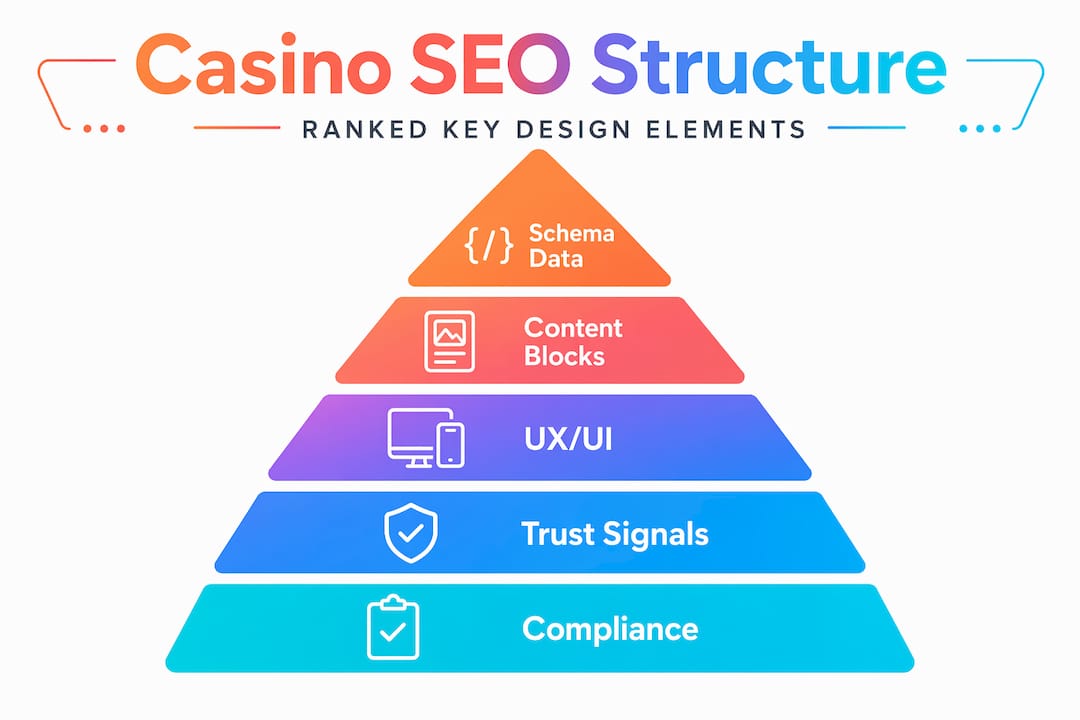
A useful framework for iGaming KPI coverage in design terms: license and security information should account for roughly 25% of a page’s trust-signal real estate, payments and withdrawals another 25%, games offering 20%, bonuses 15%, user experience elements 10%, and responsible gambling 5%. Build these proportions into your template wireframes so they are never skipped.
| Template type | Primary intent | Key SEO design requirement |
|---|---|---|
| Game lobby | Transactional | Fast LCP, crawlable filters, licensing info visible |
| Bonus review | Hybrid | Structured H2/H3 hierarchy, RTP data blocks, disclaimers |
| Game guide | Informational | Long-form layout, schema markup, no aggressive CTAs above fold |
| Registration | Transactional | Crawlable compliance, no cloaked geo-blocks |
An SEO content audit aligned to these template types will expose gaps in your current compliance and intent coverage quickly.
International SEO and hreflang for casino sites
Regulated casino markets operate market by market, each with different languages, licensing requirements, and legal restrictions. Getting hreflang right is not optional for any casino site targeting more than one region. Getting it wrong does not just reduce international traffic. It can trigger indexing failures that wipe out organic visibility across entire regions.
The most common errors are not theoretical misunderstandings. Most hreflang mistakes come from implementation errors, specifically missing bidirectional return tags and URL mismatches with canonical declarations. Both are entirely preventable.
Precise rules to follow on every casino site:
- Every hreflang tag must point to the exact URL that appears in the canonical tag, including protocol, trailing slash, and any subdirectory structure.
https://casino.com/en/andhttps://casino.com/enare different URLs to Google. - Every language variant must link back to all other variants. If your English page references your German page, the German page must reference the English page. Missing one direction causes Google to ignore both annotations.
- Self-referencing hreflang tags are required. Your English page must include an hreflang pointing to itself as well as to all other variants.
- Use
x-defaultfor users in markets where no specific language variant exists, typically pointing to your primary registration flow.
Pro Tip: After implementing hreflang, validate through the Google Search Console international targeting report and run a Screaming Frog crawler audit to confirm bidirectional links and self-references for every language variant before the site goes live.
For geo-restricted markets where certain games or promotions cannot be shown legally, keep pages crawlable. Pages with user-level display restrictions and explanatory messages for restricted users avoid cloaking penalties while maintaining indexation. Blocking the crawler to “protect” a restricted page removes it from search entirely.
Schema markup and structured data for casino authority
Structured data is where page optimization for casino sites often falls short, not because developers do not know schema exists, but because they implement it once and never maintain it. Schema is not a fire-and-forget feature in iGaming. It requires active maintenance to remain effective.
For casino content pages, Article or BlogPosting schema is the primary vehicle for signaling authorship, freshness, and credibility to Google. Schema with author, datePublished, dateModified, publisher, and mainEntityOfPage properties gives Google the full picture it needs to evaluate your content’s E-E-A-T profile. Proper implementation can boost click-through rates by up to 30% through rich snippet eligibility, which matters enormously in competitive casino SERPs.
Core schema properties to include on every content template:
authorwith aPersontype, linking to a dedicated author profile page that establishes real-world credentialsdatePublishedanddateModifiedpopulated dynamically from your CMS, not hardcoded at deploymentpublisherwith your organization’s logo URL and official name matching your licensing disclosureimageusing the primary article image at minimum 1200px width for Google Discover eligibilitymainEntityOfPagepointing to the canonical URL of the page
Update schema when content changes substantially by correcting dateModified and verifying author information. A casino bonus page updated for a new promotion needs its schema refreshed. Stale dateModified values send freshness signals that contradict the content itself.
For dynamic lobby content, consider using ItemList schema on game category pages to enumerate featured games with name, URL, and image. It will not guarantee rich results, but it gives Google structured context about what your lobby pages actually contain, which supports broader entity-based SEO strategies.
Balancing compliance, UX, and crawlability
Age verification and geo-targeting are legal requirements in most regulated markets. They are also two of the most common causes of unintentional SEO damage on casino sites. The way you implement them technically determines whether your pages rank or disappear.

Client-side JavaScript overlays for age verification that hide page content from crawlers are treated as cloaking. Google’s crawler does not click “I am 18+” before indexing your homepage. If the crawler sees a blank overlay and no content, it indexes a blank page. The fix is to integrate compliance elements as server-rendered template components that are always present in the DOM, styled visually as overlays for users but fully crawlable.
The same logic applies to geo-restricted content. If a game is unavailable in Germany, the German-language version of that game page should display a clear, crawlable message explaining why the content is restricted, along with links to available alternatives. Transparent, crawlable explanatory pages preserve indexation and demonstrate trustworthiness to both users and search engines.
Trust signals embedded in the design itself also carry weight. Displaying licensing badges, linking to your regulator’s verification page, and making responsible gambling tools findable within two clicks are not just compliance checkboxes. They are signals that E-E-A-T drives casino SEO success in a category where Google applies elevated scrutiny under its Your Money or Your Life guidelines.
Pro Tip: Test your homepage as Googlebot by using the URL Inspection tool in Google Search Console and clicking “Test Live URL.” If the rendered page shows incomplete content or a compliance overlay with no body text, your design is cloaking content unintentionally.
My honest take on casino design and SEO
I have reviewed dozens of casino sites where the content was genuinely excellent and the keyword strategy was sharp. They still ranked poorly, and the reason was almost always structural. A client-side age gate hiding the homepage body. Game tiles with no alt text and no explicit dimensions triggering constant layout shifts. Hreflang pointing to redirect chains instead of canonical URLs. None of those are content problems. They are design and development problems that no amount of link building will fix.
What I have found consistently is that developers underestimate how much Google’s evaluation of a casino site happens before a human reviewer ever looks at it. The crawler audit, the structured data parse, the Core Web Vitals measurement: these happen automatically and they shape ranking decisions continuously. If your design does not pass those automated checks, the content never gets a fair shot.
The counterintuitive lesson I keep coming back to is that transparency outperforms persuasion in iGaming SEO. Sites that expose RTP data in crawlable tables, name their compliance officer, show real withdrawal timelines, and surface licensing information prominently perform better in organic search than sites that bury that information to keep the player focused on signing up. Google rewards honesty in a category it treats with maximum suspicion.
The future of casino site SEO trends points toward even tighter integration between design systems and SEO requirements. Treat your component library as an SEO asset. Every reusable template block should have SEO requirements baked in, not added later.
— Antonio
Build your casino site to rank from the ground up
Designing a casino site that performs in organic search requires more than a good content strategy. It requires architecture decisions, template logic, and compliance implementations that most general-purpose SEO guidance never addresses. At 1on1seo, the coaching program goes deep on exactly these challenges, covering technical design requirements, geo-specific compliance strategies, and the advanced ranking frameworks that separate iGaming sites that dominate SERPs from those that stall on page three.
If you are building or rebuilding a casino site and want the full framework, the iGaming SEO strategies guide covers the implementation layer in detail. For a faster path to advanced ranking tactics specific to casino and betting sites, the advanced iGaming ranking guide is where to start.
FAQ
What is SEO-friendly casino design?
SEO-friendly casino design is the practice of building casino website architecture, templates, and UI components so that they support search engine crawlability, Core Web Vitals performance, and regulatory compliance simultaneously. It treats SEO as a structural requirement, not a post-launch task.
How do Core Web Vitals affect casino site rankings?
Google uses Core Web Vitals at the URL level as ranking signals, measuring LCP, INP, and CLS at the 75th percentile. Casino sites with dynamic lobbies and game previews frequently fail INP and LCP thresholds, which directly reduces rankings and increases bounce rates.
Why does hreflang matter for regulated casino markets?
Hreflang tells Google which language and regional version of a page to serve in specific markets. Without reciprocal bidirectional hreflang tags that exactly match canonical URLs, Google ignores the annotations and may index the wrong language variant or none at all.
Can age-gate overlays hurt a casino site’s SEO?
Yes. Client-side overlays that hide page content from crawlers are treated as cloaking and result in Google indexing blank or near-empty pages. Age verification should be implemented as server-rendered template elements that are visible in the DOM for crawlers while functioning as UI gates for users.
What schema markup should casino content pages use?
Casino content pages should implement Article or BlogPosting schema with author, datePublished, dateModified, publisher, and image properties. Keeping dateModified current with content updates and linking author markup to real credential pages strengthens E-E-A-T signals in Google’s evaluation.