

Balancing aggressive SEO tactics with regulatory compliance is the tightrope every iGaming marketer walks. One misstep can trigger penalties, tank rankings, or worse, legal action from regulators. Yet, responsible marketing isn’t just about avoiding trouble. It’s a strategic advantage that builds player trust, strengthens E-E-A-T signals, and secures long-term visibility in high-value SERPs. This guide walks you through preparing, executing, and verifying responsible marketing strategies that satisfy both search algorithms and compliance frameworks, so you can scale acquisition without risking your site’s reputation or revenue.
Table of Contents
- Key takeaways
- Understanding the importance of responsible marketing in iGaming SEO
- Preparing your iGaming SEO strategy for compliance and responsibility
- Executing responsible marketing tactics in your SEO campaigns
- Verifying compliance and optimizing results in responsible iGaming SEO
- Enhance your iGaming SEO with expert guidance
- Frequently asked questions
Key Takeaways
| Point | Details |
|---|---|
| EEAT and RG messaging | Investing in credible EEAT signals and clear responsible gambling messaging improves trust and search rankings. |
| Licensed brands only | Affiliates should promote only licensed brands and provide clear disclosures to protect compliance and conversions. |
| Geo targeting and compliance | Use geo targeting and compliance tools to ensure content appears only where gaming is legal and operators are licensed. |
| Depth and compliance over volume | Prioritize thorough, compliant content with depth over aggressive volume tactics to sustain long term visibility. |
Understanding the importance of responsible marketing in iGaming SEO
Gambling content falls squarely into the Your Money or Your Life category, meaning search engines scrutinize it harder than almost any other vertical. E-E-A-T is essential for iGaming SEO as gambling is YMYL content requiring author credentials, responsible gambling resources, and transparent disclosures. Without these trust signals, your pages won’t rank, no matter how optimized your technical setup is.
E-E-A-T (Experience, Expertise, Authoritativeness, Trustworthiness) isn’t a nice-to-have in iGaming. It’s the foundation. Search algorithms look for author bios with industry credentials, citations from reputable sources, and clear responsible gambling messaging on every page. Sites that skip these elements get buried, even if their backlink profiles are strong. Players and regulators alike demand transparency, and Google rewards sites that deliver it.
Responsible gambling resources must be prominent, not buried in footer links. This includes self-exclusion tools, deposit limits, and links to organizations like GamCare or the National Council on Problem Gambling. Transparent disclosures about affiliate relationships, bonus terms, and licensing status are mandatory. Hiding these details or using vague language erodes trust and invites penalties.
Ignoring responsible marketing doesn’t just hurt rankings. It exposes you to regulatory fines, operator partnership cancellations, and traffic drops that can take months to recover from. Conversely, sites that prioritize responsible marketing see higher conversion rates because players trust their recommendations. A compliant site with clear RG messaging converts better than a shady one with aggressive CTAs, even if the latter ranks temporarily.
Pro Tip: Add a dedicated responsible gambling page linked from your main navigation. Include helpline numbers, self-assessment tools, and links to treatment resources. This single page can significantly boost your E-E-A-T score and protect you during manual reviews.
Responsible marketing also future-proofs your SEO. Regulations tighten constantly, and search engines adapt their algorithms to reflect these changes. Sites built on compliance from day one adapt faster and suffer fewer ranking shocks than those scrambling to retrofit responsibility into their content. For a deeper dive into navigating these requirements, explore our regulatory SEO guide and international SEO for gambling strategies.
Preparing your iGaming SEO strategy for compliance and responsibility
Before you publish a single page, you need a compliance framework that aligns with both search algorithms and regulatory bodies. Geo-targeting is non-negotiable. Your content must only appear in jurisdictions where gambling is legal and your promoted operators are licensed. Use hreflang tags, IP-based redirects, and geo-specific sitemaps to ensure players in prohibited regions never see your content. Search engines penalize sites that ignore geographic restrictions, and regulators can issue fines or block your domain entirely.
Affiliates must promote only licensed brands, localize content, add RG messaging and T&Cs, use compliance tools like Rightlander or GiG Comply for monitoring non-compliant content. Never promote unlicensed operators, even if they offer higher commissions. The short-term revenue isn’t worth the long-term damage to your domain authority and reputation. Verify licenses directly with regulatory bodies, not just operator claims.

Content localization goes beyond translation. You need to adapt messaging for cultural norms, preferred payment methods, and local gambling behaviors. A bonus offer that resonates in the UK might flop in Germany due to stricter advertising rules. Localized content also improves user engagement metrics, which feed back into your SEO performance. Players stay longer, bounce less, and convert more when content speaks their language, literally and culturally.
Embed responsible gambling messaging site-wide, not just on a single compliance page. Every review, comparison, and guide should include a brief RG reminder and a link to support resources. Terms and conditions must be clear, accessible, and prominently linked wherever bonuses or promotions are mentioned. Vague or hidden T&Cs trigger player complaints and regulatory audits.
Compliance monitoring tools are essential for scaling. Manual audits can’t catch every issue across hundreds of pages. Tools like Rightlander scan your site for prohibited content, missing disclaimers, and geo-targeting errors. GiG Comply offers real-time alerts when content drifts out of compliance. These platforms also track regulatory changes, so you can update your site before violations occur.
| Compliance element | Implementation method | Tools/resources |
|---|---|---|
| Geo-targeting | Hreflang tags, IP redirects, geo-sitemaps | Google Search Console, Cloudflare |
| Licensed brand verification | Direct regulatory database checks | UKGC, MGA, Curacao eGaming registries |
| RG messaging | Site-wide banners, in-content reminders | Custom CMS modules, compliance plugins |
| T&Cs visibility | Prominent links on all promotional pages | Legal review, operator partnership agreements |
| Automated monitoring | Real-time compliance scanning | Rightlander, GiG Comply, Ahrefs Site Audit |
Pro Tip: Create a compliance checklist for every new page. Include license verification, RG messaging, geo-targeting tags, and T&Cs links. Assign a team member to audit the checklist before publishing. This simple process prevents 90% of compliance issues.
For market-specific strategies, review our guides on local SEO for betting and regulatory SEO to ensure your geo-targeting and licensing practices align with both search and legal requirements.
Executing responsible marketing tactics in your SEO campaigns
Keyword targeting in iGaming requires a delicate balance. High-intent commercial keywords drive conversions, but aggressive terms like “guaranteed wins” or “no deposit required” attract regulatory scrutiny and algorithmic penalties. Prioritize keywords that signal informed player intent, such as “licensed sportsbook reviews” or “responsible gambling tools.” These terms attract quality traffic and align with compliance standards.
Key mechanics include geo-targeting for jurisdiction-specific visibility, quality link building within regulatory boundaries, technical SEO for compliance, and content with RG messages on every page. Avoid urgency-driven keywords that imply guaranteed outcomes or pressure players into quick decisions. Search engines and regulators both flag these tactics as predatory.
Backlink strategies in iGaming must prioritize quality and compliance. Links from gambling industry publications, licensed operator blogs, and responsible gambling organizations carry far more weight than generic directory links. Avoid link schemes, PBNs, or any tactic that violates Google’s guidelines. One toxic backlink profile can undo months of compliant SEO work. Focus on earning links through original research, expert commentary, and partnerships with reputable iGaming media.
Technical SEO forms the foundation of responsible marketing. Mobile optimization is critical, as most players access gambling sites on smartphones. Slow load times and clunky mobile experiences tank engagement metrics and rankings. Security is equally important. HTTPS is mandatory, and sites handling player data need robust encryption and privacy policies. Accessibility features like screen reader compatibility and keyboard navigation improve user experience and demonstrate inclusiveness, which search engines reward.
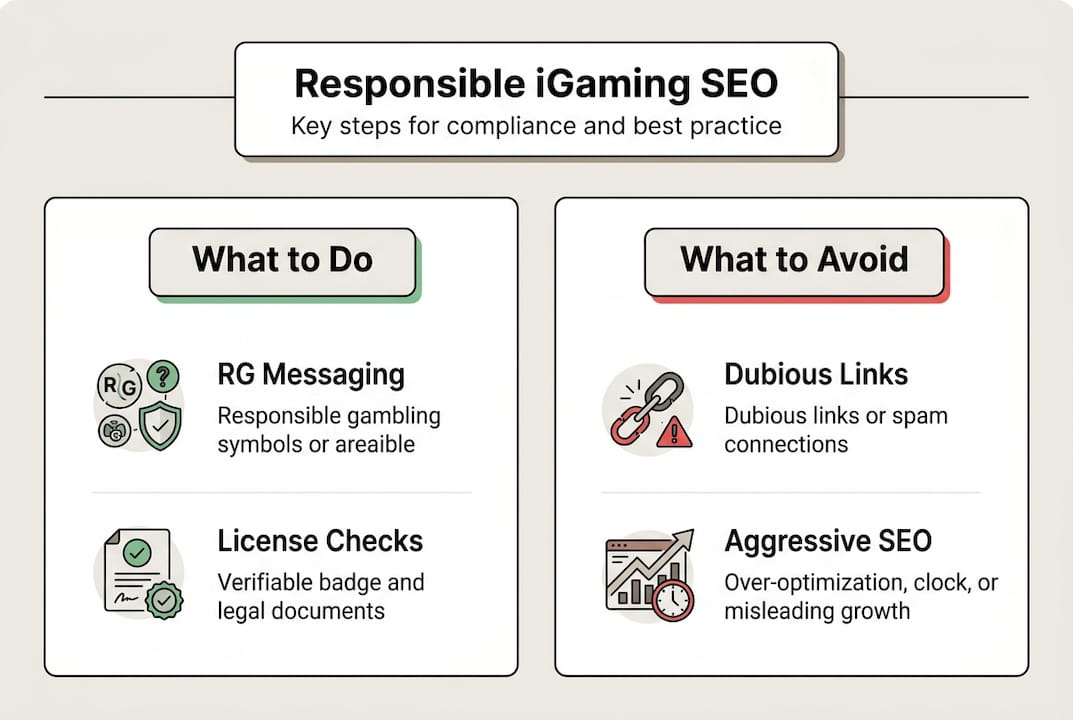
Responsible gambling messages must be prominent without disrupting user experience. A sticky banner with links to RG resources works well. In-content reminders should be brief and contextual, such as “Remember to gamble responsibly” after bonus descriptions. Avoid preachy or patronizing language. Players respond better to supportive, informative messaging than lectures.
Balancing promotional and responsible messaging is an art. Your content should inform, not manipulate. Highlight operator strengths honestly, but also note limitations. If a bonus has high wagering requirements, say so. Transparent reviews build trust and improve conversion quality. Players who understand what they’re signing up for are less likely to complain or request refunds, which protects your operator relationships.
| Tactic | Responsible approach | Risky approach |
|---|---|---|
| Keyword targeting | “Licensed casino reviews,” “RG tools” | “Guaranteed wins,” “easy money” |
| Link building | Industry publications, RG organizations | PBNs, link farms, unrelated directories |
| Bonus promotion | Clear T&Cs, wagering requirements disclosed | Hidden terms, exaggerated claims |
| Content tone | Informative, transparent, supportive | Urgent, manipulative, aggressive |
| Technical SEO | Mobile-first, HTTPS, accessibility | Slow load times, security gaps |
Pro Tip: Run A/B tests on RG messaging placement. Some players respond better to footer links, others to in-content reminders. Use heatmaps and session recordings to find the sweet spot where compliance meets user experience.
For step-by-step guidance on implementing these tactics, explore our affiliate SEO optimization steps and bonus feature SEO strategies to align promotional content with compliance standards.
Verifying compliance and optimizing results in responsible iGaming SEO
Ongoing audits are essential for maintaining compliance as regulations evolve. Schedule monthly reviews of your site’s RG messaging, licensing disclosures, and geo-targeting settings. Check that every promoted operator’s license is current and that no expired or revoked licenses appear on your site. Outdated licensing information is a red flag for both regulators and search engines.
Over 60% of iGaming markets enforce strict regulations, predictive models improve RG effectiveness, and precise intent alignment boosts rankings by 30%. Use behavioral data to identify potential problem gambling patterns. If certain pages show unusually high session durations or frequent return visits, consider adding extra RG prompts or self-assessment tools. Predictive models can flag at-risk behavior before it escalates, protecting both players and your site’s reputation.
Duplicate and thin content are compliance risks often overlooked. Regulators view duplicate content as an attempt to flood markets with promotional material, and search engines penalize it heavily. Every page must offer unique value. If you’re covering similar topics across multiple pages, differentiate them with unique angles, data, or regional focus. Thin content with minimal information and heavy affiliate links screams low quality and invites manual penalties.
Monitor ranking and traffic shifts closely. Sudden drops often correlate with regulatory changes or algorithm updates targeting iGaming sites. Use Google Search Console to track impressions, clicks, and average position. Cross-reference traffic changes with regulatory news from key markets. If rankings drop after a new law passes, audit affected pages immediately and adjust content to comply.
Regulatory landscapes shift constantly. Subscribe to industry newsletters, join iGaming compliance forums, and maintain relationships with legal experts. When regulations change, update your content proactively. Waiting for penalties or ranking drops is too late. Sites that adapt quickly maintain rankings and avoid disruptions. For example, when the UK tightened bonus advertising rules, compliant sites updated their content within days and maintained visibility, while slower competitors lost rankings for weeks.
Compliance verification checklist:
- Verify all operator licenses are current and match promoted jurisdictions
- Confirm RG messaging appears on every page with gambling content
- Check geo-targeting settings align with legal markets
- Review T&Cs links for visibility and accuracy
- Scan for duplicate or thin content across the site
- Analyze behavioral data for problem gambling indicators
- Cross-reference traffic drops with regulatory changes
- Update content to reflect new laws within 48 hours of announcement
| Metric | Monitoring frequency | Action threshold |
|---|---|---|
| License validity | Weekly | Immediate removal if expired/revoked |
| RG message presence | Monthly site audit | Add within 24 hours if missing |
| Geo-targeting accuracy | Bi-weekly | Fix within 48 hours if misdirected traffic detected |
| Duplicate content | Quarterly | Consolidate or differentiate within 2 weeks |
| Rankings/traffic | Daily | Investigate drops >10% within 24 hours |
| Regulatory updates | Daily news scan | Update content within 48 hours of law change |
Pro Tip: Set up Google Alerts for key regulatory terms like “iGaming regulation,” “gambling advertising rules,” and your target markets’ regulatory body names. This gives you early warning of changes before they impact your rankings.
For ongoing optimization and compliance monitoring, leverage our resources on SEO compliance importance and iGaming SEO bounce rate strategies to refine your approach based on performance data.
Enhance your iGaming SEO with expert guidance
Mastering responsible marketing in iGaming SEO requires specialized knowledge that generic SEO training can’t provide. Our coaching program equips you with frameworks designed specifically for regulated gambling markets, where compliance and rankings are inseparable. You’ll learn how to optimize for high-conversion keywords without triggering regulatory flags, build authority through compliant link acquisition, and track KPIs that matter in iGaming, like player lifetime value and responsible gambling engagement.
We dive deep into geo-specific strategies, showing you how to dominate SERPs in multiple jurisdictions while maintaining compliance. Our step-by-step affiliate SEO optimization guidance walks you through every stage, from keyword research to conversion optimization. Explore our comprehensive iGaming SEO strategies and SEO compliance resources to ensure your campaigns deliver sustainable growth without risking penalties.
Frequently asked questions
What is responsible marketing in SEO for iGaming?
Responsible marketing in iGaming SEO balances optimization goals with regulatory compliance and player protection. It incorporates responsible gambling messaging, transparent disclosures, and avoids misleading claims or aggressive tactics. This approach builds trust with both players and search engines, leading to sustainable rankings and conversions.
How can I ensure my SEO content complies with iGaming regulations?
Promote only licensed operators and localize content for each target market’s regulations and culture. Embed responsible gambling disclaimers and terms and conditions site-wide, making them prominent and easy to access. Employ compliance monitoring tools like Rightlander or GiG Comply to scan for violations and track regulatory changes in real time.
What SEO tactics should be avoided to maintain responsible marketing?
Avoid urgency messaging, aggressive bonus hype, or any language implying guaranteed wins or outcomes. Don’t target prohibited jurisdictions or use deceptive keywords that manipulate player intent. Steer clear of thin, duplicate, or volume-based content that prioritizes quantity over quality and compliance.
Why is E-E-A-T important for responsible marketing in iGaming SEO?
E-E-A-T signals the trust and expertise required for YMYL gambling content, directly influencing rankings. It demonstrates your site’s authority through author credentials, transparent disclosures, and responsible gambling resources. Strong E-E-A-T helps avoid penalties, builds player confidence, and secures long-term visibility in competitive SERPs.