

TL;DR:
- Many casino operators overlook user intent alignment, which can boost organic traffic and conversion rates simultaneously. Properly matching content to search intent reduces compliance risks and improves rankings, bounce rates, and user trust. Building an intent-driven site structure and dedicated responsible gambling hubs maximizes SEO, regulatory compliance, and user satisfaction.
Most casino operators obsess over keyword volume while leaving one of the most powerful ranking levers completely untouched: user intent alignment. Aligning your content with the exact reason someone is searching can simultaneously lift organic traffic, improve conversion rates, and reduce compliance friction in one move. Intent-aligned responsible gambling content can function as both a compliance asset and an SEO asset, which means the same strategic effort pays dividends across your legal and marketing teams. This guide walks iGaming marketers, affiliates, and operators through every layer of that opportunity.
Table of Contents
- Why user intent is mission-critical in casino SEO
- The three pillars: Navigational, transactional, and informational intent
- How to align your casino site with user intent
- Responsible gambling content: The intent-alignment compliance win-win
- Perspective: Why user intent is the missing multiplier in casino SEO
- Power your casino SEO growth with intent-driven strategies
- Frequently asked questions
Key Takeaways
| Point | Details |
|---|---|
| Three user intents | Navigational, transactional, and informational intent shape casino SEO content and conversion. |
| Intent cannibalization risk | Overlapping pages weaken SEO—consolidate needs by intent buckets and cornerstone content. |
| Technical audits matter | Fixing crawl/URL issues plus intent mapping drives the biggest SEO gains in casinos. |
| Responsible gambling synergy | Intent-aligned compliance content boosts rankings while lowering regulatory hassles. |
| Evolve with user needs | Regularly review intent alignment to stay ahead in competitive iGaming SEO. |
Why user intent is mission-critical in casino SEO
Casino SEO is not a keyword volume game. It never really was, but Google’s continued investment in understanding search behavior makes intent alignment more consequential than ever. Every query that lands on your site carries a purpose. When your page matches that purpose perfectly, rankings improve, bounce rates drop, and players convert. When there’s a mismatch, you lose the click, the conversion, and sometimes the compliance reviewer’s trust.
Relevancy in iGaming SEO begins with understanding what a user actually wants to accomplish. Google categorizes this at a granular level, and it directly influences which pages rank and which ones get filtered out of competitive SERPs.
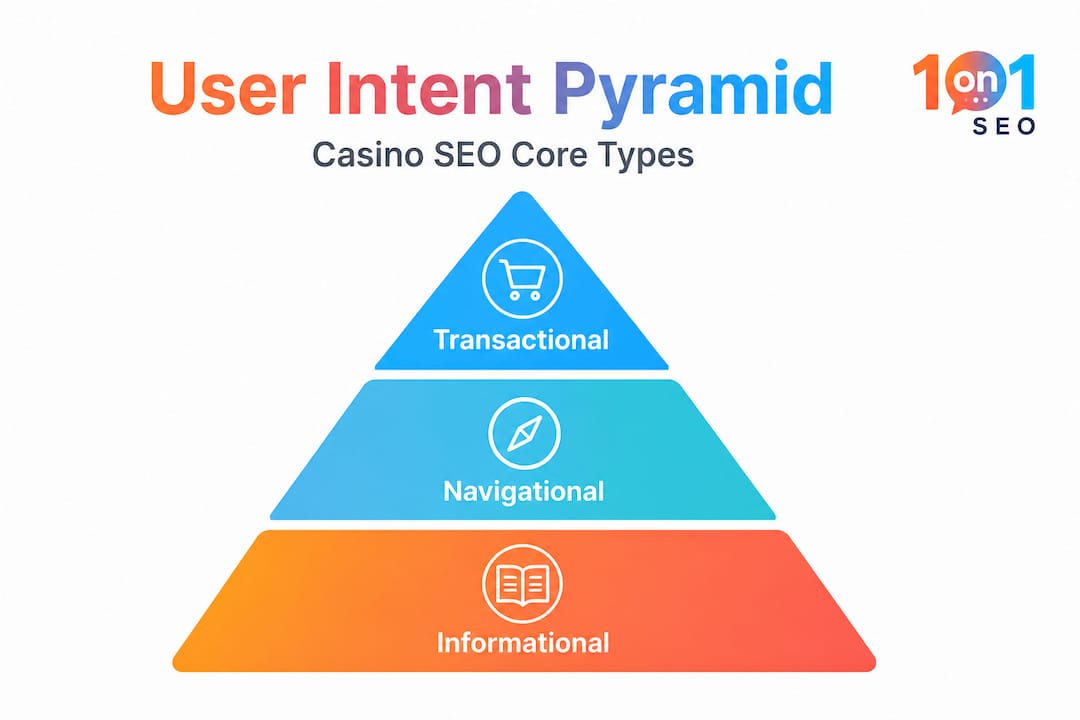
There are three core intent categories that matter for casino SEO:
| Intent type | User goal | Casino SEO implication |
|---|---|---|
| Navigational | Find a specific brand or page | Brand protection, login pages, app landing pages |
| Transactional | Take an action or make a decision | Bonus pages, deposit flows, game launches |
| Informational | Learn something specific | RTP guides, strategy content, responsible gambling hubs |
Each category demands a completely different content structure, call to action, and even compliance approach. Cramming a deposit bonus pitch into an informational slot guide, for example, confuses both the user and the algorithm. It also creates regulatory risk in markets where promotional content must be clearly separated from educational material.
“Mapping keywords to user intent categories is foundational in iGaming SEO, with navigational, transactional, and informational queries each driving distinct ranking and conversion outcomes.”
Sites that ignore these distinctions end up with pages that rank for nothing specific, serve no one clearly, and frustrate compliance auditors who cannot determine what purpose a page actually serves.
The three pillars: Navigational, transactional, and informational intent
Now that we’ve defined why user intent matters, let’s break down the three core types that every casino should target—and avoid mixing.
Navigational intent is when a user already knows where they want to go. Keywords like “bet365 login,” “DraftKings sports app,” or “PokerStars account” signal brand loyalty or existing familiarity. The landing page goal here is speed and directness. Friction kills performance. If your navigational pages load slowly, have pop-ups, or redirect through affiliate tracking layers, you’re damaging both the user experience and your ranking signal. Compliance needs here are relatively low, but brand consistency and legal disclaimers still apply.
Transactional intent is where casino revenue lives. Queries like “free spins no deposit” or “best welcome bonus UK 2026” signal a user who is ready to act. These pages need clear CTAs, prominent bonus terms, fast load speeds, and verified promotional claims. This is also where compliance risk is highest. Misleading bonus terms on transactional pages have triggered regulator action in multiple jurisdictions. Every claim must be accurate, evergreen or dynamically updated, and geographically appropriate.

Informational intent covers the research phase. Searches like “what is RTP in slots” or “how does live dealer blackjack work” come from players who are learning, comparing, or evaluating options. These pages should educate without hard-selling. Done right, they build trust and feed users into transactional flows later. Done wrong, they become compliance liabilities when operators try to force promotional content into educational articles.
Here’s a practical framework to apply across all three intent types:
- Identify the primary intent behind each target keyword before you assign it to a page.
- Audit every existing page to determine whether its content matches the intent it’s currently ranking for.
- Strip promotional language from informational pages and educational framing from transactional ones.
- Add intent-specific trust signals: bonus terms on transactional pages, expert authorship on informational ones.
- Monitor search result pages (SERPs) regularly to detect when Google shifts its interpretation of a query’s intent.
Pro Tip: If Google is ranking review pages for a query you’re targeting with a bonus landing page, that’s a strong signal the SERP has informational intent. Pivot the page format or create a separate asset targeting that angle.
Responsible marketing in iGaming SEO adds another layer here. Each intent type carries different requirements for how and where responsible gambling messaging appears. Transactional pages in regulated markets typically require prominent problem gambling links. Informational content can integrate harm reduction messaging more naturally into the body copy, which is better for both UX and compliance.
How to align your casino site with user intent
Understanding these intent types is only half the battle. The real impact comes from aligning your site architecture and pages with user needs.
The most common problem we see during technical audits is intent misalignment baked deep into a site’s structure. A single domain may have dozens of pages all targeting variations of “online slots,” but with wildly different content types: a bonus offer page, a game lobby, a strategy article, a FAQ, and a review. Google struggles to determine which one to surface, and users land on the wrong page for their needs. This is the core of intent cannibalization.
“Intent cannibalization is more serious than keyword cannibalization” because it fragments the user journey and splits authority across pages that should be working together toward a single goal.
The fix is a structured content silo approach:
- Run a full SEO content audit to categorize every page by its current intent signal, not what you intended when you published it.
- Map your keyword targets to clear intent buckets. Each bucket corresponds to one primary page type: navigational, transactional, or informational.
- Consolidate competing pages. If three informational pages all target “slots RTP,” merge the best content into one authoritative hub and redirect the others.
- Restructure internal linking so navigational pages point deeper into the funnel, informational pages link to related informational content and relevant transactional pages, and transactional pages include compliant terms without leaking authority outward.
- Resolve technical SEO issues that mask intent signals: duplicate content, crawl traps, thin pages with mixed messaging, and slow load times all dilute the clarity of your intent architecture.
- Track ranking movement and user behavior post-cleanup. SEO recovery case studies confirm that technical cleanup combined with intent alignment drives the largest measurable ranking gains.
One area where common SEO mistakes in iGaming surface most often is in over-optimizing transactional pages for informational keywords. An operator sees high search volume for “how to play roulette” and adds a spin to “play roulette now for free.” The page ends up serving neither intent well and converts poorly on both.
Pro Tip: Use a simple spreadsheet to track each page’s primary keyword, its assigned intent type, and its current bounce rate. Pages with high bounce rates are almost always suffering from intent mismatch, not just poor copy or slow speed.
Responsible gambling content: The intent-alignment compliance win-win
A special case of user intent alignment is responsible gambling content, where the upside goes far beyond SEO traffic.
Users searching for “how to set deposit limits,” “self-exclusion options,” or “problem gambling help” have a very specific informational need. They are not browsing. They are looking for clear, credible, actionable information. If your site does not have a well-structured hub that answers these queries directly, you are missing both an SEO opportunity and a regulatory obligation in most licensed markets.
The results from building intent-aligned responsible gambling hubs are striking. One regional casino saw organic sessions rise +78% after launching a structured hub, bounce rate fell 39%, and support calls about limits dropped 21%. That final metric matters enormously to operations teams dealing with regulatory reporting.
Here’s what an effective responsible gambling content hub looks like in practice:
- Dedicated URL structure: A standalone hub like "/responsible-gambling/` that search engines can index independently.
- Intent-specific sub-pages: Separate pages for self-exclusion, deposit limits, reality checks, and support resources. Each targets a distinct informational query.
- Medically reviewed content: Adding a qualified reviewer to the byline improves both E-E-A-T signals and regulatory standing.
- Interactive tools: Self-assessment quizzes and limit calculators dramatically increase engagement and session depth, which reduces bounce rate.
- Clear, prominent CTAs: Links to GamCare, BeGambleAware, and national helplines must be easy to find. Burying them is a compliance risk and a UX failure.
Intent-aligned responsible gambling content is not just a legal checkbox. It is a measurable SEO asset that earns trust from users, regulators, and search engines simultaneously.
Building this content also feeds directly into SEO risk mitigation strategies that protect rankings during algorithm updates. Google’s helpful content system rewards pages that serve a genuine user need over pages that exist primarily to capture organic traffic. A responsible gambling hub built for users, not algorithms, passes that test easily.
For operators expanding into new markets, international casino SEO adds another dimension. Each jurisdiction has different responsible gambling requirements, and localizing your hub pages for those requirements doubles their value: they satisfy local compliance standards while also targeting market-specific informational queries.
Perspective: Why user intent is the missing multiplier in casino SEO
Here’s a view that most SEO playbooks will not say out loud: the majority of casino operators are not losing rankings because of weaker links or thinner budgets. They’re losing because they’ve built sites that confuse users and algorithms with the same content.
We’ve audited large iGaming sites where over 60% of pages had a measurable intent mismatch. The operator was investing heavily in new content and link acquisition while the foundational architecture was actively working against them. Cleaning up that intent confusion, not adding more content, was what moved the needle in winning ranking strategies.
The other thing experienced operators still miss is the pace at which intent evolves. A query like “best crypto casino 2026” carries different intent signals today than it did 18 months ago. The SERP has shifted from pure review content toward comparison tools and crypto-specific guides. Operators who monitored that shift early captured significant organic market share. Those who didn’t are still wondering why their evergreen reviews stopped ranking.
The third blind spot is organizational. SEO teams and compliance teams rarely sit in the same planning meeting. This separation means SEO teams optimize for visibility while compliance teams review content after publication. By the time compliance flags an issue, the page has already been live, indexed, and potentially flagged by regulators. Bringing compliance into the content planning stage, before a single word is written, is not a bottleneck. It’s the most efficient workflow a casino marketing team can run.
User intent is not a one-time audit item. It is a continuous signal that the market sends you. The sites that read it well, and update their architecture accordingly, are the ones that dominate competitive SERPs year after year.
Power your casino SEO growth with intent-driven strategies
If this guide has made one thing clear, it’s that intent alignment is not a minor optimization. It’s the strategic foundation that makes every other SEO tactic work harder. Stronger links, better content, cleaner technical structure: all of these compound when built on an intent-aligned architecture. Without it, you’re adding floors to a building with a cracked foundation.
Our iGaming SEO strategies are built specifically for the regulated, high-stakes environment where casino, betting, and affiliate brands compete. From intent mapping to geo-specific content architecture, we help you execute the strategies covered in this guide with the precision the iGaming space demands. Explore our advanced ranking strategies to see how intent alignment fits into a full-funnel SEO approach, and reference the casino SEO glossary to ensure your team is working with a shared, precise vocabulary. The competitive edge is there. It starts with intent.
Frequently asked questions
What are the three main types of user intent in casino SEO?
Navigational, transactional, and informational intent each require different content formats and conversion approaches. Mapping keywords to intent categories is foundational to any effective iGaming SEO strategy.
How does intent alignment improve regulatory compliance?
When content matches the intent of the query, especially for responsible gambling topics, it reduces confusion and operational friction. A structured intent-aligned hub dropped support calls by 21% and reduced regulatory inquiries by 68%.
What is intent cannibalization in casino SEO?
Intent cannibalization happens when multiple pages on your site compete for the same user need, splitting authority and diluting conversion signals. Intent cannibalization is more damaging than traditional keyword cannibalization because it fractures the entire user journey.
What practical steps align casino content with user intent?
Start with a full content audit, then map every keyword to a clear intent bucket, consolidate competing pages, and fix technical issues that dilute intent signals. Technical and intent cleanup combined produce the largest measurable SEO recovery gains.
Why should responsible gambling content be a priority?
It drives genuine organic growth and satisfies regulatory requirements at the same time, making it one of the highest-ROI content investments a casino can make. Organic sessions rose 78% for a casino that built an intent-aligned responsible gambling hub.