

Casino SEO has never been a simple game of keyword stuffing and link building. Google’s quality raters now scrutinize gambling sites more aggressively than almost any other vertical, and sites with anonymous authors or thin affiliate content face ranking penalties that can wipe out months of traffic overnight. E-A-T, which stands for Experience, Expertise, Authoritativeness, and Trustworthiness, is no longer a bonus signal for casino brands. It’s the foundation. This guide breaks down what E-A-T actually means in regulated iGaming markets, how to build it systematically, and what to measure so your rankings hold up through every algorithm update.
Table of Contents
- What E-A-T means for casino SEO
- Why trust and authority matter in highly regulated markets
- Building E-A-T: Practical steps for iGaming marketers
- Common E-A-T pitfalls in casino SEO and how to avoid them
- Measuring and optimizing E-A-T for ongoing casino SEO success
- Our take: What most casino SEOs overlook about E-A-T
- Turbo-charge your casino SEO with E-A-T specialists
- Frequently asked questions
Key Takeaways
| Point | Details |
|---|---|
| E-A-T is non-negotiable | Google strictly enforces E-A-T for online casino sites, especially in regulated markets. |
| Transparency and compliance win | Sites with clear author info and local compliance perform best in casino SEO. |
| Ongoing audits needed | Continuous monitoring and improvement of E-A-T signals are necessary for long-term rankings. |
| Avoid common pitfalls | Mistakes like anonymous content or overpromising wins can quickly tank your rankings. |
| Real expertise pays off | Investing in genuine authority and expert content differentiates winning casino SEOs from the rest. |
What E-A-T means for casino SEO
E-A-T is Google’s framework for evaluating whether a page genuinely serves users or just exists to capture clicks. For casino sites, this framework carries extra weight because gambling falls into the YMYL category, short for “Your Money or Your Life.” YMYL pages can directly affect a user’s financial wellbeing, so Google holds them to a stricter standard than a recipe blog or travel guide.
Understanding the four pillars is the starting point for any serious E-E-A-T for casino industry strategy:
- Experience: Has the author actually played the games or used the platform they’re reviewing? First-hand experience now matters as a ranking signal.
- Expertise: Do your writers and editors have verifiable credentials in gambling, finance, or regulation?
- Authoritativeness: Are reputable third parties citing your site, linking to it, or referencing your brand?
- Trustworthiness: Is your site transparent about ownership, licensing, terms, and responsible gaming?
“Ignoring jurisdiction-specific regulations signals low trust” and directly undermines your E-A-T score in the eyes of Google’s quality raters. (source)
Common pitfalls include publishing generic bonus comparison tables with no author attribution, skipping age verification disclosures, and failing to update content when licensing rules change. Every one of these gaps is a trust signal that Google’s systems can detect. If you’re unclear on the terminology, the casino SEO glossary is a solid reference point for getting the definitions right before you audit your site.
Recent core updates, including the 2024 and early 2026 quality-focused rollouts, have made E-A-T foundational rather than supplementary. Sites that ignored it are now playing catch-up, often from a dramatically lower ranking position.
Why trust and authority matter in highly regulated markets
Once you understand what E-A-T is, the next question is why it hits harder in iGaming than in most other niches. The answer is regulatory pressure combined with user vulnerability. Casino players are making real financial decisions, and Google knows it.
Explicit trust signals that Google’s quality raters look for in casino content include:
- Visible company registration and licensing information
- Clear, jargon-free terms and conditions
- Responsible gaming links and self-exclusion options
- Named authors with verifiable industry backgrounds
Here’s a direct comparison of how E-A-T levels translate to SEO outcomes:
| Signal | Low E-A-T site | High E-A-T site |
|---|---|---|
| Author transparency | Anonymous or generic bylines | Named experts with bios and credentials |
| Regulatory compliance | Missing or outdated licensing info | Current license numbers, jurisdiction-specific pages |
| Content depth | Thin bonus tables, no context | Tested reviews, odds analysis, player guides |
| Link profile | Low-quality directories | Industry publications, regulatory bodies |
| SERP outcome | Suppressed or penalized | Stable rankings, featured snippets |
The data is clear: sites that overpromise wins harm their own trustworthiness score, which feeds directly into lower rankings. Claiming “guaranteed jackpots” or “100% win rates” doesn’t just violate advertising standards in most jurisdictions. It tells Google your content is unreliable.

Building search engine trust in a regulated market means treating compliance as an SEO asset, not a legal checkbox. Every license badge, every responsible gaming footer, and every accurate odds disclosure is a positive signal.
Building E-A-T: Practical steps for iGaming marketers
Knowing the theory is one thing. Executing it on a live casino or affiliate site is another. Here’s a practical workflow you can start applying this week.
- Create expert author profiles. Every piece of content needs a named author with a bio that lists their gambling industry experience, credentials, and any regulatory knowledge. Link those bios to LinkedIn profiles or industry publications for external verification.
- Audit your content for first-hand experience. Google now rewards content that shows the author actually used the product. Add screenshots, personal observations, and specific details that only someone who tested the platform would know.
- Earn authoritative citations. Reach out to gambling news outlets, regulatory bodies, and industry associations for mentions and links. A single link from a licensed gambling authority is worth more than fifty directory submissions.
- Display compliance signals prominently. License numbers, responsible gaming logos, and age restriction notices should appear in your header or footer on every page, not buried in a terms page.
- Review your privacy policy and terms. These documents must be current, jurisdiction-specific, and written in plain language. Vague or templated legal pages are a red flag for quality raters.
- Test every affiliate recommendation yourself. Thin affiliate content without testing is demoted by Google’s systems, so document your testing process and include it in your reviews.
Pro Tip: Run your top 10 pages through Google’s Search Quality Evaluator Guidelines checklist before publishing. If a human quality rater would flag the page for low trust, Google’s algorithm likely will too. You can find practical frameworks for improving E-E-A-T that map directly to casino content requirements.
Common E-A-T pitfalls in casino SEO and how to avoid them
Even experienced iGaming marketers make E-A-T mistakes that quietly erode rankings over time. Recognizing the symptoms early is the fastest way to course-correct.
| Pitfall | SEO symptom | Quick fix | Long-term safeguard |
|---|---|---|---|
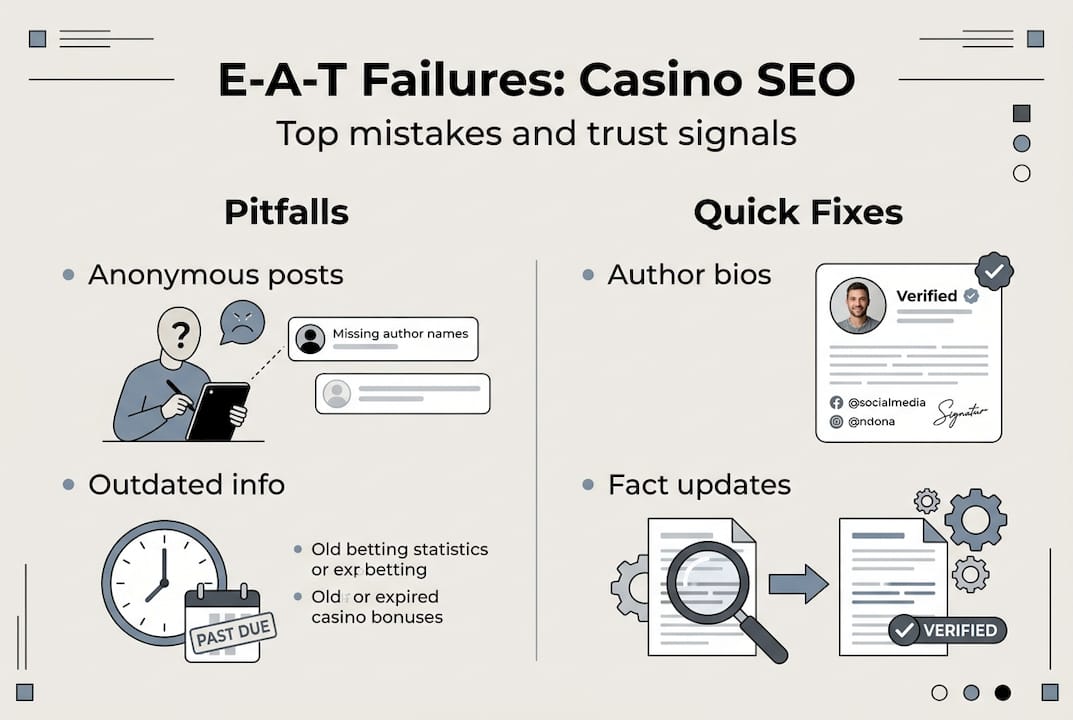
| Anonymous content | Ranking drops after core updates | Add author bios immediately | Hire or credential named writers |
| Unsubstantiated promos | Quality rater flags, manual actions | Remove or qualify all claims | Build a compliance review process |
| Ignoring local regulations | Geo-specific ranking losses | Add jurisdiction pages | Assign a compliance editor per market |
| Outdated licensing info | Trust score erosion | Update license numbers and dates | Schedule quarterly compliance audits |
| Generic bonus tables | Low dwell time, high bounce | Add context, testing notes, and comparisons | Shift to in-depth tested reviews |
Anonymous authors and generic content can lead to severe demotion, particularly after broad core updates that specifically target YMYL verticals. The fix isn’t complicated, but it does require commitment.
Here are the most impactful corrections you can make right now:
- Replace every anonymous byline with a named, credentialed author
- Add a “how we review” methodology page that explains your testing process
- Audit all promotional claims against the advertising standards of each jurisdiction you target
- Cross-reference your content against the E-A-T glossary to ensure you’re using accurate terminology
The pattern behind most E-A-T failures is the same: operators treat content as a volume game rather than a credibility game. One well-researched, transparently authored review outperforms ten generic bonus tables every time.
Measuring and optimizing E-A-T for ongoing casino SEO success
Avoiding mistakes is important, but continuously monitoring and improving E-A-T is what separates stable long-term rankings from volatile ones. E-A-T isn’t a one-time setup. It’s a living system.
Key metrics to track:
- Brand mentions. Use tools like Ahrefs or Semrush to monitor unlinked mentions of your brand across gambling forums, news sites, and regulatory publications. Growing mentions signal rising authority.
- Link profile quality. Track the ratio of high-authority gambling and finance domains linking to you versus low-quality directories. Quality beats quantity every time.
- Author disclosure rate. Audit what percentage of your published pages have named, credentialed authors. Aim for 100%.
- Review sentiment. Monitor player reviews on Trustpilot and similar platforms. Negative patterns around trust or fairness will eventually surface as ranking signals.
- Compliance currency. Set calendar reminders to review licensing information, responsible gaming links, and jurisdiction-specific content every quarter.
Thin content and lack of transparency are ongoing ranking risks, not problems you solve once and forget. Every major algorithm update in the YMYL space has targeted exactly these weaknesses.
For tracking site trust over time, build a simple monthly dashboard that captures brand mentions, new authoritative links, author coverage percentage, and any compliance changes in your target markets. Review it after every major Google update and adjust your content calendar accordingly.
Our take: What most casino SEOs overlook about E-A-T
Here’s the uncomfortable truth most casino SEO guides won’t tell you: the majority of E-A-T failures aren’t technical. They’re cultural. Teams chase volume because volume feels productive. Publishing 50 bonus pages a month looks like progress on a spreadsheet. But Google’s quality systems are increasingly good at detecting the difference between content created to serve users and content created to capture rankings.
Regulated markets reward patience and genuine credibility. The operators and affiliates we see holding top positions through multiple core updates share one trait: they invested in real expertise before they needed it. They hired writers who actually gamble. They built relationships with compliance consultants. They treated their author bios as seriously as their backlink profiles.
Shifting from volume publishing to expert-driven content isn’t a slow strategy. It’s actually faster in regulated markets because the competition is still playing the old game. When you boost brand authority through genuine credibility signals, you build a moat that templated content farms simply can’t cross.
Turbo-charge your casino SEO with E-A-T specialists
Putting E-A-T principles into practice across a live casino or affiliate site takes more than a checklist. It takes frameworks built specifically for regulated iGaming markets. At 1on1 SEO, we work with casino brands, affiliates, and sportsbook operators who are ready to compete on credibility, not just content volume. Our coaching covers iGaming SEO strategies designed for high-stakes SERPs, including geo-specific compliance, expert content workflows, and authority-building link acquisition. Whether you’re scaling an affiliate program or managing a licensed operator’s organic channel, our affiliate SEO steps and E-E-A-T brand authority frameworks give you a clear path to sustainable rankings. Let’s build something Google trusts.
Frequently asked questions
What does E-A-T stand for in casino SEO?
E-A-T stands for Experience, Expertise, Authoritativeness, and Trustworthiness, the four factors Google uses to evaluate whether a casino site deserves to rank. E-E-A-T is critical for online casino SEO success because gambling is classified as a YMYL niche.
How does E-A-T impact casino affiliate sites?
Affiliate sites with unnamed authors and untested content consistently rank lower than those with credentialed writers and documented review processes. Thin affiliate content is actively demoted in search, especially after core updates targeting YMYL verticals.
Can ignoring local regulations hurt my casino SEO E-A-T?
Yes, absolutely. Failing to address jurisdiction-specific compliance, such as missing license numbers or absent responsible gaming disclosures, directly signals low trust and reduces your visibility in those markets.
What are quick ways to boost E-A-T for a casino site?
Add detailed author bios with verifiable credentials, display compliance badges prominently, and audit every promotional claim for accuracy against the advertising standards of your target jurisdictions.
Is E-A-T a one-time setup or ongoing process for casino SEO?
E-A-T is an ongoing process. Continuous content and trust audits are necessary to maintain rankings as Google updates its quality systems and regulatory requirements shift across markets.