

TL;DR:
- Casino site crawlability is crucial to ensure all pages are indexed and ranked properly in competitive SERPs. Technical issues like JavaScript rendering failures, bloated sitemaps, and deep site architecture hinder Googlebot’s access, leading to lost visibility. Ongoing governance, proper site structure, and server-side rendering are essential for scalable, high-performance casino SEO.
Casino site crawlability is the silent variable behind most iGaming ranking failures. While operators obsess over content and backlinks, Googlebot is quietly skipping thousands of pages because of bloated sitemaps, JavaScript-locked game lobbies, and age-gate configurations that block rendering entirely. The result is incomplete indexation, diluted authority, and rankings that never materialize despite solid content investment. This guide cuts through the noise and gives you a precise, technical roadmap for making every corner of your casino site crawlable, indexable, and competitive in high-stakes SERPs.
Table of Contents
- Key takeaways
- Casino site crawlability challenges
- Site architecture and internal linking for crawl efficiency
- JavaScript, page speed, and Core Web Vitals
- Crawl control and indexation strategies
- What I have learned about casino crawlability the hard way
- Take your casino SEO beyond the basics
- FAQ
Key takeaways
| Point | Details |
|---|---|
| LCP thresholds trigger deindexing | Slot pages with LCP above 4.0 seconds face silent exclusion from Google’s index. |
| Architecture depth controls crawl coverage | Keeping key pages within 3 clicks of the homepage directly resolves indexation gaps. |
| JavaScript must be rendered server-side | Dynamic game lobbies require SSR or static generation for Googlebot to access content. |
| Index bloat kills crawl budget | Canonical tags and noindex directives on filter and parameter URLs protect your crawl allocation. |
| Automated audits prevent regression | Scheduled monitoring catches technical drift before it compounds into ranking losses. |
Casino site crawlability challenges
Casino websites are structurally unlike any other category in search. A mid-size operator can have 50,000 to 200,000 URLs generated by game libraries, promotional pages, regional variants, filter combinations, and affiliate tracking parameters. That scale creates crawl problems that no generic technical SEO checklist addresses.
The core challenges you are dealing with include:
- Game library URL sprawl. A single game title can generate dozens of URL variants through demo modes, jurisdictional landing pages, and parameter-based filtering. Most of those URLs add no unique indexable value.
- High content velocity. Promotions rotate weekly. Bonus terms update constantly. Odds change in real time. That frequency strains crawl budgets because Googlebot re-crawls modified pages at a higher rate, pulling resources from deeper, higher-value content.
- Mobile-first indexing penalties. LCP above 4.0 seconds causes silent deindexing of slot pages, and 89% of sites exceeding that threshold had 15% of their pages excluded from the index.
- JavaScript rendering failures. Dynamic game lobbies and live odds widgets built entirely in client-side JavaScript are invisible to Googlebot until it queues a second-wave rendering pass, which may never happen at scale.
- Regulatory crawl restrictions. Age gates, geoblocking scripts, and compliance popups are often configured in ways that block rendering entirely, preventing Googlebot from accessing the content sitting behind them.
- Index bloat from low-value pages. Pagination, session IDs, and filter URLs accumulate silently, consuming crawl budget without contributing a single ranking signal.
Casino SEO is uniquely vulnerable to ranking volatility caused by this exact combination of rapid content updates and massive URL generation. Fixing it requires a deliberate architecture and governance approach, not ad hoc patches.
Site architecture and internal linking for crawl efficiency
The most efficient thing you can do for casino site indexing is make your site architecture work like a crawl map. Every structural decision either guides Googlebot toward your highest-value pages or lets it waste budget on irrelevant URLs.
Start with your URL hierarchy. Organize game categories, jurisdictions, and promotional content into clean, keyword-rich paths. A structure like "/en-gb/slots/megaways/` tells both Googlebot and users exactly where they are and what the page covers. When you layer in jurisdiction segmentation, you create a foundation for international SEO that prevents duplicate content issues across regulated markets.
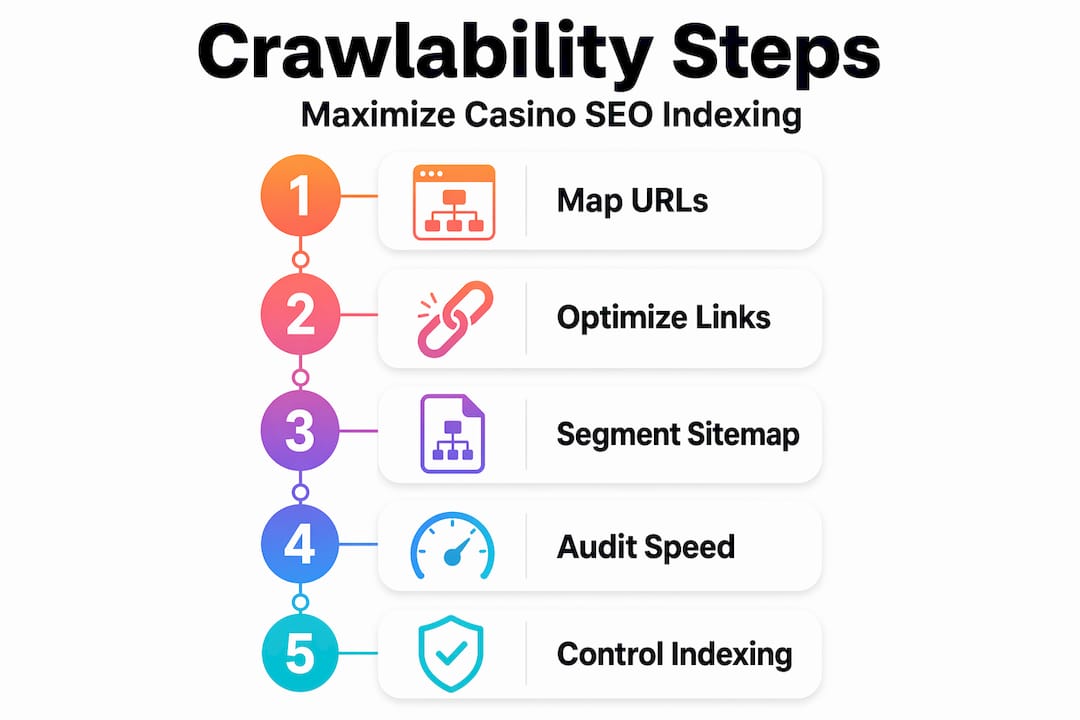
Your XML sitemaps should reflect the pages you actually want indexed, nothing more. Exclude any URL tagged with noindex, thin promotional pages with short shelf lives, and parameter-based variants. A bloated sitemap signals to Google that you have poor quality control, and it will crawl your site accordingly.
Internal linking is where most casino operators leave authority on the table. 3 to 5 contextual links per 1,000 words with varied anchor text is the benchmark for pushing authority from informational content toward commercial game and deposit pages. Most sites use generic “play now” links that do nothing for topical relevance. A guide on Megaways mechanics should link to your Megaways game category with anchor text that reflects the search intent of the surrounding paragraph.
Canonical tags and noindex directives need systematic deployment, not manual spot-checks. Every filter URL, every paginated game lobby page, and every parameterized affiliate tracking URL should either be canonicalized to its parent or marked noindex.
Cutting crawl depth from 10 or more clicks down to 3 levels from the homepage resolves indexation problems for category and collection pages directly. If your live casino section is buried 8 clicks deep, it is functionally invisible to Google’s crawler.

Pro Tip: Segment your XML sitemap by content type: one for game pages, one for promotional content, one for informational articles. Submit them separately in Google Search Console and monitor crawl rates individually. This tells you exactly where Googlebot is spending its budget and where it is not bothering at all.
The payoff for getting architecture right is not incremental. Indexed pages can jump from 1,500 to over 8,200 after cleaning sitemaps and fixing JavaScript navigation, with crawl coverage expanding to over 145,000 URLs. That is not a marginal improvement. That is a structural unlock.
For a deeper look at scaling crawl efficiency across large iGaming properties, the technical principles compound quickly when you apply them systematically.
JavaScript, page speed, and Core Web Vitals
This is the section most casino SEO guides handle superficially. The reality is that JavaScript rendering is the single biggest crawlability threat on modern casino platforms, and it intersects with Core Web Vitals in ways that will cost you rankings silently.
Googlebot must render JavaScript to access dynamic game lobbies and live odds. The problem is that client-side rendering delays Googlebot’s ability to see your content until a second rendering pass, which happens in a queue that can be days behind the initial crawl. Server-side rendering or static generation at initial load is the only reliable fix. For live odds and jackpot counters specifically, SSR with dynamic rendering ensures that time-sensitive content is available on the first crawl request.
On page speed, the LCP target for casino pages is under 2.5 seconds. Slot game pages in particular carry heavy iframe loads, autoplay preview videos, and third-party game provider scripts that compound load times quickly. Three specific techniques reduce LCP meaningfully:
- Replace autoplay iframe embeds with click-to-play thumbnail buttons that load the actual iframe only on user interaction
- Lazy load iframes that appear below the fold so they do not contribute to initial load weight
- Defer all non-critical third-party scripts and preload your Largest Contentful Paint element explicitly in the HTML head
Blocking Googlebot from CSS or JavaScript files is a crawlability error that looks invisible from the front end but destroys your index coverage. Verify your robots.txt is not disallowing access to any CSS, JS, or font resources. Age-gate modals configured incorrectly blind Googlebot entirely. The fix is to configure age verification so that it is visible to actual users but renders transparently for verified crawler user-agents, a setup that requires specialist configuration to stay compliant.
Pro Tip: Use Google Search Console’s URL Inspection tool to render your most important game category pages as Googlebot sees them. If rendered screenshots show incomplete content, missing navigation, or blank sections where game tiles should appear, you have a JavaScript rendering problem that is actively costing you indexed pages.
For operators managing mobile-first indexing across their casino portfolio, the mobile Core Web Vitals thresholds are applied to your mobile version first, and that is the version Google indexes.
Crawl control and indexation strategies
Getting your crawl controls right requires a mix of robots.txt discipline, pagination management, international SEO structure, and schema markup. Each element protects your crawl budget and strengthens the quality signal your site sends to Google.
Here is how to approach each layer:
- Robots.txt targeting. Block user-account pages, login flows, affiliate tracking paths, and internal search result URLs. These generate thousands of low-value or duplicate pages that waste crawl budget without any indexation benefit.
- Infinite scroll management. Game lobbies that use infinite scroll are crawl traps by default. Implementing paginated URL patterns and the History API as a fallback gives Googlebot discrete URLs to crawl and follow, turning an infinite scroll trap into a crawlable, indexable sequence.
- Hreflang for multi-regional operators. Incorrect or missing hreflang tags on geo-segmented casino sites create duplicate content problems across every regulated jurisdiction you operate in. Correct hreflang implementation tells Google which version to serve in which market, protecting both your crawl budget and your authority distribution.
- Schema markup. Article and Organization schema with proper
authoranddatePublishedfields improves trust signals for YMYL content. Never use self-assigned star ratings in Review schema on gambling pages. Google’s quality standards for YMYL gambling content make schema compliance a ranking factor, not just a rich result opportunity.
The table below compares crawl control approaches by use case:
| Scenario | Recommended control | Expected outcome |
|---|---|---|
| Filter URL variants | Canonical to parent page | Prevent index bloat, consolidate authority |
| Paginated game lobby | Paginated URLs with History API fallback | Full crawl coverage of all game tiles |
| Affiliate tracking parameters | Robots.txt disallow or URL parameter handling | Protect crawl budget, no duplicate pages |
| Geo-variant pages | Hreflang tags per jurisdiction | Correct regional indexation, no duplication |
| Expired promotions | Noindex or 301 redirect | Remove low-value pages, preserve link equity |
Canonical and noindex controls need to be applied aggressively to prevent crawl budget traps from parameter-driven URLs. And structured data that includes rich result opportunities beyond basic schema can give casino pages a competitive visibility edge in SERPs when implemented correctly.
Schedule technical audits at a minimum monthly cadence. Broken links, redirect chains, and outdated sitemap entries accumulate fast on high-velocity casino properties. Each one is a small drag on crawl efficiency that compounds over time.
What I have learned about casino crawlability the hard way
I have worked on casino site technical SEO long enough to know that the biggest crawlability failures are rarely caused by a single mistake. They come from compounding neglect: a JavaScript navigation change that quietly drops 3,000 pages from the index, a robots.txt update that blocks CSS files for four months before anyone notices, a sitemap that still lists 800 expired bonus pages.
The operators who solve this consistently are not the ones who run the best one-time audit. They are the ones who have automated monitoring and governance baked into their workflow. Crawl stats, indexation rates, and Core Web Vitals get reviewed on a schedule, not when rankings drop.
There is also a trust dimension that most casino SEO guides treat as separate from crawlability. It is not. Sites without named authors took significant traffic losses after Google’s 2026 quality updates, while sites with clear authorship attribution gained. Google’s quality raters and algorithms treat named authorship as a trust signal for YMYL content, and trust affects how aggressively Googlebot allocates crawl budget to your site.
My honest take: most casino operators treat crawlability as a one-time fix rather than a continuous discipline. The sites that dominate competitive SERPs treat it as infrastructure maintenance.
— Antonio
Take your casino SEO beyond the basics
If this guide has made one thing clear, it is that casino site crawlability is not a checkbox. It is a discipline that requires architecture decisions, JavaScript expertise, Core Web Vitals management, and ongoing governance working together.
At 1on1seo, the iGaming SEO coaching program is built specifically for operators, affiliates, and agencies who need to solve exactly these problems at scale. From technical site audits to crawl budget optimization and geo-specific architecture frameworks, the program gives you the frameworks and specialist knowledge to compete in the most contested SERPs in search. Explore the iGaming SEO strategies that operators are using right now to build stable, crawlable, high-converting casino properties. Or go deeper into advanced ranking strategies built for the pace and complexity of iGaming SERPs.
FAQ
What is casino site crawlability and why does it matter?
Casino site crawlability refers to how efficiently Googlebot can discover, access, and process all the pages on a casino website. Poor crawlability means key pages go unindexed and cannot rank, regardless of content quality.
How does JavaScript affect casino site indexing?
Client-side JavaScript delays Googlebot’s ability to see dynamic content like game lobbies and live odds, because Google renders JavaScript in a separate queue that can lag days behind the initial crawl. Server-side rendering at page load resolves this.
What LCP threshold triggers deindexing on slot pages?
LCP above 4.0 seconds causes silent deindexing of slot pages. The target is under 2.5 seconds, achievable through click-to-play buttons, deferred iframes, and script optimization.
How do you prevent index bloat on a large casino site?
Apply canonical tags to filter and parameter URL variants, use noindex on thin promotional or expired pages, and exclude low-value URLs from XML sitemaps. Aggressive canonical and noindex use is standard practice for managing crawl budget on large casino properties.
How often should casino sites run technical SEO audits?
Monthly at minimum. High-velocity casino sites with frequent promotions, game library updates, and regional content changes need scheduled audits to catch broken links, redirect chains, and sitemap drift before they compound into ranking losses.