

TL;DR:
- Digital PR boosts casino SEO through authoritative backlinks and brand mentions that build trust signals. However, unresolved technical issues can negate these gains, emphasizing the need for integrated SEO and PR strategies. Compliance with jurisdictional regulations and technical optimization are essential for long-term, durable rankings.
Casino operators pour budgets into technical SEO fixes, only to watch competitors leap past them on the strength of earned media and authoritative backlinks. Technical optimization is foundational, but it rarely captures the trust signals that search engines now demand from gambling brands. Digital PR fills that gap by creating content-driven, compliance-aware link acquisition that no amount of site speed tuning can replicate. Understanding how to combine both disciplines is the single biggest lever most iGaming operators are leaving untouched.
Table of Contents
- Why digital PR matters in casino SEO
- Compliance and regulatory standards: PR’s hidden challenge
- Building casino authority: PR strategies that work
- How digital PR and technical SEO work together for casino success
- The real-world truth: Why PR is overrated, unless it’s integrated
- Connect with iGaming SEO experts for strategic PR solutions
- Frequently asked questions
Key Takeaways
| Point | Details |
|---|---|
| PR boosts casino authority | Digital PR earns credible backlinks and press coverage that increase search visibility and user trust. |
| Compliance is essential | Ignoring regulatory standards in PR campaigns can risk penalties and negate SEO benefits. |
| Technical SEO is foundational | PR efforts will be wasted without resolving crawl, indexation, and site structure issues. |
| Integrated strategies outperform | Combining digital PR and technical SEO delivers more sustainable and competitive casino rankings. |
Why digital PR matters in casino SEO
Standard technical SEO, covering crawlability, page speed, schema markup, and site architecture, forms the baseline for any competitive casino site. But it has a ceiling. Once your technical house is in order, the next ranking differentiator is authority, and authority in iGaming comes overwhelmingly from the quality and relevance of sites linking to you.
Digital PR closes that gap. Instead of manually prospecting for link placements, PR campaigns generate earned coverage from journalists, editors, and publishers who cite your brand because your content is genuinely newsworthy or useful. This is a fundamentally different signal to Google’s algorithm compared to a paid placement or a directory listing.
“PR-linked assets increase visibility, but technical issues can still block rankings.” — Hard Times Online Casinos: Cost of Ignoring SEO
That quote matters a lot. Even the most successful PR campaign can be neutralized by unresolved crawl errors, redirect chains, or mobile usability failures. This is why SEO expertise in iGaming requires practitioners who understand both the technical and PR layers simultaneously.
Here is what distinguishes digital PR from traditional link outreach in the casino space:
- Earned editorial coverage from gambling news sites, tier-one sports publications, and finance outlets carries far more trust weight than sponsored content
- Brand mentions with or without links build topical authority and signal relevance to Google’s entity recognition systems
- Data-driven assets such as original gambling market research or responsible gaming reports attract backlinks passively, long after the initial campaign ends
- Thought leadership content positioned under a named expert builds E-E-A-T (experience, expertise, authoritativeness, trustworthiness) signals that pure technical SEO cannot manufacture
For casino brands operating across multiple jurisdictions, international SEO for gambling strategies must account for the fact that earned links from market-specific publications carry stronger geo-relevance signals than generic global coverage.
Compliance and regulatory standards: PR’s hidden challenge
Most digital PR agencies understand how to place stories in mainstream media. Very few understand what a UK Gambling Commission license actually requires in editorial content, or why a New Jersey Division of Gaming Enforcement operator cannot include certain bonus messaging in a media pitch. These are not minor footnotes. They are the difference between a campaign that strengthens your rankings and one that attracts a regulatory warning letter.
Jurisdiction-specific compliance shapes digital PR in ways that operators consistently underestimate. Consider the following required steps when building a PR campaign for a regulated casino brand:
- Identify the licensing jurisdiction before drafting any asset. Malta Gaming Authority rules differ materially from UKGC requirements, especially around bonus promotion language and responsible gambling disclaimers.
- Review the publisher’s editorial standards to ensure they include responsible gambling messaging where required by your target market’s regulations.
- Vet every outreach target for age-gating and audience verification capabilities, particularly if your target jurisdiction prohibits gambling advertising to under-25s or general audiences.
- Align geo-targeting parameters in any linkable asset with the intended market, because a UK-facing asset published on a broadly international site may still create geo-targeting conflicts.
- Document every placement with compliance notes in case of a future regulatory audit. This is a step most pure-play PR agencies skip entirely.
As the Casino SEO Guide: Technical Content and Link Strategies makes clear, earned media absolutely requires compliance with local licensing and responsible gambling rules, or any SEO gains risk being undermined by penalties or enforcement action.
Pro Tip: Build a compliance checklist template for every target market before your PR team begins outreach. This single step eliminates most of the reactive compliance fire-fighting that bleeds campaign budgets in regulated iGaming markets.
Operators who stay ahead of this use dedicated SEO compliance strategies that integrate regulatory requirements directly into content briefs rather than treating compliance as an afterthought.
Building casino authority: PR strategies that work
With compliance grounded, the strategic work of actually building casino brand authority through PR can begin. Not all PR strategies are created equal in this vertical. Some approaches look impressive on a coverage report but deliver minimal SEO value. Others seem understated yet compound into significant ranking advantages over 12 to 18 months.

Here is a direct comparison of the major PR approaches available to casino operators:
| PR approach | SEO link value | Compliance risk | Longevity of impact |
|---|---|---|---|
| Earned editorial (data-led) | Very high | Low if structured correctly | High, assets attract ongoing links |
| Thought leadership (executive bylines) | High | Low | Medium, tied to topic relevance |
| Press release distribution | Low to medium | Medium, depends on distribution partner | Low, diminishing returns |
| Sponsored content / native advertising | Low (often nofollow) | High, requires clear disclosure | Low |
| Reactive newsjacking | Medium | Medium, speed increases compliance risk | Low, news cycles are short |
| Original research assets | Very high | Low | Very high, cited repeatedly |
The table makes the hierarchy clear. Original research and data-led earned editorial are the highest-value PR activities for casino SEO, and they also happen to carry the lowest compliance risk when structured correctly. This is not a coincidence. Regulatory bodies are less concerned about factual market data than they are about promotional claims tied to bonus offers or specific betting odds.
Regulated market campaigns that prioritize compliance and localization consistently outperform generic link-building approaches, both in terms of search ranking durability and in their resilience against algorithm updates.
The actionable steps for building compliance-friendly authority through PR include:
- Publish proprietary research on gambling behavior, responsible gaming trends, or regional market statistics. These assets attract natural citations from academics, journalists, and regulators.
- Position named executives as industry commentators on gambling regulation, technology, and responsible gaming. Journalists actively seek expert sources for these topics.
- Create region-specific educational content tied to local licensing frameworks. This signals localization to search engines while providing genuine editorial value to publishers.
- Build relationships with gambling trade media well before you need coverage. Journalists at specialist outlets move stories faster for known and trusted sources.
- Monitor brand mentions using media intelligence tools to identify unlinked citations and convert them to followed links through targeted outreach.
For operators running affiliate programs, casino affiliate lead gen strategies benefit directly from PR-driven brand authority because affiliates are more likely to promote and link to brands that already carry editorial credibility in their target market.
How digital PR and technical SEO work together for casino success
Here is where most casino marketing teams fail. They run a successful PR campaign, watch their domain authority tick upward, see a short burst of ranking improvements, and then plateau. The reason is almost always that unresolved technical SEO issues are absorbing or blocking the authority passed by those earned links.
The relationship between PR and technical SEO is not parallel. It is sequential and dependent. Think of technical SEO as the plumbing in a building and PR as the water pressure. More water pressure is useless if the pipes are leaking, blocked, or incorrectly routed.
| Technical SEO issue | Impact on PR link equity | Priority fix |
|---|---|---|
| Crawl budget waste on thin pages | Earned links to thin pages pass no authority | Consolidate or noindex thin content |
| Redirect chains (3 or more hops) | Link equity diminishes significantly at each hop | Flatten all redirects to single 301s |
| Canonicalization errors | Authority split across duplicate URLs | Enforce consistent canonical tags |
| Mobile usability failures | Google’s mobile-first index may ignore strong PR links | Prioritize mobile rendering fixes |
| Core Web Vitals failures | Rankings suppressed despite strong authority signals | Fix LCP, CLS, INP before PR launch |
| Hreflang configuration errors | International PR links assigned to wrong geo-variant | Audit and fix hreflang before outreach |
As research on iGaming SEO costs confirms, technical SEO problems can genuinely erode PR gains, and PR must complement core technical fixes rather than substitute for them. This is a critical framework shift for operators who have historically treated SEO and PR as separate budget lines.
Pro Tip: Before launching any major PR campaign, run a full technical SEO audit specifically focused on link equity flow. Map how authority from incoming links travels to your highest-value pages, and fix every redirect, canonical, and crawl issue that sits between the landing URL and your target pages.
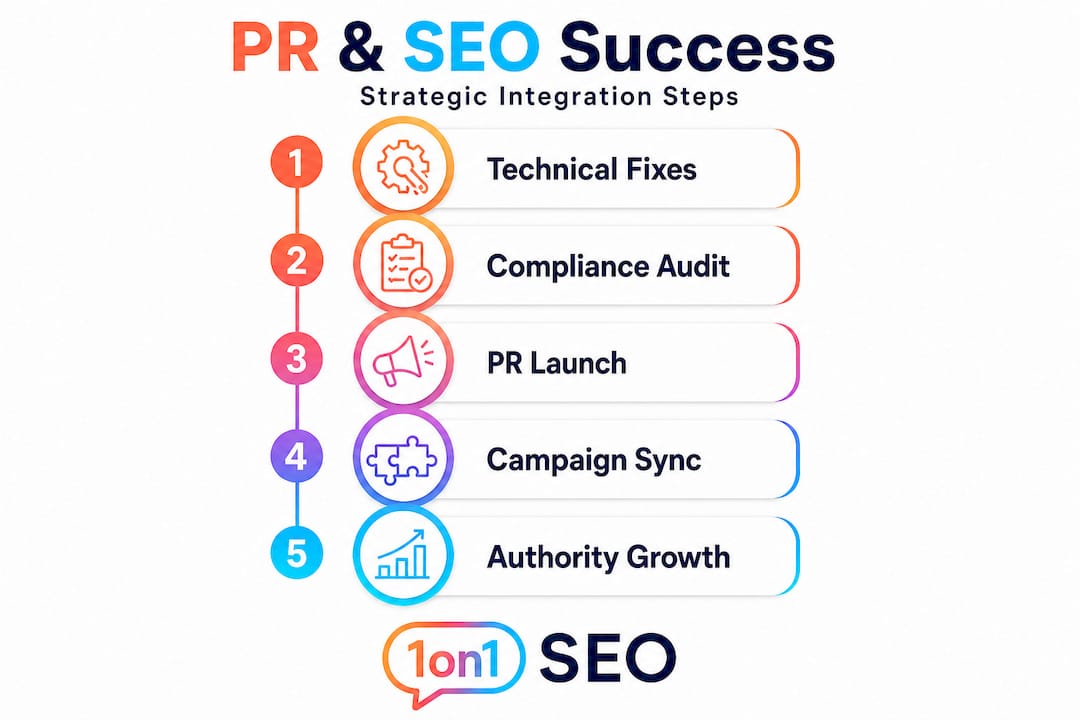
A practical framework for synchronizing both disciplines looks like this. First, resolve all critical technical issues, particularly those affecting crawlability, mobile rendering, and Core Web Vitals. Second, build out your compliance-ready PR assets and identify target publications per jurisdiction. Third, execute your earned media outreach while simultaneously monitoring for any new technical issues created by content additions. Fourth, track ranking movement at the page level, not just domain-level authority, because domain authority without page-level optimization rarely converts to actual rankings for competitive casino keywords.
Integrating international SEO considerations into this framework is non-negotiable for operators running campaigns across multiple regulated markets. Geo-specific technical structures must be in place before you invest in geo-specific PR.
The real-world truth: Why PR is overrated, unless it’s integrated
Let’s be direct about something the broader marketing conversation tends to avoid. Digital PR has been significantly overhyped in the iGaming sector over the last few years. Agencies have sold casino operators on the idea that earned coverage is a near-automatic path to first-page rankings, and operators have believed it because the logic sounds clean on paper.
The reality, as anyone who has managed large-scale iGaming SEO programs knows, is messier. We have seen casino brands generate genuinely impressive PR coverage, tier-one sports media, mainstream finance publications, gambling trade press, only to see zero meaningful ranking movement because their site had a JavaScript rendering issue that was preventing Google from processing any of the pages those links pointed to.
That is not a hypothetical scenario. It is a pattern. And research into the real cost of ignoring SEO confirms that coverage overstating PR’s role ignores how major technical SEO problems can completely wipe out the gains from even well-executed campaigns.
The operators who win long-term are not the ones with the biggest PR budgets. They are the ones who treat technical SEO and digital PR as a single integrated discipline with shared KPIs and shared accountability. Their PR briefs include technical requirements. Their technical roadmaps include PR timelines. Their analytics track both coverage velocity and ranking movement at the same time.
This integrated approach also handles the compliance layer better because technical fixes like hreflang, geo-targeted canonicalization, and jurisdiction-specific page structures directly support the geo-localized PR strategy. The two disciplines reinforce each other at every level when managed correctly. iGaming SEO expertise means knowing this at a structural level, not discovering it after a failed campaign.
Stop treating PR as a shortcut to authority and start treating it as a multiplier for technical foundations that already work. That framing change is worth more than any single campaign tactic.
Connect with iGaming SEO experts for strategic PR solutions
Ready to translate digital PR and SEO theory into practice? At 1on1 SEO, we work exclusively with iGaming operators, affiliates, and agencies who need frameworks that actually survive contact with regulated markets. Our iGaming SEO strategies are built around the integration principle: technical foundations first, then PR amplification, always within compliance boundaries. Whether you need to audit your current technical setup before a PR push, structure a compliance-ready linkable asset campaign, or develop off-page SEO for casinos that holds up across jurisdiction-specific scrutiny, our coaching programs cover every dimension. Start with our casino SEO glossary to align your team’s vocabulary, then let’s build your integrated strategy from the ground up.
Frequently asked questions
How does digital PR improve casino SEO rankings?
Digital PR earns authoritative backlinks and broad brand mentions from credible publishers, which signal trust and topical authority to search engines. However, as PR-linked assets show, underlying technical issues can still prevent those signals from translating into actual ranking gains.
What are the most common compliance errors in casino PR campaigns?
The most frequent mistakes are ignoring regional licensing rules in editorial assets, failing to include required responsible gambling messaging, and using geo-generic content that violates jurisdiction-specific targeting requirements. Local licensing compliance is non-negotiable for PR-driven SEO gains to hold.
Can digital PR compensate for poor technical SEO on casino sites?
No. If your site has unresolved crawl issues, redirect chains, or rendering failures, PR coverage will not deliver lasting ranking improvements because link equity cannot flow correctly to target pages. As the evidence confirms, technical SEO problems erode PR gains when left unaddressed.
What are the best digital PR strategies for online casinos?
Original research assets and compliance-friendly earned editorial coverage from respected regional publications consistently deliver the strongest and most durable SEO results. Regulated market campaigns that prioritize localization and compliance outperform generic link-building approaches every time.