

TL;DR:
- Site authority encompasses trust, relevance, and credibility signals, not just tool scores or metrics.
- Building genuine authority involves acquiring high-quality backlinks, producing expert content, and ensuring regulatory compliance.
- Strong site authority enhances search rankings, regulatory standing, and competitive visibility in regulated iGaming markets.
Most iGaming marketers treat site authority like a speedometer: one number, one reading, done. That mental model costs them rankings. Site authority is not a single metric produced by any one tool. It is a layered, dynamic signal that search engines use to determine whether your betting or casino site deserves to appear at the top of highly competitive search results. For affiliates and operators working in regulated markets, getting this wrong is not just an SEO problem; it is a compliance risk and a revenue problem rolled into one.
Table of Contents
- Defining site authority: What it is and what it isn’t
- The building blocks: Key factors driving site authority for iGaming
- Why site authority matters for search visibility and compliance
- How to measure and grow your site authority: Actionable steps
- A smarter take: Why most marketers get site authority wrong
- Put authority to work: Get expert guidance for your iGaming SEO
- Frequently asked questions
Key Takeaways
| Point | Details |
|---|---|
| Site authority defined | Site authority is a multifaceted score reflecting your trust, expertise, and link reputation. |
| iGaming essentials | For iGaming, authority means strong backlinks, quality content, regulatory clarity, and visible trust signals. |
| Measure and grow | Regularly audit key metrics and focus on link-building and compliance to steadily increase authority. |
| Avoid shortcuts | Chasing tool scores is common, but long-term authority relies on real value and ongoing optimization. |
Defining site authority: What it is and what it isn’t
With a clear need for precision, let us explore what site authority really means and, just as important, what it does not.
The phrase “site authority” gets tossed around constantly in SEO conversations, yet it rarely gets defined with precision. In technical terms, no search engine publishes a single “site authority” score. What we call site authority is really a shorthand for a collection of signals that tell Google and other engines whether your site should be trusted, ranked highly, and treated as a credible source in your niche.
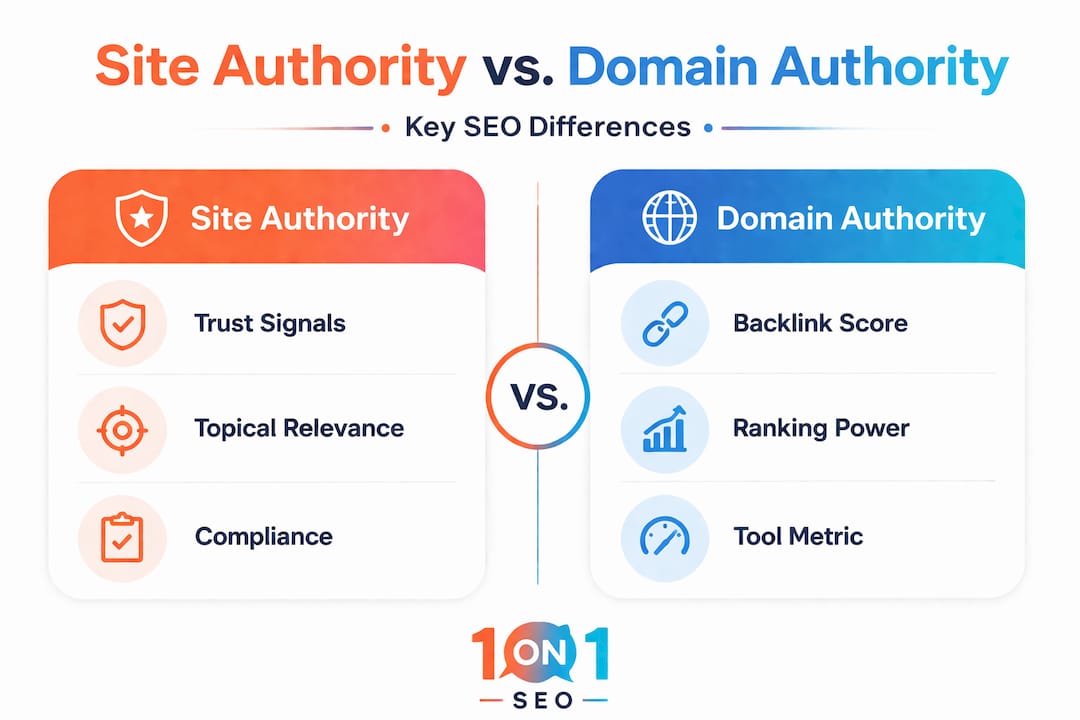
Confusion often starts when marketers conflate site authority with proprietary tool metrics. Domain Authority is Moz’s own predictive score, scaled from 1 to 100, estimating how likely a domain is to rank. Domain Rating from Ahrefs measures the strength of a site’s backlink profile specifically. These are useful tools, but they are approximations. They do not capture the full picture of how a search engine actually evaluates your site’s credibility.
Then there is E-E-A-T and brand authority: Experience, Expertise, Authoritativeness, and Trustworthiness. This is Google’s own quality evaluator framework, used by human raters to assess whether content and the site producing it genuinely serves users. In iGaming, E-E-A-T carries enormous weight because gambling content falls under Google’s “Your Money or Your Life” category, where the stakes of bad information are considered especially high.
Core dimensions of site authority in iGaming:
- Trustworthiness: Does your site display clear licensing information, responsible gambling resources, and transparent ownership?
- Link profile: Are inbound links coming from credible, topically relevant sources within the gambling and finance verticals?
- Topical relevance: Does your site cover a specific niche in iGaming deeply, or does it scatter content across unrelated topics?
- Content quality: Is your content original, accurate, updated regularly, and genuinely useful to a player or bettor audience?
“A site’s authority often determines whether it can compete in ultra-competitive iGaming markets. Tool scores matter for benchmarking, but what search engines actually reward is the combination of trust, relevance, and credibility built over time.”
| Factor assessed | Site authority | Domain authority (Moz) | E-E-A-T (Google) |
|---|---|---|---|
| What it measures | Holistic trust and credibility | Backlink-based ranking likelihood | Content quality and expertise signals |
| Who uses it | Industry practitioners | SEO professionals | Google quality raters |
| How it is measured | Multiple signals combined | Proprietary algorithm (links) | Qualitative + algorithmic evaluation |
| Scope | Site-wide and contextual | Domain-level metric | Page and site-level |
Understanding this distinction is not academic. It shapes every decision you make about link acquisition, content strategy, and technical infrastructure.
The building blocks: Key factors driving site authority for iGaming
Knowing what site authority is, marketers need to understand the specific factors that move the needle.
Not all authority-building activities carry equal weight. In the iGaming vertical, the order of priority matters because some factors protect your regulatory standing while others boost organic reach. Here are the four core pillars, ranked by their impact in highly regulated iGaming markets.
Ranked order of importance:
- Authoritative backlinks: Links from trusted gambling media, regulatory bodies, and high-authority finance sites signal credibility faster than almost anything else. The quality of your backlinks and anchor text directly shapes how engines interpret your topical relevance.
- Content quality and depth: Original game reviews, odds analysis, regulatory guides, and responsible gambling content demonstrate genuine expertise. Thin content, even on a domain with decent metrics, gets deprioritized in competitive SERPs.
- Technical SEO: Site speed, crawlability, structured data, and clean internal architecture allow engines to index your authority signals accurately. A technically broken site hides its own strengths.
- Trust signals and compliance: Licensing badges, terms and conditions pages, privacy policies, responsible gambling statements, and affiliate disclosure notices are not just legal formalities. They are ranking signals in regulated markets.
| Site audit factor | Why it matters in iGaming | Recommended threshold |
|---|---|---|
| Referring domains | Backlink diversity drives authority | 200+ unique domains for mid-tier affiliates |
| Page load speed | User experience signal, especially mobile | Under 2.5 seconds (Core Web Vitals) |
| Licensing page presence | Trust and compliance signal | Clearly visible on every regulated domain |
| Content freshness | Google prioritizes updated iGaming info | Monthly updates for core pages |
| Toxic link ratio | Bad links erode authority | Under 5% of backlink profile |
Incorporating branding and SEO integration early in your site architecture pays long-term dividends. Brands that establish consistent identity signals across search, social, and licensing channels build authority faster because engines see congruence rather than confusion.
Pro Tip: Don’t overlook compliance pages. Transparent terms, responsible gambling info, and licensing credentials are not just regulatory checkboxes. They actively boost your site’s trustworthiness signals in Google’s quality evaluation process and can meaningfully lift rankings in licensed market SERPs.
Why site authority matters for search visibility and compliance
Once you know what builds authority, it is vital to see why it pays off, especially for iGaming marketers navigating slim margins and strict rules.

Search engines do not rank pages in isolation. They rank pages in the context of the site that hosts them. A high-authority iGaming site can rank new content faster, recover from algorithm updates more quickly, and compete on keywords that low-authority competitors simply cannot touch. Google’s own documentation makes clear that trustworthiness is a primary factor for sites in sensitive verticals, and gambling is explicitly listed as one of those sensitive areas.
Research on ranking factors consistently shows that low-quality inbound links do not just fail to help. They actively damage authority scores and can trigger manual actions from Google’s spam team. For an iGaming affiliate that depends on organic traffic for player acquisition, a manual penalty is not a minor setback. It can eliminate months or years of traffic overnight.
Major visibility and compliance benefits of high site authority:
- Better SERP positions: High-authority sites rank more consistently on competitive terms like “best online casino UK” or “sports betting bonuses.”
- More affiliate partnership opportunities: Operators choose affiliates with strong authority profiles because they signal quality traffic and lower compliance risk.
- Faster content indexing: Google crawls trusted sites more frequently, meaning new pages rank sooner after publication.
- Stronger brand protection: Authoritative sites are less likely to be outranked by scraper sites or low-quality competitors using duplicate content.
- Regulatory credibility: Licensing bodies in markets like the UK, Malta, and New Jersey increasingly scrutinize the online presence of operators and their marketing partners.
Studies on ranking distributions suggest that sites in the top 20% of authority scores within a niche capture disproportionately high click-through rates on competitive keywords. In a market where the top three organic results capture the majority of clicks, authority is the price of entry, not a competitive advantage.
The compliance dimension often surprises marketers who think of SEO and regulatory adherence as separate concerns. They are not. A site that ranks well but displays unlicensed operator offers, lacks responsible gambling messaging, or obscures affiliate relationships risks regulatory action that can force domain changes, killing all accumulated authority in the process.
How to measure and grow your site authority: Actionable steps
So how does a betting affiliate or operator put these insights into practice? It starts with smart measurement and systematic action.
Step-by-step authority audit process:
- Pull baseline metrics: Use Ahrefs, Moz, or Semrush to capture your current Domain Rating, Domain Authority, referring domains count, and organic traffic. Do the same for your top three competitors to establish benchmarks.
- Analyze your backlink profile: Identify your top linking domains, flag any toxic or irrelevant links, and note gaps where competitors have links you do not. Prioritize outreach to iGaming news sites, licensing information portals, and regulated operator blogs.
- Audit your content for E-E-A-T signals: Check that every major page includes author credentials, publication dates, update history, and references to licensed operators or verified data sources.
- Review technical health: Run a crawl with Screaming Frog or a similar tool. Fix broken internal links, improve page speed scores, and confirm that structured data is implemented correctly on review and comparison pages.
- Check compliance elements: Confirm that licensing disclosures, terms and conditions, responsible gambling links, and affiliate relationship notices are present, visible, and up to date on every key page.
- Set KPIs and a review cadence: Track referring domain growth, organic ranking changes on your 20 highest-value keywords, and organic traffic trends monthly. Quarterly, repeat the full audit cycle.
A practical mini case example: an iGaming affiliate in the Canadian market ran a full authority audit and discovered that 40% of their backlinks came from a single link network that had been flagged as low quality in recent algorithm updates. After disavowing those links and launching an outreach campaign targeting Canadian gambling news sites and provincial licensing information pages, their Domain Rating stabilized and their top 10 keyword rankings increased by 35% over six months.
Understanding absolute vs. relative links in your internal architecture also matters more than most affiliates realize. Internal links that use absolute URLs pass authority signals more cleanly across subdomains and HTTPS migrations, which is especially relevant during rebrands or market expansions.
Pro Tip: Focus on earning links from industry-respected and compliant iGaming resources. A single editorial mention from a respected gambling regulatory news outlet or a major licensed operator’s blog is worth more to your authority profile than dozens of links from generic directories or low-relevance finance sites.
Ongoing measurement is not optional in this space. Google’s algorithm changes frequently, regulators update requirements, and competitor authority profiles shift constantly. Setting a monthly check-in and a quarterly deep audit keeps you aware of threats before they become penalties.
A smarter take: Why most marketers get site authority wrong
Beyond tactical actions, it is worth asking: are you chasing metrics or building real, defensible authority?
Here is the uncomfortable truth about how most iGaming affiliates approach authority. They optimize for the score, not the substance. They celebrate a bump in Domain Rating without asking whether their site is genuinely more trustworthy or relevant than it was last quarter. Tool scores are proxies. They can be manipulated in the short term through link schemes or bulk outreach. But the sites that hold positions through core algorithm updates are the ones that have built something real.
We have seen it happen repeatedly. An affiliate invests heavily in a private blog network or buys a package of gambling-niche links, watches their Domain Rating climb, ranks for a few competitive terms, and then gets decimated by the next Helpful Content or core update. The metric moved. The underlying authority did not.
True authority in iGaming means being recognized as best-in-class by two very different audiences simultaneously: search engine algorithms and regulatory bodies. These two groups are increasingly aligned. Google wants trustworthy, compliant, expert content. Regulators want transparent, honest, responsible marketing. The sites that satisfy both criteria build authority that is genuinely defensible because it has real-world grounding.
The contrarian advice here is this: invest in your compliance infrastructure with the same energy you invest in link building. A thorough, clearly written responsible gambling section, an accurate and current licensing page, and honest affiliate disclosures do more for long-term authority than most link campaigns. They are also far more resistant to algorithm changes because they serve the user directly, which is ultimately what Google’s quality evaluators are measuring.
Tracking iGaming SEO success indicators this way, as a combination of rankings, compliance health, and trust signal quality, gives you a far more accurate picture of your competitive position than any single dashboard metric.
Put authority to work: Get expert guidance for your iGaming SEO
Understanding site authority is the first step. Turning that understanding into a disciplined, ongoing strategy is where most affiliates and operators struggle without experienced guidance. The iGaming vertical moves fast, regulatory requirements shift across markets, and the link tactics that worked two years ago can harm you today.
Our iGaming SEO ranking strategies guide walks you through market-specific frameworks that account for both algorithmic trust and licensing compliance. If you are running affiliate campaigns, the casino affiliate compliance strategies resource covers exactly how to structure your site for both performance and regulatory adherence. Expert coaching accelerates what takes years to figure out alone, especially in a space where the cost of getting it wrong shows up in both your rankings and your license status.
Frequently asked questions
Is site authority the same as domain authority or domain rating?
No. Site authority is a broad concept reflecting overall trust, topical relevance, and credibility across multiple signals, while domain authority and domain rating are specific numerical metrics calculated by individual tool providers using their own methodologies.
How can iGaming affiliates increase their site authority?
Affiliates should prioritize earning high-quality backlinks from licensed and respected iGaming sources, publish original expert-level content on a consistent schedule, and make compliance elements like licensing disclosures and responsible gambling pages clearly visible throughout the site.
Does having site authority guarantee top search rankings?
Site authority significantly improves ranking potential but works best when combined with strong on-page optimization, technical SEO health, and full compliance with the search engine’s quality guidelines for sensitive verticals like gambling.
Are there risks to authority from bad links or poor compliance?
Yes. Low-quality or manipulative backlinks can trigger algorithmic demotions or manual penalties, while missing regulatory pages can damage both your search trust signals and your standing with licensing authorities in regulated markets.
What is the fastest way to measure site authority?
Run a site audit using tools like Ahrefs, Moz, or Semrush to capture backlink profile data, referring domain counts, and organic traffic trends, then benchmark those numbers against your top three competitors to identify specific gaps.