

TL;DR:
- Backlink profiles in betting are both an SEO asset and a compliance document requiring careful management.
- Regular audits identify toxic links, anchor text issues, and geographic mismatches to prevent penalties.
- Continuous backlink monitoring and strategic cleanup are essential for sustainable growth and regulatory adherence.
Backlinks are the backbone of iGaming SEO, but not every link pointing to your betting site is working in your favor. Many operators and affiliates treat link acquisition as a pure numbers game, assuming that a larger backlink profile automatically translates to stronger rankings. That assumption is expensive in regulated markets. A single cluster of toxic links can invite a manual penalty, trigger regulatory scrutiny, or quietly erode the trust signals that Google uses to rank betting content. Regular backlink audits are not a defensive chore — they are a proactive growth strategy that separates the brands scaling sustainably from those chasing short-term gains.
Table of Contents
- The unique challenges of betting backlink profiles
- How backlink audits protect betting sites from SEO penalties
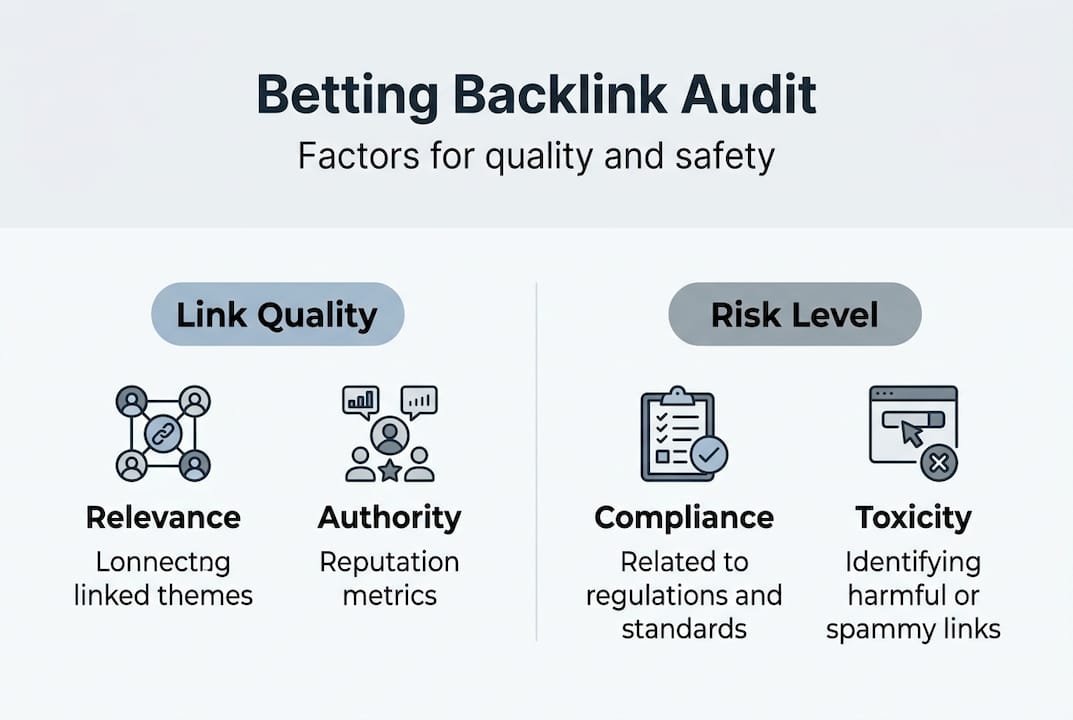
- What to look for: Key factors in a betting backlink audit
- Translating audit insights into real SEO growth
- Our take: Why most betting backlink audits fall short — and what to do differently
- Expert help to maximize your betting backlink strategy
- Frequently asked questions
Key Takeaways
| Point | Details |
|---|---|
| Regulated markets increase risk | Betting brands in regulated markets face stricter link scrutiny and must audit links to stay compliant. |
| Audits prevent costly penalties | Regular backlink audits catch toxic links before search engines or regulators penalize you. |
| Actionable audits drive growth | Moving from insight to action with your backlink audits creates lasting SEO advantages. |
| Expert support amplifies results | Specialist knowledge and tailored tools make backlink audits more effective for betting SEO. |
The unique challenges of betting backlink profiles
Running SEO for a betting brand is nothing like running SEO for an e-commerce store or a SaaS product. The iGaming vertical lives at the intersection of aggressive competition, strict regulation, and intense search engine scrutiny. That combination creates a backlink environment where even experienced SEOs can be caught off guard.
Regulated betting markets impose rules that go far beyond what Google’s own guidelines require. In jurisdictions like the UK, Sweden, or New Jersey, licensed operators must adhere to advertising and promotion standards that restrict how and where their brand can appear online. A backlink from a site that violates those standards — even if the link itself looks “clean” by traditional SEO metrics — can become a compliance problem. The regulated SEO challenges in these markets require marketers to think about link profiles through both an SEO lens and a legal one simultaneously.
The competitive intensity of high-value betting keywords also attracts bad actors. Terms like “best sports betting sites” or “online casino bonuses” generate enormous traffic and revenue, which makes them targets for black-hat link schemes. Link farms, private blog networks, and fake review sites proliferate in iGaming because the financial incentives are large enough to justify the risk for those willing to take shortcuts. When those links point to your site, you inherit the risk.
Then there is negative SEO. Competitors in the betting space sometimes deliberately point toxic or spammy links at rival domains to trigger penalties. This tactic is more common in iGaming than almost any other vertical because displacing a competitor by even a few positions can mean significant revenue differences. You may be doing everything right and still find your backlink profile contaminated by links you never requested.
Consider the following warning signs that are especially relevant for betting brands:
- Links from gambling sites that operate without a license or in markets where your brand is not licensed
- Guest posts on thin, unrelated content sites that clearly exist only to sell links
- Forum profiles and comment spam from low-quality domains with no real editorial standards
- Anchor text that is keyword-stuffed in ways that look manipulative to both Google and regulators
- Sudden spikes in backlink volume that coincide with competitor campaigns or negative SEO attacks
“In regulated betting markets, your backlink profile is not just an SEO asset. It is a compliance document. Regulators and search engines are both reading it.”
Understanding this context is what makes a specialized betting backlink audit so different from a generic SEO audit. You are not just checking domain authority scores — you are assessing risk across multiple dimensions that can affect your license, your rankings, and your revenue simultaneously.
How backlink audits protect betting sites from SEO penalties
Google’s systems are sophisticated, and they pay particular attention to betting and gambling sites because the vertical has historically been a hotbed for link manipulation. Algorithmic filters like Google Penguin work continuously in the background, and manual reviewers can be triggered by patterns that fall below the threshold of automated detection. Both represent real risks for betting brands that do not actively manage their link profiles.
A structured backlink audit gives you a clear picture of what is pointing to your site, how those links are distributed, and whether any patterns exist that could attract negative attention. Here is a practical process for conducting an effective audit:
- Export your full backlink profile using tools like Ahrefs, Semrush, or Majestic. Cross-referencing at least two tools is important because no single crawler indexes every link on the web.
- Segment links by source quality. Separate links from high-authority, relevant sources from those with low domain ratings, thin content, or no clear editorial purpose.
- Analyze anchor text distribution. A healthy backlink profile for a betting site should have a natural spread of branded anchors, generic anchors, and a modest proportion of keyword-rich anchors. Over-optimization is a major red flag.
- Check for geographic mismatches. If your site targets UK bettors and you suddenly have hundreds of links from Indonesian or Brazilian domains with no topical relevance, that pattern needs investigation.
- Identify link velocity anomalies. Sudden spikes in new links, especially from similar-looking domains, often indicate link schemes or negative SEO campaigns.
- Cross-reference with SEO success indicators for betting to ensure you are measuring link quality against metrics that actually correlate with performance in the iGaming vertical.
- Prepare your disavow file. For links you cannot remove through webmaster outreach, Google’s disavow tool is your last line of defense.
Pro Tip: Do not disavow aggressively without evidence. Removing authority links by mistake can actually hurt your rankings. Use a tiered approach: flag for review first, reach out for removal second, and disavow only when the risk clearly outweighs any potential benefit.
The downstream value of this process is significant. Brands that audit consistently are less likely to experience the sudden ranking drops that often follow an algorithmic update, because their profiles are already cleaner and more natural-looking than competitors who take a passive approach. Preventing a manual penalty is far less costly — in both time and revenue — than recovering from one.
What to look for: Key factors in a betting backlink audit
Knowing that you need to audit is one thing. Knowing exactly what to examine is where most audits stall out. Here is a practical breakdown of the key factors that matter most in the betting context.
Quality and relevance are the foundation. A link from a respected sports media outlet or a licensed review site carries far more weight than ten links from generic directories. Relevance is especially important for betting brands because Google’s understanding of topical authority means that links from unrelated niches contribute less and may even appear manipulative.
| Link type | Risk level | SEO value | Regulatory concern |
|---|---|---|---|
| Licensed review site | Low | High | Low |
| Sports media outlet | Low | High | Low |
| Generic directory | Medium | Low | Medium |
| Unrelated blog (paid) | High | Negative | High |
| Link farm or PBN | Very High | Very Negative | Very High |
| Forum comment spam | High | None | Medium |
Domain authority and trust flow are useful proxies, but they should not be used in isolation. A domain can have decent authority scores while still being a problematic source if its content is thin, its link profile is itself manipulated, or it operates in a gray area of compliance. Always look at the actual site, not just the numbers.
Some of the most important warning signs for local SEO audit priorities in betting include:
- Sites that exist solely to host sponsored betting content with no organic editorial voice
- Domains registered within the past six months that are already linking to multiple betting operators
- Sites that rank for no organic keywords outside of heavily commercial betting terms
- Backlinks from domains that have received penalties themselves, which you can often detect through traffic drop patterns in tools like Semrush
Anchor text analysis deserves its own focus. In iGaming, affiliates and link builders often default to exact-match anchors like “best online casino” or “free bets UK” because those are the terms they want to rank for. But a backlink profile where 40% or more of anchors are exact-match commercial terms is a clear manipulation signal. A realistic, healthy profile mixes branded mentions, URL anchors, generic terms like “click here” or “learn more,” and a carefully controlled proportion of keyword-rich anchors.
Geographic relevance is another factor that many iGaming SEOs overlook. If your license covers specific territories and the bulk of your links come from sites based in completely different markets, that disconnect can weaken both your SEO authority and your standing with local regulators who review operators’ digital footprints.
Translating audit insights into real SEO growth
An audit is only valuable if you act on what it reveals. The practical steps you take after identifying problems — and opportunities — determine whether your backlink investment actually moves rankings and revenue.

Removing or disavowing harmful links should be your first action. Prioritize links that appear in multiple risk categories: low authority, irrelevant topic, suspicious anchor text, and geographic mismatch. The combination of factors matters more than any single dimension. When reaching out to webmasters for link removal, keep your message professional and concise. Many site owners will comply if approached respectfully. For those who do not respond, use Google’s disavow tool with a well-organized disavow file that groups domains and includes comments explaining your reasoning.
Here is how audit actions translate into measurable SEO outcomes:
| Audit action | Short-term impact | Long-term impact |
|---|---|---|
| Disavow toxic link cluster | Possible ranking volatility | Reduced penalty risk, cleaner profile |
| Remove over-optimized anchors | Minimal immediate change | Healthier anchor distribution over time |
| Build relevant authority links | Gradual ranking improvement | Sustained organic traffic growth |
| Fix geographic link mismatches | Improved local signals | Better performance in targeted markets |
| Monitor for new toxic links | Early risk detection | Proactive protection of rankings |
Building replacement links is just as important as removing bad ones. After cleaning up your profile, you create space to strengthen it with links that actually improve your authority. Target sports media outlets, licensed affiliate review sites, responsible gaming organizations, and industry publications that are genuinely respected in your market. These links are harder to earn, but they are the ones that compound in value over time and are far less vulnerable to algorithm updates.
Pro Tip: Use your audit findings to build a link acquisition brief for your outreach team. When you know exactly which types of sites and anchors your profile needs more of, you can run targeted campaigns instead of scattershot outreach that wastes time and budget.
Ongoing monitoring is what separates elite betting SEO from reactive firefighting. Set up automated alerts in your preferred backlink tool to notify you when new links appear at scale. Review your profile at a minimum every quarter, and after every major campaign, competitor move, or regulatory announcement that could affect your link environment. Consistently tracking SEO progress against performance benchmarks helps you connect audit actions to actual ranking and revenue outcomes, which is the only metric that ultimately matters.
Our take: Why most betting backlink audits fall short — and what to do differently
Most iGaming operators treat backlink audits as a one-time cleanup exercise. They run an audit, disavow the obvious bad links, and move on. That approach misses the point entirely. The backlink landscape in betting changes constantly: competitors launch new negative SEO campaigns, link networks evolve to avoid detection, and regulators update their expectations for what responsible digital marketing looks like.
The brands we see consistently outranking their competitors share one trait — they treat their backlink profile as a living asset, not a static checklist. They audit continuously, they connect audit findings to broader content and authority strategy, and they measure link quality against player acquisition outcomes, not just domain metrics. Measuring real SEO success in this vertical means asking whether your links are actually driving qualified traffic and conversions, not just whether your domain rating went up.
The deeper mindset shift is this: a backlink audit is not about defense alone. It is an intelligence-gathering process that tells you where the market is going, what your competitors are doing, and where the genuine authority opportunities exist in your niche. Use it that way, and it becomes one of your most powerful strategic tools.
Expert help to maximize your betting backlink strategy
Auditing your backlink profile is complex work, especially when compliance, competition, and algorithm changes are all moving at once. Having a framework built specifically for iGaming makes a measurable difference. Our iGaming SEO ranking strategies guide covers the full scope of authority-building in competitive betting markets, from link acquisition to audit workflows. If you want a broader foundation, explore our breakdown of winning iGaming SEO strategies that have helped affiliates and operators build durable search visibility. Both resources are built for the realities of regulated markets, where generic SEO advice simply does not apply.
Frequently asked questions
What makes auditing backlinks essential for betting sites?
Auditing backlinks is critical for betting sites to prevent algorithmic and manual penalties, maintain search rankings, and comply with regulatory requirements in markets where both Google and licensing authorities scrutinize operator behavior closely.
How often should you audit backlinks for a betting site?
It’s best practice to audit backlinks at least quarterly, with more frequent reviews triggered by major link-building campaigns, competitor activity, or regulatory changes that affect how operators can promote their services.
What signals indicate a harmful backlink in the betting industry?
Links from unrelated or low-authority sites, excessive keyword-rich anchor text, and links originating from known link networks or unlicensed gambling domains are especially dangerous under both Google’s guidelines and regulator scrutiny.
Can a single bad backlink cause a penalty?
While rare, a single link from a highly toxic or previously penalized source can trigger a manual review, particularly if your overall profile already shows other risk patterns that attract reviewer attention.
What’s the first step if you discover harmful backlinks?
Identify and document every harmful link with supporting evidence from your audit tool, then prioritize outreach to webmasters for removal before using Google Search Console’s disavow tool as a final step.