
TL;DR:
- iGaming SEO is highly sensitive due to strict regulations, negative SEO attacks, and rapid penalties.
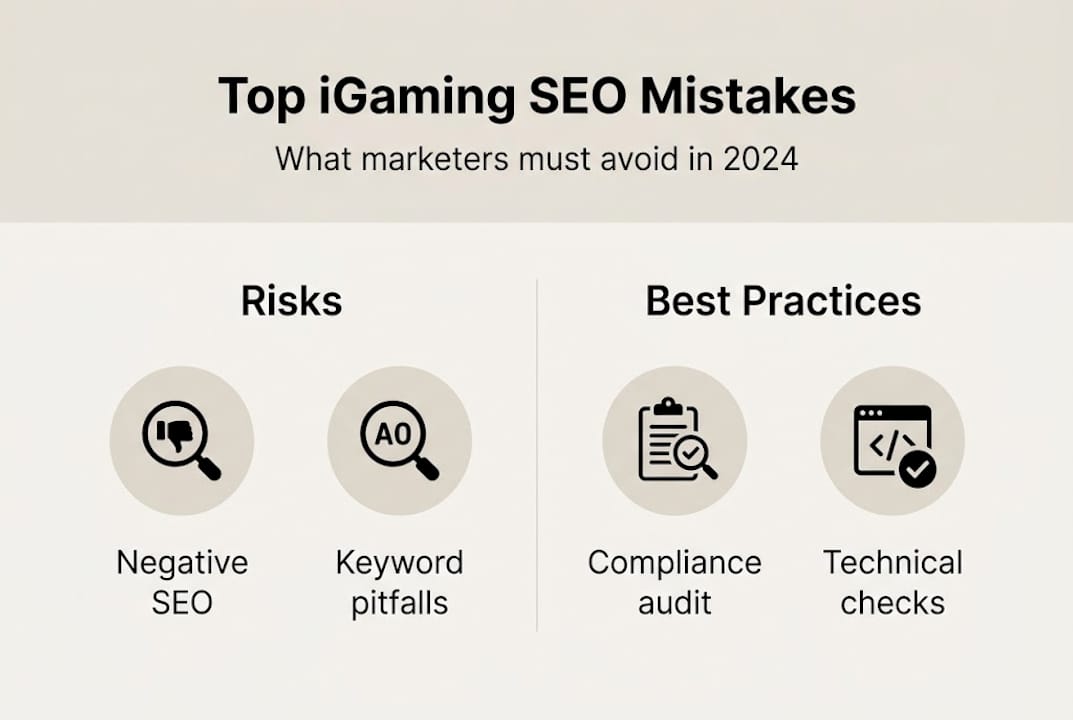
- Common mistakes include neglecting compliance constraints, targeting high-risk broad keywords, and underestimating technical vulnerabilities.
- Continuous risk management, monitoring, and adaptive strategies are essential for long-term success in iGaming SEO.
iGaming SEO is not like any other vertical. The margin for error is razor thin, and the consequences of getting it wrong extend well beyond a rankings drop. Negative SEO attacks like link spamming, fake removal requests, and malware injection are rising threats specifically designed to exploit the competitive and heavily regulated nature of this industry. For advanced marketers and affiliates, the danger is not just from search algorithm updates. It is from competitors weaponizing SEO against you, regulators flagging non-compliant content, and technical vulnerabilities that can silently erode your visibility. This guide breaks down the most costly mistakes and shows you exactly how to avoid them.
Table of Contents
- Why SEO mistakes are amplified in iGaming
- Mistake #1: Neglecting compliance-driven SEO constraints
- Mistake #2: Choosing high-risk keywords over intent-focused terms
- Mistake #3: Underestimating technical risks and negative SEO attacks
- What most guides miss about iGaming SEO mistakes
- Take your iGaming SEO to the next level
- Frequently asked questions
Key Takeaways
| Point | Details |
|---|---|
| Negative SEO threats | iGaming sites face surging negative SEO attacks that can cripple rankings if not proactively managed. |
| Compliance-driven SEO | Ignoring compliance requirements in content, keywords, and links is the fastest way to lose search visibility and risk legal trouble. |
| Smart keyword targeting | Success comes from prioritizing long-tail, geo-specific, and intent-focused keywords, not chasing risky high-volume terms. |
| Technical vigilance | Regularly monitor for technical flaws, suspicious links, and penalty warnings using tools like Google Search Console. |
| Expert resources | Advancing iGaming SEO requires leveraging trusted guides and proven strategies tailored for regulated markets. |
Why SEO mistakes are amplified in iGaming
In most industries, an SEO mistake costs you some traffic. In iGaming, it can cost you your entire presence. The combination of aggressive competitors, strict regulatory frameworks, and algorithm sensitivity creates an environment where errors compound fast.
Consider the competitive intensity. Casino and betting SERPs are among the most contested on the planet. Brands spend millions to hold top positions, and that financial pressure pushes some operators toward tactics that damage competitors rather than simply outranking them. Negative SEO attacks are more damaging in iGaming specifically because the regulatory scrutiny magnifies every signal Google evaluates.
Here is what makes the iGaming environment uniquely hostile for SEO:
- Compliance layers: Regulatory bodies in the UK, Malta, and New Jersey impose specific content rules that directly affect what you can say and how you say it.
- Elevated trust signals: Google applies additional quality scrutiny to Your Money or Your Life (YMYL) pages, which includes gambling content.
- Aggressive competitor tactics: Fake disavow campaigns, negative link bombs, and scraped content attacks are more common in iGaming than in almost any other niche.
- Fast penalty timelines: De-indexing can happen in days; recovery takes months.
The table below illustrates how common SEO risks differ between standard industries and iGaming:
| Risk factor | Standard industry | iGaming |
|---|---|---|
| Negative SEO frequency | Low to moderate | High |
| Regulatory content penalties | Rare | Frequent |
| Recovery timeline | Weeks | Months |
| YMYL scrutiny | Moderate | Maximum |
| Compliance link constraints | Minimal | Strict |
Understanding seo compliance mistakes in this context is not optional. It is foundational. Before you build any SEO campaign, you need to understand that errors here trigger cascading effects across rankings, reputation, and even legal standing. Start with a thorough iGaming on-page SEO checklist to ensure your baseline is solid before scaling.
Mistake #1: Neglecting compliance-driven SEO constraints
This is the mistake that surprises even experienced SEOs when they move into iGaming. Compliance is not a legal team problem. It is an SEO problem too.

Geo-specific keyword targeting presents the most immediate risk. Targeting terms like “best online casino USA” when your license does not cover certain US states can trigger both Google penalties and regulatory action. Content claiming guaranteed wins, suppressing responsible gaming messaging, or linking to unlicensed operators creates exposure on multiple fronts simultaneously.
Here are the most common compliance-driven SEO errors:
- Targeting geo-restricted keywords without proper license coverage
- Publishing promotional claims that violate advertising standards (misleading bonuses, income guarantees)
- Failing to include required responsible gaming disclaimers
- Using unmanaged affiliate outbound links without nofollow or sponsored attributes
- Ignoring age-gating requirements for landing pages in regulated markets
“The most dangerous compliance errors in iGaming SEO are the ones that look like standard optimization tactics until a regulator or algorithm update surfaces them.” This is a pattern we see repeatedly: affiliates running campaigns that worked two years ago, unaware that the regulatory environment shifted beneath them.
Penalty monitoring is not a set-and-forget task. You need real-time alerts in Google Search Console, routine content audits aligned with the latest regulatory updates in your target markets, and a clear protocol for recovering from Google penalties before they compound.
Compliance mistakes in SEO can trigger de-indexing or legal action, and the recovery window is narrow. The time between a compliance flag and a penalty notice from Google can be shorter than most teams expect.
Pro Tip: Create a compliance content calendar that aligns your editorial schedule with known regulatory review cycles in your target markets. This prevents reactive scrambles and keeps your content proactively clean.
For affiliates, avoiding compliance errors requires auditing your entire link ecosystem, not just the content on the page. Review your affiliate SEO optimization steps regularly to ensure your linking strategy stays within bounds as regulations evolve.
Mistake #2: Choosing high-risk keywords over intent-focused terms
High-volume iGaming keywords are tempting. “Online casino,” “sports betting,” and “best slots” pull massive search numbers. But chasing those terms is often the strategic equivalent of driving at top speed on black ice.
Broad, high-volume keywords in iGaming attract bot traffic, negative SEO targeting, and near-impossible competition from brands with eight-figure SEO budgets. The risk-to-reward ratio is brutal for most operators and affiliates. Long-tail, geo-specific, high-intent keywords outperform broad high-volume terms because they balance competition, compliance risk, and conversion potential simultaneously.
Look at the real difference in keyword selection strategy:
| Keyword type | Example | Risk level | Conversion intent |
|---|---|---|---|
| Broad, high-volume | “online casino” | Very high | Low |
| Geo-specific | “NJ licensed online casino 2026” | Low | High |
| Long-tail intent | “best low deposit casino UK players” | Low | Very high |
| Brand modifier | “BetMGM welcome offer review” | Moderate | High |
The intent-driven approach also aligns better with compliance requirements. A geo-specific term naturally filters your audience to users in jurisdictions where you are licensed. This reduces the risk of serving regulated content to users in restricted territories.
Here is a framework for smarter keyword selection in iGaming:
- Filter by jurisdiction first: Only target terms relevant to markets where you hold valid licenses.
- Layer intent signals: Add qualifiers like “review,” “bonus,” “deposit,” or “legal” to shift from informational to transactional intent.
- Use player value as a ranking proxy: Keywords that attract high-lifetime-value players are worth more than raw volume.
- Benchmark competitor difficulty realistically: If the top three results are all Tier 1 operators with 10-year-old domains, that keyword is off the table for most affiliates.
Pro Tip: Use Google Search Console to find the long-tail queries already driving impressions to your site. These are often your highest-opportunity, lowest-competition targets sitting right in front of you.
Deep guidance on high-risk keyword optimization and building out a full geo-specific SEO strategy can give your keyword architecture the structure it needs to scale safely.
Mistake #3: Underestimating technical risks and negative SEO attacks
Technical SEO in iGaming goes beyond site speed and schema markup. It is a security and defensive operation. The rising threat of negative SEO in competitive iGaming means your technical infrastructure needs to actively defend your rankings, not just support them.
Negative SEO attacks in iGaming take several distinct forms:
- Link bombing: Competitors point thousands of low-quality, spammy links at your domain to trigger a manual penalty.
- Fake removal requests: Bad actors file DMCA or content removal requests impersonating your brand to get your pages deindexed.
- Content scraping: Your content gets duplicated across hundreds of low-quality sites, diluting your authority and triggering duplicate content flags.
- Malware injection: Compromised servers serve hidden redirect pages or inject casino spam into your site’s code.
- Crawl rate manipulation: Bots flood your server, slowing response times and damaging Core Web Vitals scores.
Monitoring is your first line of defense. Set up weekly backlink audits using tools like Ahrefs or Semrush. Configure Google Search Console manual action alerts so you catch penalties immediately. Review your index coverage report monthly to spot unexpected deindexing patterns.
When you identify a toxic link wave, act fast. Document the attack, build a disavow file using Google’s Disavow Tool, and file it before the next crawl cycle picks up the new links. Recovery from a link bomb attack that went unchecked for 60 days is dramatically harder than one caught in week one.
Pro Tip: Set up a Google Alert for your brand name plus terms like “casino spam” or “link removal.” Fake removal requests and impersonation attacks often surface in forum posts or complaint threads before they hit your rankings.
Your advanced ranking strategies need a technical foundation that includes proactive defense, not just optimization. Understanding search engine relevancy signals for iGaming in 2026 will also help you interpret whether ranking drops are algorithmic or attack-driven.
What most guides miss about iGaming SEO mistakes
Most “SEO mistakes” articles treat iGaming like any other niche with a few extra compliance bullet points added at the bottom. That fundamentally misreads the challenge. The regulatory nuance here is not a footnote. It is the entire operating context.
What we see consistently is that successful iGaming marketers treat SEO as a continuous risk management system, not a one-time optimization project. They build monitoring workflows, maintain compliance review cycles, and treat negative SEO defense as a permanent budget line. Not an emergency response.
The brands that recover fastest from penalties are the ones who never stopped auditing. Penalty recovery requires a full site audit, toxic link disavowal, and content refresh, and even then, full recovery takes months. The lesson is not how to recover faster. It is how to reduce the frequency and severity of exposure.
Long-term brand resilience in iGaming SEO comes from building systems that adapt. Algorithms change, regulations tighten, and competitors escalate their tactics. The marketers who thrive are the ones who treat every metric as a signal to act on, not just a number to report. Explore winning iGaming SEO strategies that are built around this kind of adaptive resilience.
Take your iGaming SEO to the next level
The mistakes covered in this guide are not rare edge cases. They are the patterns we see repeatedly across affiliates, operators, and agencies entering or scaling in iGaming. Compliance errors, misaligned keyword strategies, and undefended technical vulnerabilities are costing brands rankings every day.
Our iGaming SEO coaching program gives you the frameworks to fix all three. From advanced SEO ranking strategies built for regulated markets to winning strategies for iGaming that scale with compliance, every resource is designed for the real conditions of this industry. Measure your progress with SEO success indicators that actually reflect player value and acquisition performance, not just vanity metrics.
Frequently asked questions
How are negative SEO attacks impacting iGaming sites in 2026?
Negative SEO attacks including link spamming, fake removal requests, and malware injection are growing in frequency, directly causing rankings drops and security vulnerabilities for iGaming brands that lack active monitoring systems.
What is the best keyword strategy to avoid SEO mistakes in iGaming?
Focus on geo-specific, high-intent keywords with clear compliance alignment rather than broad high-volume terms, which attract bot traffic, negative SEO exposure, and competition from brands with far greater domain authority.
How do I recover from an SEO penalty in the iGaming industry?
Full penalty recovery requires a thorough site audit, a toxic backlink disavowal, and a content refresh aligned with current compliance standards; depending on severity, this process typically takes several months.
Which compliance mistakes are most common for iGaming SEO?
Compliance errors that most frequently trigger penalties include targeting geo-restricted keywords without the right licensing, using unmanaged affiliate links, and publishing promotional content that violates advertising standards in regulated markets.