

TL;DR:
- High-risk keywords in iGaming offer high traffic but require careful compliance and risk management.
- Effective strategies involve thorough research, ongoing monitoring, and strict adherence to regulatory guidelines.
- Sustainable success depends on staged testing, documentation, and balancing volume with responsible optimization.
Most iGaming marketers fall into one of two traps: they either avoid high-risk keywords entirely out of fear, or they chase them recklessly without a compliance plan. Both approaches leave money on the table. High-risk keyword optimization in iGaming is not about gambling with your domain authority. It is about understanding exactly where the danger zones are, building safeguards around them, and executing with precision. This article breaks down what high-risk keywords actually are, why they matter, what can go wrong, and how to build a strategy that captures serious traffic without triggering penalties or regulatory violations.
Table of Contents
- Defining high-risk keyword optimization in iGaming
- Key risks and pitfalls of optimizing for high-risk keywords
- Compliance in high-risk keyword optimization: what matters most
- High-risk keyword optimization strategies that work
- Our take: what most iGaming marketers get wrong about high-risk optimization
- Boost your iGaming SEO with expert-led strategies
- Frequently asked questions
Key Takeaways
| Point | Details |
|---|---|
| Understand high-risk SEO | High-risk keyword optimization involves targeting valuable but volatile search terms requiring careful compliance. |
| Mitigate penalties and risks | Proactive risk management and compliance practices greatly decrease the chance of penalties. |
| Strategic execution wins | Combining research, compliance, and ongoing optimization leads to sustainable visibility and ROI in iGaming. |
| Adapt tools and frameworks | Using specialized tools and structured frameworks helps marketers thrive safely in high-risk verticals. |
Defining high-risk keyword optimization in iGaming
Not every keyword carries the same weight in iGaming SEO. Some terms are straightforward and relatively safe. Others sit at the intersection of high commercial value and serious regulatory scrutiny. Those are your high-risk keywords.
In plain terms, high-risk keywords are those with elevated chances of penalties, compliance issues, or volatility due to regulatory scrutiny. Think phrases like “online casino bonus,” “sports betting real money,” or “no-deposit slots.” These terms attract enormous search volume and signal strong buying intent, but they also attract close attention from search engines and advertising regulators alike.
Why are they appealing? Because a single well-ranked page targeting “best online casino bonuses” can generate thousands of qualified visitors per month. The conversion potential is real. But so is the downside. Thin content, misleading claims, or unlicensed operator references tied to these terms can result in manual penalties, deindexing, or even legal exposure depending on your jurisdiction.
Here is a comparison to help frame the difference:
| Criteria | High-risk keywords | Medium/low-risk keywords |
|---|---|---|
| Search volume | Very high | Moderate to low |
| Regulatory sensitivity | High | Low |
| SERP volatility | Frequent shifts | Relatively stable |
| Compliance requirements | Strict | Minimal |
| Conversion potential | Very high | Moderate |
A few common misconceptions are worth addressing directly:
- High-risk does not mean illegal. Many of these terms are perfectly valid in licensed markets.
- Risk tolerance is not recklessness. Managing risk means having systems in place, not ignoring the danger.
- Volume alone does not justify targeting. Context, compliance, and content quality all determine whether a keyword is worth pursuing.
“The biggest mistake in iGaming SEO is treating keyword risk as binary. It is not on or off. It is a spectrum that requires ongoing management.”
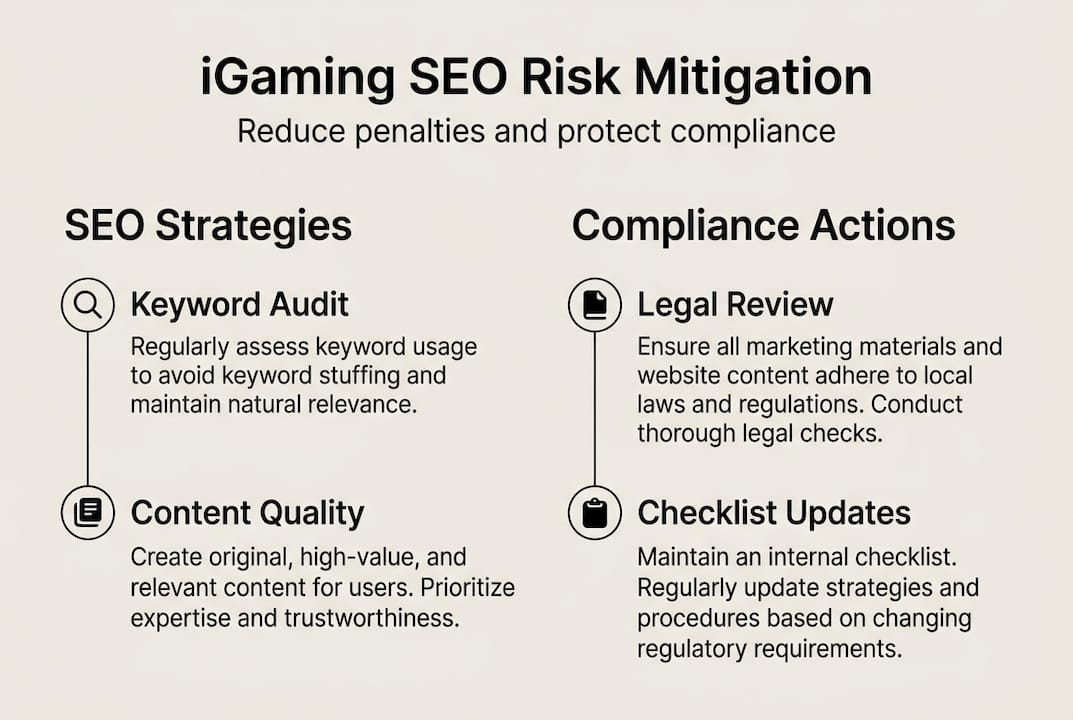
Building a foundation with SEO risk mitigation strategies is the starting point before you ever publish a page targeting these terms.
Key risks and pitfalls of optimizing for high-risk keywords
Now that you know what sets a keyword apart as high-risk, the next step is understanding the very real downsides that come with targeting them.
The most immediate threat is algorithmic or manual penalties from Google. Pages that over-optimize for competitive iGaming terms, stuff keywords into thin content, or make unverified claims about bonuses and payouts are exactly the type of content that Google’s quality raters flag. Pages targeting aggressive iGaming keywords are more likely to trigger algorithmic penalties, and recovery from those penalties can take months.
Beyond search engines, there is legal exposure. Gambling advertising laws vary significantly by country. In the UK, for example, the Advertising Standards Authority enforces strict rules around bonus promotions. A page optimized for “free spins no deposit” that fails to display clear terms and conditions is not just an SEO problem. It is a compliance violation.

Then there is the user behavior problem. iGaming keywords have up to 20% higher bounce rates than industry averages. When content does not match user intent precisely, visitors leave fast. That signals low quality to search engines and compounds your ranking challenges.
| Pitfall | Impact | Mitigation |
|---|---|---|
| Thin content | Penalty risk, low rankings | Build depth with expert-level copy |
| Keyword stuffing | Algorithmic demotion | Use semantic variations naturally |
| Misleading bonus claims | Legal violations, trust loss | Include full T&C disclosures |
| Unlicensed operator links | Domain reputation damage | Only link to licensed operators |
Four pitfalls every marketer should avoid:
- Publishing bonus pages without clear terms and conditions attached.
- Targeting keywords before verifying the operator is licensed in that market.
- Ignoring managing bounce rates for risky keywords as a ranking signal.
- Building links from low-quality gambling directories just to boost authority fast.
Pro Tip: Build a compliance checklist specific to each market you target and review it quarterly. Regulatory changes happen fast in iGaming, and a page that was compliant six months ago may not be today.
Compliance in high-risk keyword optimization: what matters most
High-risk optimization can open doors, but only to those who follow the critical and often fast-changing compliance rules.
The regulatory landscape in iGaming is fragmented. The UK Gambling Commission (UKGC), Malta Gaming Authority (MGA), and various state-level bodies in the US each have their own standards for how gambling products can be marketed online. What is acceptable in Malta may be restricted in the UK. What works in New Jersey may not be permitted in California. Your keyword strategy must account for these differences at the geo level.
Search engine compliance adds another layer. Google’s policies on gambling content require that advertisers and publishers operate with proper licensing and that content does not target restricted audiences. This is not just about paid ads. Organic content that promotes gambling to minors or obscures risks can be flagged through quality reviews.
Responsible marketing frameworks are critical for iGaming SEO compliance and long-term growth. That means building compliance into your content workflow, not treating it as an afterthought.
Compliance best practices for high-risk keyword pages:
- Include clear age restriction notices (18+ or 21+ depending on jurisdiction).
- Link only to licensed and regulated operators.
- Display transparent bonus terms, including wagering requirements.
- Add responsible gaming resources and links to support organizations.
- Avoid superlative claims like “best” or “guaranteed wins” without substantiation.
“Compliance is not a constraint on your SEO. It is the foundation that makes your rankings sustainable.”
Pro Tip: Bring your legal and compliance team into the content planning process before writing begins. Retroactive fixes to non-compliant pages often require significant rewrites that can disrupt your internal linking structure and hurt rankings.
High-risk keyword optimization strategies that work
Understanding the risks and compliance barriers is vital, but the real value comes from proven techniques that actually boost visibility and ROI.
The process does not start with writing. It starts with research and vetting. Risk mitigation frameworks improve rankings while reducing the likelihood of penalties in high-stakes iGaming niches. Here is how to apply that in practice:
- Research with intent mapping. Identify high-risk keywords and categorize them by user intent: informational, navigational, or transactional. Transactional terms like “deposit casino bonus” carry the most risk and require the most compliance work.
- Compliance vetting before selection. Before finalizing your target list, check each keyword against the regulatory requirements of your target market. A term that is safe in one jurisdiction may be restricted in another.
- On-page optimization with semantic depth. Use your primary keyword naturally in the title, H1, and first 100 words. Build semantic coverage with related terms to avoid over-reliance on a single phrase.
- Content quality benchmarking. Audit the top 5 ranking pages for each target keyword. Match or exceed their depth, structure, and trust signals. Thin content will not survive in this space.
- Ongoing SERP monitoring and keyword rotation. High-risk SERPs shift fast. Review performance monthly and rotate or update target keywords based on volatility data.
Recommended tools for execution:
- SERP monitoring: Semrush or Ahrefs for rank tracking and volatility alerts.
- Compliance scanning: Tools like Siteimprove or manual checklists aligned to UKGC and MGA standards.
- Competitive analysis: SpyFu or SimilarWeb to understand competitor keyword strategies.
Pro Tip: Run quarterly SERP volatility assessments on your top 20 high-risk keywords. If a term shows consistent ranking swings, it may signal an algorithm update targeting that space. Rotating to a safer variant temporarily protects your traffic while you investigate.
Our take: what most iGaming marketers get wrong about high-risk optimization
With detailed strategies covered, here is a candid perspective grounded in experience: what most marketers overlook about high-risk keyword plays.
Avoiding high-risk keywords entirely is not a conservative strategy. It is a missed opportunity. The marketers who refuse to touch terms like “real money slots” or “live dealer casino” are handing that traffic to competitors who are willing to do the compliance work. The risk is manageable. The reward is real.
The most common error we see is chasing volume without a maintenance plan. Marketers optimize a page, rank it, and then ignore it. In iGaming, that is how you get hit by a regulatory update six months later and lose everything you built.
The hard-won lesson is this: sustainable high-risk SEO is built on staged testing and documented compliance safeguards. Launch one page, monitor it for 60 days, document what worked and what needed adjustment, and then scale. That discipline is what separates operators who hold rankings from those who spike and crash.
The contrarian truth is that outranking competitors in high-risk search is rarely about being more aggressive. It is about being more patient and more differentiated. Real-world risk mitigation done consistently beats any shortcut.
Boost your iGaming SEO with expert-led strategies

If you are serious about capturing high-risk keyword traffic without jeopardizing your domain or your compliance standing, the next step is building a system around it. Our coaching program gives you the exact frameworks to do that. From winning iGaming SEO strategies to detailed playbooks for advanced iGaming SEO ranking, we cover every layer of this process. You also get access to regulatory SEO guidance built specifically for the markets where compliance is non-negotiable. Stop guessing and start executing with confidence.
Frequently asked questions
What are high-risk keywords in iGaming SEO?
High-risk keywords are search terms with a high chance of triggering search penalties or compliance issues, often due to their regulatory sensitivity or competitive nature in the iGaming industry. Examples include terms like “online casino bonus” and “sports betting real money.”
Why do marketers target high-risk keywords if they are risky?
Despite the risks, these keywords can generate significant traffic and revenue, making them valuable for growth when managed strategically and compliantly. High-risk keyword traffic can have a big commercial impact but must be balanced against compliance and penalty risks.
How can I reduce the risk of penalties when optimizing for high-risk terms?
Follow strict compliance guidelines, use quality content, and regularly review your site for regulatory and search updates. Responsible marketing frameworks help reduce penalties in high-stakes iGaming SEO.
What tools help with high-risk keyword optimization?
SERP monitoring platforms like Semrush and Ahrefs, compliance scanners aligned to UKGC or MGA standards, and competitor analysis tools like SpyFu are essential for managing high-risk keywords effectively.
Is it possible to succeed with high-risk keywords long term?
Yes, with proper compliance, monitoring, and strategic rotation of keywords, sustained success is possible even in high-risk iGaming niches. Risk mitigation frameworks improve rankings while reducing the likelihood of penalties over time.