
More than half of all search queries now end without a single click to any website. For iGaming marketers and SEO professionals, that number should stop you cold. The old model of tracking rankings and counting blue-link clicks is no longer enough to understand how visible your brand actually is in search. This article defines search visibility in its modern form, explains why it carries extra weight in the regulated iGaming space, breaks down every component you need to track, and gives you a concrete action plan to improve your position starting today.
Table of Contents
- Understanding search visibility: New rules for a changing SEO landscape
- Why search visibility matters for iGaming: Traffic, trust, and compliance
- The components of search visibility: Beyond blue links
- How to measure and monitor search visibility: Tools and best practices
- Common pitfalls and edge cases: What most iGaming SEOs miss
- Action plan: Steps to improve iGaming search visibility now
- Take your iGaming site’s search visibility further with proven SEO solutions
- Frequently asked questions
Key Takeaways
| Point | Details |
|---|---|
| Modern visibility is multi-faceted | Ranking alone is not enough—SERP features and brand mentions now shape results. |
| iGaming faces unique challenges | Compliance, competition, and zero-click trends amplify the importance of holistic tracking. |
| Measure, monitor, and adapt | Use the right tools, focus on share of SERP, and update strategies to stay visible. |
| Avoid common SEO mistakes | Don’t overlook compliance or new search feature opportunities in your iGaming campaigns. |
Understanding search visibility: New rules for a changing SEO landscape
Search visibility used to mean one thing: what percentage of available clicks does your site capture from a given set of keywords? That definition still matters, but it only tells part of the story. Today, SERP features and share of SERP have become equally crucial visibility components alongside traditional organic rankings.
Modern search visibility includes your presence in featured snippets, image packs, knowledge panels, People Also Ask boxes, and AI-generated summaries. A site can rank on page one and still be nearly invisible if competitors dominate every SERP feature above the fold. For iGaming brands, this is especially dangerous because paid ads, affiliate comparison boxes, and regulatory disclaimers already crowd the top of results pages.
Here is a quick comparison of old versus new visibility thinking:
| Visibility factor | Traditional view | Modern view |
|---|---|---|
| Organic ranking | Primary metric | One of many signals |
| Click-through rate | Key success measure | Declining due to zero-click |
| SERP features | Bonus | Core visibility component |
| Brand mentions | Ignored | Indirect ranking signal |
| AI search presence | Not applicable | Growing priority |
Key shifts every iGaming SEO professional must internalize:
- Zero-click searches in iGaming are reshaping how players discover brands without ever visiting a site
- SERP feature domination is now a competitive battleground, not a nice-to-have
- Share of voice across all SERP real estate matters more than any single keyword position
“Visibility is no longer just about ranking. It is about owning as much of the search results page as possible, across every format Google chooses to display.”
Why search visibility matters for iGaming: Traffic, trust, and compliance
Now that you know what search visibility is, let’s examine why it’s especially mission-critical for your iGaming operation. The iGaming vertical is one of the most competitive and legally complex spaces in digital marketing. Paid search is restricted or banned outright in many regulated markets, which means organic and SERP visibility carries even more weight than in other industries.

iGaming must balance high-risk keywords with strict compliance requirements to avoid manual actions from Google. A single misstep in keyword targeting, such as promoting unlicensed gambling terms in a restricted jurisdiction, can trigger a manual penalty that wipes out months of visibility gains.
Search visibility also builds long-term brand trust. Players searching for a sportsbook or casino are making a financial decision. They gravitate toward brands that appear authoritative, consistent, and present across multiple SERP formats. A brand that only shows up as a blue link looks far less credible than one appearing in a knowledge panel, featured snippet, and image pack simultaneously.
Visibility vs. compliance: A practical comparison
| Goal | Visibility-first approach | Compliance-first approach | Balanced approach |
|---|---|---|---|
| Keyword targeting | Aggressive, high-volume | Conservative, low-risk | Geo-filtered, intent-matched |
| Content strategy | Volume-driven | Restriction-driven | Authority-driven |
| SERP presence | Broad but risky | Safe but limited | Sustainable and scalable |
Pro Tip: Map every target keyword to the regulatory framework of its target market before publishing. Use iGaming SEO compliance frameworks to filter out terms that could attract penalties in specific jurisdictions.
Tracking SEO success indicators specific to iGaming, such as player acquisition cost per organic visit and lifetime value by keyword cluster, gives you a far clearer picture of whether your visibility is actually converting.
The components of search visibility: Beyond blue links
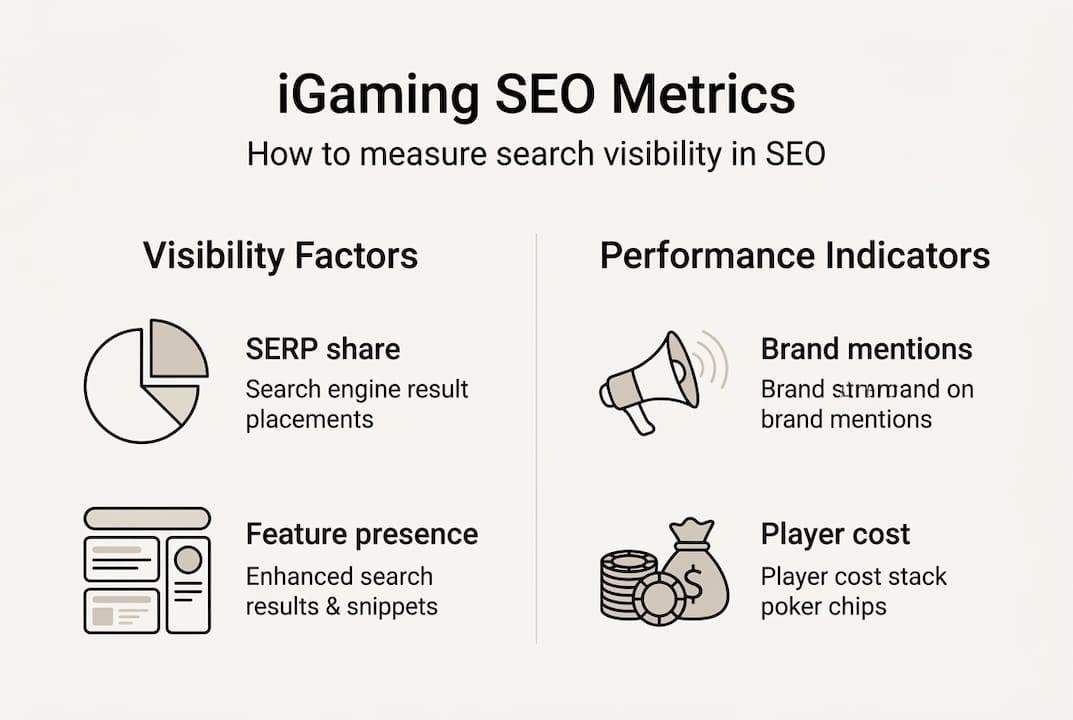
Let’s dive deeper: what makes up search visibility in tactical terms? Think of your total search visibility as a pie. Organic rankings are one slice. The rest of the pie includes featured snippets, image results, video carousels, knowledge panels, local packs, and AI overviews. Ignoring any slice means leaving visibility on the table.
Marketers should track SERP features, brand mentions, and share of SERP as core visibility metrics, not optional extras. Here is how to think about each component:
- Organic rankings: Your baseline. Track positions for primary, secondary, and long-tail keywords across each target market.
- Featured snippets: High-value real estate. Structured content and clear answers win these spots and can double your effective visibility even without a ranking change.
- Knowledge panels: Critical for brand authority. A verified knowledge panel signals legitimacy, which matters enormously in regulated iGaming markets.
- Image and video packs: Often overlooked by iGaming SEOs. Using images strategically for SEO can unlock additional SERP real estate without competing directly on text-based keywords.
- Brand mentions: Unlinked brand mentions across news sites, forums, and review platforms contribute to brand authority in AI search and indirectly reinforce your E-E-A-T signals.
- Share of voice: The percentage of total SERP impressions your brand captures across a defined keyword set. This is your true visibility score.
Pro Tip: Use a tool like SEMrush’s Position Tracking combined with a custom share-of-voice report to see exactly how much of the SERP your brand owns versus competitors. Do this monthly, not quarterly.
“Branding and SEO are no longer separate disciplines. In iGaming, your brand’s search presence is your most defensible competitive asset.”
How to measure and monitor search visibility: Tools and best practices
Understanding components is only valuable if you can measure progress. Here’s how to do it effectively. The good news is that the tools exist. The challenge is knowing which metrics actually matter for iGaming and which are just vanity numbers.
Track SERP features, brand mentions, and share of SERP as your primary visibility dashboard, especially as zero-click and AI search formats continue to grow. Here are the metrics and tools that matter most:
- Share of SERP: Measured via SEMrush, Ahrefs, or Sistrix. Track weekly for high-competition terms.
- SERP feature presence: Log which features your pages appear in and which competitors dominate.
- Brand mention volume: Use Google Alerts, Mention.com, or Ahrefs Content Explorer to track unlinked mentions.
- Organic click-through rate by feature type: Separate CTR data for featured snippets versus standard blue links in Google Search Console.
- Visibility by geo-market: Essential for iGaming. A brand visible in the UK may be invisible in Germany or Ontario.
| Tool | Primary use | iGaming-specific value |
|---|---|---|
| SEMrush | Rank tracking, share of voice | Competitor gap analysis by market |
| Ahrefs | Backlink and mention monitoring | Authority benchmarking |
| Google Search Console | CTR and impression data | Feature-level performance |
| Sistrix | Visibility index scoring | Regulated market tracking |
| Mention.com | Brand mention alerts | Compliance and reputation monitoring |
A real-world example: one sports news site went from 0 to 1,432 organic clicks in 30 days by focusing on geo-specific content and SERP feature optimization rather than chasing broad keyword rankings alone.
Common pitfalls and edge cases: What most iGaming SEOs miss
Even with tracking in place, certain mistakes can undermine your iGaming site’s search visibility. The most common error is treating rank position as the only visibility metric. A site ranking number three for a high-volume term but missing from the featured snippet, image pack, and People Also Ask section is far less visible than its position suggests.
Another major blind spot is AI search and zero-click formats. Google’s AI Overviews now answer many gambling-related informational queries directly on the results page. If your content is not structured to be cited in those summaries, you are invisible to a growing segment of searchers who never scroll past the AI answer.
Compliance failures are the most costly pitfall. iGaming must balance high-risk keywords with regulatory requirements to avoid manual actions. Targeting terms like “free bets no verification” or promoting bonuses without required responsible gaming language can trigger both algorithmic and manual penalties.
Pro Tip: Run a quarterly compliance audit on your top 50 landing pages. Check that every page targeting a regulated market includes the required responsible gaming messaging, age verification language, and jurisdiction-specific disclaimers.
Other pitfalls to avoid:
- Ignoring share of voice in favor of individual keyword rankings
- Failing to track competitor SERP feature gains in real time
- Not segmenting visibility data by geo-market and device type
- Overlooking the impact of site speed and Core Web Vitals on SERP feature eligibility
“The iGaming brands that lose visibility fastest are usually the ones that stopped watching the full SERP and started watching only their own rankings.”
Action plan: Steps to improve iGaming search visibility now
Ready to put these insights into practice? Here’s a step-by-step plan that covers your full SERP footprint, not just your ranking report.
Monitor edge cases like zero-click and compliance as part of your standard iGaming SEO workflow, not as occasional checks. Here is your action plan:
- Audit your full SERP footprint. Pull share-of-voice data for your top 100 keywords. Identify which SERP features competitors own that you do not.
- Map keywords to compliance requirements. For every target market, filter your keyword list through the relevant regulatory framework before creating content.
- Optimize existing content for SERP features. Add structured FAQ sections, clear definitions, and concise answer paragraphs to pages targeting informational queries.
- Build brand mention velocity. Pitch iGaming news sites, review platforms, and industry directories for unlinked brand mentions. These feed E-E-A-T signals.
- Set up a geo-segmented visibility dashboard. Track share of SERP separately for each regulated market you operate in.
- Review AI search presence monthly. Check whether your content appears in Google AI Overviews for your core informational keywords.
- Align your SEO performance indicators with player value metrics. Visibility that does not convert to qualified player acquisition is not worth chasing.
Pro Tip: Schedule a full SERP audit every 90 days. Search behavior, AI features, and competitor strategies shift fast in iGaming. A quarterly review keeps your visibility strategy current and your compliance posture clean.
Take your iGaming site’s search visibility further with proven SEO solutions
The frameworks in this article give you a strong foundation, but executing them at scale in a regulated, competitive iGaming market requires more than a checklist. It requires deep expertise in how Google treats gambling content, how regulators define compliant marketing, and how to build authority that survives algorithm updates. Our advanced iGaming SEO ranking strategies are built specifically for operators, affiliates, and agencies navigating these exact challenges. Whether you need a full visibility audit, geo-specific content frameworks, or link acquisition strategies that hold up under scrutiny, explore our winning iGaming SEO strategies to see how we approach each layer of search visibility. You can also discover how influencer SEO for iGaming can amplify brand mentions and SERP presence in ways traditional link building cannot.
Frequently asked questions
How is search visibility measured in iGaming SEO?
Track SERP features and share of SERP alongside brand mentions for accurate visibility measurement. Rankings alone miss too much of the modern SERP to be a reliable standalone metric.
Why is zero-click search important for iGaming brands?
Zero-click and AI search now account for more than half of all queries, making brand mentions and SERP feature presence essential for iGaming brands that can no longer rely on click-through volume alone.
What’s the biggest search visibility pitfall for iGaming marketers?
Ignoring compliance in keyword selection is the fastest way to lose visibility. Regulated markets penalize brands that target restricted terms, and a manual action can erase years of SEO progress overnight.
How can I quickly improve my brand’s search visibility?
Audit your SERP features first, then optimize your top pages for featured snippets and People Also Ask boxes. Brand mentions and SERP features deliver faster visibility gains than chasing new keyword rankings from scratch.