

Every iGaming marketer knows that standing out in American, Canadian, or European markets is no simple task. In regulated gambling, traditional SEO shortcuts rarely survive algorithm updates or compliance checks. As search engines raise their standards and regional authorities tighten oversight, mastering iGaming SEO means blending technical precision with strict regulatory alignment. This article unpacks the core techniques and debunks common myths, giving operators and affiliates the edge in visibility—without risking penalties.
Table of Contents
- Defining iGaming SEO And Common Misconceptions
- Key SEO Types In Casino And Betting Markets
- Geo-Targeted Strategies For Regulated Regions
- Safe Keyword Optimization For High Conversion
- Authority, Trust, And Link Acquisition Tactics
- Compliance Risks And Performance Measurement
Key Takeaways
| Point | Details |
|---|---|
| iGaming SEO Requires Specialized Knowledge | Optimizing gambling sites necessitates understanding specific regulations, keyword strategies, and compliance requirements that differ from traditional SEO practices. |
| Quality Backlinks Are Crucial | Building authority through high-quality links from reputable sources is essential, as low-quality links can damage rankings significantly. |
| Ongoing Adaptation Is Necessary | Continuous monitoring and adjustment to SEO strategies are vital due to frequent algorithm updates and shifting player behaviors in the iGaming sector. |
| Compliance Is Fundamental to SEO Success | Failing to meet compliance standards can lead to severe penalties from search engines, impacting visibility and revenue potential. |
Defining iGaming SEO and Common Misconceptions
At its core, iGaming SEO is the specialized practice of optimizing online gambling and betting websites for search engine visibility within a highly competitive and heavily regulated environment. Unlike general SEO, it demands expertise in keyword optimization, quality backlinking, and strict compliance with varying jurisdictional regulations across multiple markets.
The stakes are substantially higher in iGaming than traditional industries. Search engines penalize non-compliant gambling sites aggressively, which means ranking strategies must simultaneously build authority and maintain regulatory alignment. This dual requirement separates iGaming SEO from standard search optimization.
Several misconceptions cloud how many affiliates and operators approach iGaming search visibility:
-
Misconception #1: “Standard SEO tactics work fine” – Gambling sites face unique algorithm scrutiny that general B2B or ecommerce sites don’t encounter. Generic strategies often trigger manual penalties or algorithmic suppression.
-
Misconception #2: “Compliance kills rankings” – The opposite is true. Responsible gaming signals, transparent terms, and regulatory compliance actually improve trust signals that search engines now reward heavily.
-
Misconception #3: “Backlinks from anywhere count” – Low-quality or irrelevant links from non-regulated industries damage iGaming sites faster than they help. Quality matters exponentially more here.
-
Misconception #4: “You optimize once, then maintain” – iGaming search behaviors shift constantly. Algorithm updates arrive frequently, and player intent evolves seasonally and by jurisdiction. Ongoing adaptation is non-negotiable.
Many operators assume they can hire any SEO agency and expect results. The reality is sharper: iGaming requires specialists who understand both algorithm mechanics and regulatory frameworks like MGA, UKGC, or jurisdiction-specific rules.
Search engines treat gambling websites differently than other industries. Compliance isn’t a constraint on SEO—it’s the foundation for it.
Pro tip: Before hiring an SEO agency or building your strategy, audit whether your current optimization aligns with your jurisdiction’s specific regulations; missing compliance requirements often creates ranking walls that talent alone cannot overcome.
Key SEO Types in Casino and Betting Markets
Casino and betting SEO isn’t monolithic. It breaks down into distinct types, each targeting different player behaviors and business goals. Understanding which applies to your operation determines your ranking strategy.
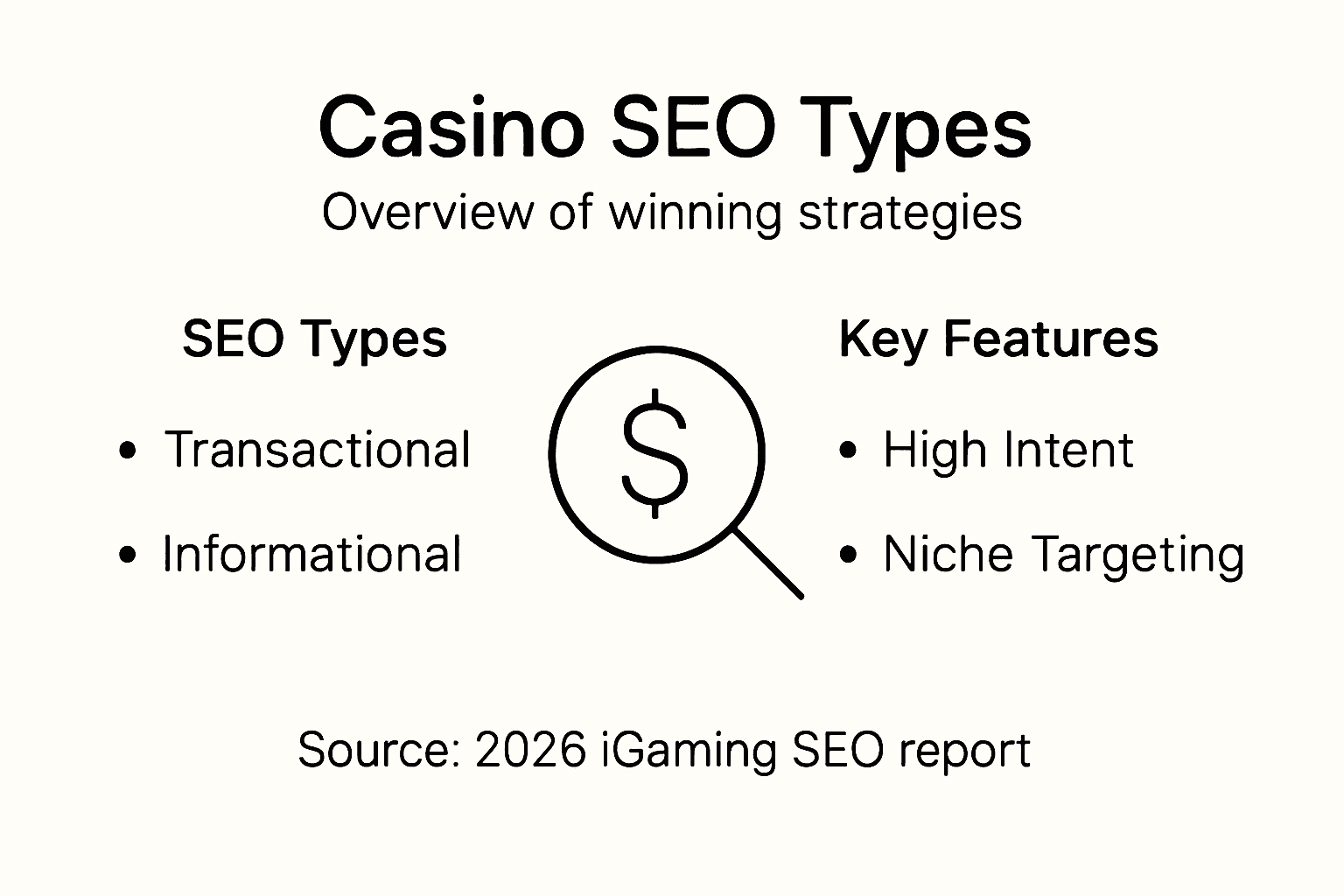
Transactional SEO captures players actively ready to sign up or deposit. These are high-intent searches like “best casino sites” or “place a sports bet online.” They convert quickly but face intense competition and regulatory scrutiny.

Informational SEO attracts players in research mode. Queries like “how to play blackjack” or “betting odds explained” build trust and authority before conversion happens. This is your long-term relationship builder.
Long-tail keyword SEO targets niche searches with lower volume but higher intent specificity. “Licensed sportsbook with live betting in New York” beats fighting for “sportsbook” every time. These keywords are easier to rank for and attract serious players.
Here’s how they compare:
Here’s a quick comparison of iGaming SEO types and their most suitable use cases:
| SEO Type | Best For | Business Benefit | Typical Challenge |
|---|---|---|---|
| Transactional | High-intent sign-ups | Fast conversions, high revenue | Intense competition, high risk |
| Informational | Player education | Builds expertise, trust signals | Slower ROI, ongoing effort |
| Long-tail | Niche targeting | Sustainable, high-quality traffic | Lower search volume |
-
Transactional: High competition, fast conversions, regulatory risk, expensive to rank for
-
Informational: Builds authority, lower immediate ROI, establishes expertise signals, protects against algorithm shifts
-
Long-tail: Lower volume, easier rankings, higher conversion quality, sustainable traffic foundation
Technical SEO forms the base layer across all types. Your site speed, mobile optimization, indexation, and structured data directly impact how search engines crawl gambling content. One indexation error can suppress your entire domain.
Local SEO for betting markets becomes critical when targeting players in specific jurisdictions where licensing varies. A player in Ontario needs different trust signals than one in New Jersey.
Content quality acts as a filter. Low-effort content triggers algorithmic suppression faster in gambling than other industries. Search engines reward depth, accuracy, and responsible gaming mentions heavily.
The strongest iGaming sites use all three keyword types simultaneously, layering authority through informational content while capturing high-intent transactional searches and dominating long-tail niches.
Pro tip: Map your current content inventory against these three types; most operators over-focus on transactional and under-invest in informational content that actually builds the topical authority needed to rank for transactional keywords safely.
Geo-Targeted Strategies for Regulated Regions
Geo-targeting in iGaming isn’t about showing the same content everywhere and hoping it works. Each regulated region has distinct licensing requirements, player preferences, and search behavior patterns that demand customized approaches.
Localized keyword research forms the foundation. A New Jersey player searches “online casino NJ licensed” while a Michigan player searches “Michigan sports betting apps.” These regional modifiers matter tremendously for ranking and compliance visibility.
Your content strategy shifts by jurisdiction. Ontario’s responsible gaming messaging requirements differ significantly from Pennsylvania’s. Search engines reward content that reflects regional legal nuances through signals like local responsible gaming language and jurisdiction-specific licensing badges.
Here’s what changes per region:
-
Keyword strategy: Add regional modifiers, target local player intent, avoid terms prohibited in that jurisdiction
-
Content messaging: Highlight applicable licenses, reference local laws, mention regional payment methods
-
Technical setup: Implement geo-blocking for restricted regions, use hreflang tags for multi-region content
-
Link building: Target local media, regional betting affiliates, jurisdiction-specific authority sites
Geo-blocking prevents accidental regulatory violations. When a user from a restricted jurisdiction hits your site, they should see a compliance notice, not a sign-up form. Search engines evaluate whether your site respects geographic licensing boundaries—failure triggers manual action penalties.
Master geo-specific SEO strategies for iGaming to understand how technical implementation protects rankings while maintaining compliance across multiple markets simultaneously.
Metadata and schema markup communicate regional targeting clearly to search engines. Using location-based schema markup tells Google which jurisdiction your content serves, improving ranking accuracy and reducing compliance risk through misinterpretation.
Budget allocation follows player value. High-value regulated markets like New Jersey and Pennsylvania warrant deeper content investment. Lower-revenue jurisdictions still need compliance coverage but with leaner resource allocation.
This summary highlights how geo-targeted SEO adaptations support compliance and rankings:
| Region Factor | SEO Tactic Applied | Compliance Impact |
|---|---|---|
| Keyword Phrases | Regional modifiers and intent match | Avoids restricted terms penalties |
| Content Messaging | Local laws, licenses, payment types | Boosts legal credibility signals |
| Technical Setup | Geo-blocking, hreflang, schema | Prevents cross-jurisdiction issues |
| Link Building | Local media and directories | Ensures trusted, relevant backlinks |
Geo-targeted SEO in iGaming isn’t optional marketing—it’s a legal requirement enforced through search engine algorithms that penalize sites operating across jurisdictions without proper regional segmentation.
Pro tip: Build a jurisdiction matrix listing each region’s licensing bodies, prohibited keywords, required disclosures, and payment methods accepted; use this to guide your keyword research and content calendars for each market simultaneously.
Safe Keyword Optimization for High Conversion
Keyword optimization in iGaming walks a tightrope. You need high-conversion terms to generate revenue, but use the wrong phrase and compliance violations sink your rankings instantly. The solution is strategic specificity.
Long-tail keywords dominate safe optimization. Instead of targeting “online casino,” focus on “licensed online casino accepting New Jersey players.” These longer phrases naturally incorporate compliance signals while attracting players with genuine intent to sign up legally.
Restricted terms require careful avoidance. “Free bonus no deposit” might trigger algorithmic suppression. “Welcome bonus for new players” signals the same offer without prohibited language. Search engines flag iGaming sites aggressively for keyword misuse, so precision matters exponentially.
Your keyword research workflow should include:
-
Compliance audit: Check if each target term appears in restricted keyword lists for your jurisdiction
-
Intent matching: Select keywords reflecting actual player behavior and available offerings
-
Regional relevance: Target keywords specific to licensed games available in each market
-
Competition analysis: Identify which long-tail terms competitors overlook
Keyword specificity directly improves conversion. A player searching “best licensed sportsbook in Pennsylvania” is closer to deposit than one searching “sportsbook.” This specificity also reduces your algorithmic risk by using naturally compliant language.
Metadata optimization becomes critical. Your title tags, meta descriptions, and H1 headers should reflect your target keywords organically. Cramming prohibited terms into hidden metadata triggers manual review faster than you can respond.
Content integration determines ranking power. Your keyword should appear naturally 2-3 times in body content per 500 words, plus once in your H1 and once in your first paragraph. Unnatural keyword stuffing triggers algorithmic suppression specific to gambling sites.
Safe keyword optimization means choosing specificity over volume. Lower-volume long-tail keywords with compliance built-in convert better and rank faster than generic high-volume terms that trigger algorithmic caution.
Pro tip: Build a master keyword spreadsheet listing target terms, compliance status, monthly search volume, regional applicability, and whether competitors rank for each; prioritize terms scoring green across all compliance dimensions before optimizing any page.
Authority, Trust, and Link Acquisition Tactics
In iGaming, authority and trust aren’t abstract metrics. They’re survival mechanisms. Search engines scrutinize gambling sites harder than most industries, meaning your domain authority directly correlates with ranking resilience during algorithm updates.
Trust signals come first. Display your gaming license prominently, link to regulatory bodies like the Malta Gaming Authority or UK Gambling Commission, and feature responsible gambling resources above the fold. These visible compliance markers tell search engines your site operates legitimately.
New iGaming sites start with zero authority. Building it requires a deliberate link acquisition strategy targeting the right sources. Low-quality links from unrelated industries actually damage rankings faster than no links at all.
Your link targets should focus on:
-
Gaming industry publications: Casino review sites, betting analysis blogs, iGaming news outlets
-
Regulatory authority mentions: Backlinks from gaming commission pages or licensed operator directories
-
Local business directories: Regional business listings in your target jurisdictions
-
Responsible gaming partnerships: Links from gambling addiction awareness organizations
-
Sports and entertainment media: Industry-adjacent sources covering betting culture or sports outcomes
Avoid link sources that trigger red flags. Casinos and sportsbooks shouldn’t link swap with unrelated niches or purchase links from link farms. These tactics invite manual penalties faster in gambling than any other sector.
Search engine trust requires more than compliance signals alone; you must demonstrate topical expertise through quality backlinks from authority sources that validate your industry knowledge.
Author credibility matters increasingly. Publish content under named experts with visible credentials in gaming, compliance, or responsible gambling. Search engines now reward demonstrated expertise more heavily than generic operator content.
Link velocity requires patience. Acquiring 50 quality links in one month looks suspicious. Acquiring 5-8 monthly over 12 months builds natural authority that withstands algorithmic scrutiny.
Trust and authority in iGaming aren’t negotiable—they’re the foundation that prevents algorithmic suppression when regulatory changes shift search behavior unpredictably.
Pro tip: Create a link prospect list targeting only sources already linking to your legitimate competitors; these vetted sources already view gaming content as credible, making outreach faster and acceptance rates significantly higher.
Compliance Risks and Performance Measurement
Compliance and performance measurement in iGaming SEO aren’t separate tracks. They intersect constantly. A ranking boost from non-compliant tactics evaporates within weeks when regulators or search engines catch up.
Compliance failures create measurable penalties. Missing licensing disclosures, using prohibited bonus language, or ignoring geo-blocking requirements triggers manual actions that tank domain authority. These aren’t minor ranking drops—they’re visibility wipeouts that take months to recover from.
Your compliance infrastructure must involve legal, marketing, and technical teams. Search engine optimization touches regulatory requirements at every point. One team member ignoring compliance puts the entire operation at risk.
Key compliance risks include:
-
Misleading bonus claims: Overstating welcome offers or hiding wagering requirements violates FTC and gaming authority standards
-
Missing licensing information: Failing to display gaming commission credentials on homepage and footer pages triggers algorithmic suppression
-
Geo-blocking failures: Allowing restricted-market players to access signup flows violates jurisdiction-specific laws
-
Unsubstantiated claims: Making payout promises or game fairness statements without certification documentation violates advertising standards
Performance measurement extends beyond rankings now. SEO compliance for iGaming directly impacts metrics like visibility retention during algorithm shifts and brand reputation sustainability across regulated markets.
Track these KPIs monthly:
-
Organic visibility score: Aggregate ranking positions across all target keywords weighted by search volume
-
Compliance audit scores: Percentage of pages passing jurisdiction-specific compliance checks
-
Brand reputation sentiment: Monitoring mentions across gaming forums, review sites, and social channels
-
Player lifetime value by traffic source: Isolating organic SEO quality versus paid traffic conversion patterns
Manual penalties remove all organic visibility overnight. Prevention through compliance monitoring costs far less than recovery. Audit your site monthly against regulatory requirements specific to each jurisdiction you serve.
Compliance risks aren’t hypothetical in iGaming—they’re guaranteed revenue threats that materialize when algorithm updates hit sites operating outside regulatory boundaries.
Pro tip: Create a quarterly compliance scorecard tracking licensing display, geo-blocking accuracy, bonus language compliance, and responsible gambling messaging visibility; share results directly with legal and compliance leadership to secure buy-in for preventive SEO investments.
Unlock Success with Expert iGaming SEO Coaching
The article reveals the unique challenges of iGaming SEO from regulatory compliance to geo-targeted keyword strategies and authority building. If you recognize the struggle to safely optimize high-risk keywords or manage evolving jurisdictional demands while maintaining trust and visibility this is your next step. Many operators face intense competition and compliance risks that lower generic SEO approaches cannot overcome.
Our specialized coaching program at 1on1seo.com is built precisely for these hurdles. You will gain proven frameworks to master safe keyword optimization, execute geo-specific SEO across regulated markets, and build authoritative backlinks that search engines trust. Learn to track performance with KPIs focused on player value and avoid costly compliance pitfalls that cause manual penalties. Don’t let algorithm shifts or legal complexities stall your growth.
Take control of your iGaming SEO strategy today and outperform competitors with confidence. Visit 1on1seo.com now to join the program tailored for affiliates, operators, and agencies ready to dominate competitive betting, casino, and sportsbook SERPs. Start building sustainable, compliant, and profitable organic traffic that scales.
Frequently Asked Questions
What is iGaming SEO?
At its core, iGaming SEO is the specialized practice of optimizing online gambling and betting websites for better search engine visibility while adhering to strict regulatory requirements.
How does compliance affect iGaming SEO rankings?
Compliance acts as a foundation for SEO in iGaming; sites that prioritize regulatory adherence can improve their trust signals, resulting in better rankings instead of hindering them.
What are the different types of SEO strategies for iGaming?
The main types of SEO strategies for iGaming include transactional SEO for high-intent sign-ups, informational SEO for educating players, and long-tail keyword SEO for targeting niche searches with high conversion potential.
Why is keyword optimization crucial in iGaming SEO?
Keyword optimization is critical as it helps to target high-conversion terms while ensuring compliance. Using specific long-tail keywords minimizes the risk of penalties and improves the chances of ranking higher in search results.