

Every British and Maltese operator knows the challenge of reaching players across shifting regulatory borders. Geo-blocking is more than a technical hurdle in iGaming, shaping both legal access and search visibility in markets like Malta and the United Kingdom. Understanding the power of geolocation technology and its compliance-driven strategies helps SEO specialists and marketing managers master regional rules while maintaining search performance.
Table of Contents
- Geo-Blocking In Igaming: Key Concepts
- Types Of Geo-Blocking And Seo Impacts
- Legal Compliance For Malta And Uk Markets
- Geo-Optimization Strategies For Regulated Seo
- Risks, Penalties, And Ranking Mistakes
Key Takeaways
| Point | Details |
|---|---|
| Geo-Blocking Mechanism | Operators leverage geo-blocking to ensure regulatory compliance by controlling digital access based on user locations. |
| Technical Implementation | Effective geo-blocking requires sophisticated systems to verify user location and prevent spoofing while maintaining user experience. |
| SEO Considerations | Different types of geo-blocking impact search engine visibility and require tailored content strategies to balance compliance with online presence. |
| Regulatory Complexity | Operating in regions like Malta and the UK necessitates rigorous geo-blocking measures to meet specific legal requirements and maintain licenses. |
Geo-Blocking in iGaming: Key Concepts
Geo-blocking represents a critical technological strategy in the iGaming industry, enabling operators to control digital service access based on users’ geographic locations. This sophisticated approach allows gaming platforms to enforce regulatory compliance, manage market entry, and protect their business from potential legal complications.
The core mechanism of geo-blocking relies on geolocation technology, which precisely determines a user’s physical location through multiple verification methods:
- IP address tracking
- GPS coordinates
- WiFi network registration
- Mobile device triangulation
- Payment method country verification
In the complex landscape of iGaming, geo-blocking serves multiple strategic purposes. Cross-market SEO strategies become essential when navigating international regulatory environments, where legal frameworks differ dramatically between jurisdictions.
Regulatory compliance represents the primary driver for implementing geo-blocking in iGaming. Different countries and regions maintain distinct legal standards for online gambling, requiring platforms to restrict access dynamically. For instance, a platform legally operating in the United Kingdom must prevent users from regions with stricter gambling regulations from accessing their services.
Geo-blocking is not just a technical constraint but a sophisticated compliance mechanism that protects both operators and potential players from legal risks.
Technical Implementation involves sophisticated backend systems that cross-reference multiple data points to verify user location. These systems must be robust enough to:
- Detect and block VPN usage
- Verify location in real-time
- Prevent location spoofing attempts
- Maintain seamless user experience
Pro tip: Implement multi-layered geo-blocking verification to enhance accuracy and reduce false positives in user location detection.
Types of Geo-Blocking and SEO Impacts
In the iGaming industry, geo-blocking technologies manifest in two primary forms, each with distinct implications for search engine optimization and digital market access. Understanding these variations is crucial for developing sophisticated digital strategies that balance regulatory compliance with online visibility.
The first type involves activation restrictions, which prevent game content from being registered or activated outside specific geographic territories. These restrictions directly impact SEO by:
- Limiting content indexing across international search engines
- Reducing potential global search visibility
- Creating region-specific search ranking challenges
- Requiring localized content strategies
The second type encompasses run-time restrictions, which dynamically control user access during actual gameplay or content interaction. Geo-specific SEO strategies become essential when managing these complex digital boundaries.
Technological implementation of geo-blocking relies on multiple verification mechanisms:
Here’s how geo-blocking types impact both iGaming platforms and SEO strategies:
| Geo-Blocking Type | Example Scenario | Platform Impact | SEO Implication |
|---|---|---|---|
| Activation Restriction | Preventing account creation abroad | Limits player base expansion | Reduces global search indexing |
| Run-Time Restriction | Blocking gameplay post-login | Enforces compliance dynamically | Demands region-specific content |
- IP address filtering
- Device location tracking
- Payment method country verification
- DNS-level restrictions
- Mobile network identification
Sophisticated geo-blocking requires a nuanced approach that balances technical accuracy with user experience and search engine optimization requirements.
Search engine optimization professionals must carefully navigate these geographic constraints, developing content and technical strategies that accommodate regional legal frameworks while maximizing potential search visibility.

Pro tip: Develop multilayered geo-blocking verification protocols that provide granular control while maintaining seamless user experience across different search environments.
Legal Compliance for Malta and UK Markets
The iGaming regulatory landscape in Malta and the United Kingdom represents a complex ecosystem of legal requirements that demand precise geo-blocking implementation. These markets have developed sophisticated frameworks that require operators to demonstrate rigorous geographic access controls and licensing compliance.
Malta and the United Kingdom maintain distinct yet interconnected regulatory approaches to iGaming market access. SEO compliance strategies become critical when navigating these intricate legal environments. The key compliance requirements include:
- Obtaining valid national gaming licenses
- Implementing robust geolocation verification
- Preventing access from unauthorized jurisdictions
- Maintaining transparent user verification protocols
- Documenting comprehensive geo-blocking mechanisms
The European Union’s regulatory stance provides unique flexibility for these markets. While the EU Geo-blocking Regulation generally aims to reduce digital barriers, gambling services remain explicitly exempt, allowing Malta and the United Kingdom to maintain strict territorial control over online gaming platforms.
Operators must develop multi-layered verification strategies that go beyond simple IP address filtering. These advanced approaches typically involve:
- Real-time geolocation tracking
- Payment method country validation
- Mobile network identification
- Document verification systems
- Continuous compliance monitoring
Successful geo-blocking in iGaming requires a holistic approach that balances technical sophistication with legal precision.
The regulatory complexity demands that iGaming platforms invest significantly in technological infrastructure and legal expertise to maintain compliant operations across these highly regulated markets.
Pro tip: Develop a comprehensive geo-blocking strategy that incorporates multiple verification layers and maintains real-time compliance documentation.
Geo-Optimization Strategies for Regulated SEO
Geo-optimization in the iGaming industry represents a sophisticated approach to balancing search engine visibility with stringent regulatory requirements. Successful strategies demand a nuanced understanding of how geographic targeting intersects with technical SEO and legal compliance.
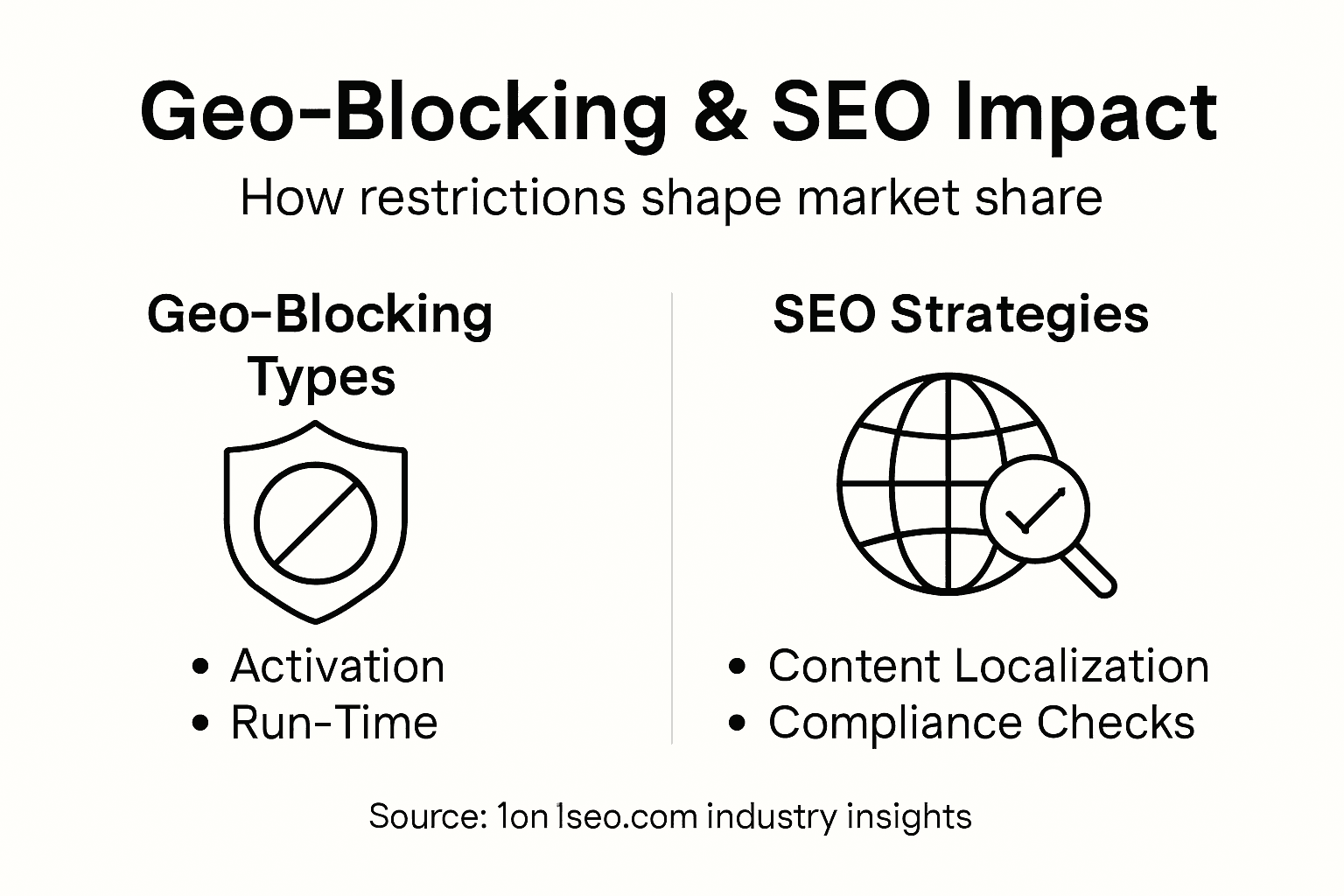
The core of effective geo-optimization involves creating jurisdiction-specific content strategies that align with regional search behaviors and legal frameworks. SEO content audit workflows become critical for maintaining compliance while maximizing search performance across different markets.
Key technical approaches for geo-optimization include:
- Implementing precise hreflang tag configurations
- Developing localized domain or subdirectory structures
- Creating region-specific content variations
- Utilizing advanced geolocation verification technologies
- Managing international search engine indexing strategies
Technological implementation requires sophisticated multi-layered approaches that go beyond simple IP address filtering:
- Advanced geolocation tracking
- Dynamic content adaptation
- Comprehensive user verification protocols
- Real-time regulatory compliance monitoring
- Search engine signal optimization
Effective geo-optimization balances technical precision with legal compliance, creating a seamless user experience across regulated markets.
Search engine optimization professionals must develop adaptive strategies that can dynamically respond to changing regulatory landscapes while maintaining consistent search visibility and user accessibility.
Pro tip: Develop a flexible geo-optimization framework that integrates continuous compliance monitoring with advanced technical SEO techniques.
Risks, Penalties, and Ranking Mistakes
The iGaming industry faces complex regulatory challenges that can transform seemingly minor geo-blocking errors into significant legal and search performance risks. Understanding these potential pitfalls is crucial for maintaining both legal compliance and search engine visibility.
Misconfigurations in geo-blocking strategies can trigger severe consequences across multiple domains. SERP feature domination becomes challenging when platforms inadvertently violate regional regulations or search engine guidelines.
Key risks and potential penalties include:
- Substantial financial sanctions for competition law violations
- Permanent search engine ranking penalties
- Loss of regional licensing credentials
- Reduced international market accessibility
- Potential antitrust investigations
The most critical ranking mistakes involve unintentional restrictions that harm search engine performance:
This table summarizes the main risks and penalties associated with geo-blocking missteps in iGaming:
| Issue | Legal Consequence | Search Impact |
|---|---|---|
| Access from restricted regions | Large regulatory fines | Removal from search results |
| Crawler blocking misconfigs | None, but triggers audits | Drops in international rankings |
| Failure to update compliance | License suspension | Ongoing loss of traffic |
- Blocking search engine crawlers accidentally
- Implementing overly restrictive geo-filtering
- Failing to provide clear regional content variations
- Inconsistent hreflang tag configurations
- Neglecting international SEO best practices
Effective geo-blocking requires a delicate balance between legal compliance, user experience, and search engine optimization strategies.
Search engine optimization professionals must develop sophisticated, adaptive strategies that anticipate potential regulatory shifts while maintaining consistent global visibility and accessibility.
Pro tip: Conduct regular comprehensive audits of your geo-blocking configurations to ensure simultaneous legal compliance and optimal search performance.
Unlock Geo-Blocking Challenges with Proven iGaming SEO Solutions
Navigating the complex world of geo-blocking in iGaming demands more than basic SEO knowledge. The article highlights how improper geo-blocking can cause regulatory penalties, reduce search visibility, and block valuable users from key markets like Malta and the United Kingdom. If you are struggling to balance compliant geolocation verification, regional SEO optimization, and user accessibility, your growth potential is at risk. Mastering these concepts requires specialized strategies that integrate regulatory compliance with effective search engine performance.
Our iGaming SEO coaching program is designed exclusively to help marketers, affiliates, and operators overcome these exact hurdles. Learn to implement geo-specific SEO techniques safely, avoid costly geo-blocking misconfigurations, and rank higher in competitive betting, casino, and sportsbook markets. Discover how to stay ahead with frameworks that focus on:
- Optimizing geo-targeted content without compromising compliance
- Using multi-layered geolocation verification to safeguard legal access
- Building authority and trust signals tailored to the iGaming space
Start transforming your geo-blocking challenges into competitive advantages today. Visit 1on1seo.com to gain the expert guidance you need to dominate regulated markets and expand your iGaming footprint.
Explore our detailed SEO content audit workflows and geo-specific SEO strategies to accelerate your success now.
Frequently Asked Questions
What is geo-blocking in iGaming?
Geo-blocking is a technological strategy that restricts access to online gaming platforms based on the user’s geographic location. It helps operators comply with regional regulations and control market access.
How does geo-blocking impact search engine optimization (SEO)?
Geo-blocking can limit content indexing and reduce search visibility across different regions, making it essential for iGaming platforms to adapt their SEO strategies to maintain compliance while maximizing visibility.
What are the different types of geo-blocking in iGaming?
There are two main types of geo-blocking: activation restrictions, which prevent users from registering accounts in specific regions, and run-time restrictions, which control access during gameplay.
How can iGaming platforms ensure compliance with geo-blocking regulations?
Platforms can ensure compliance by implementing multi-layered geo-blocking strategies that include real-time geolocation tracking, payment method validation, and continuous monitoring of regulatory requirements.
Recommended
- Cross-Market SEO Strategy: Gaining iGaming Edge Globally
- Master Geo-Specific SEO Strategies for iGaming Success
- 7 Steps to a Winning iGaming On-Page SEO Checklist
- SERP Feature Domination: iGaming SEO’s Competitive Edge
- SEO Trends in 2025: Maximizing Bookings for Hospitality – Lind Creative
- Market Segmentation: Boosting Startup Conversions - seo analytic
- Why Local SEO Optimization Is a Game Changer for You - LSA SEO Agency